


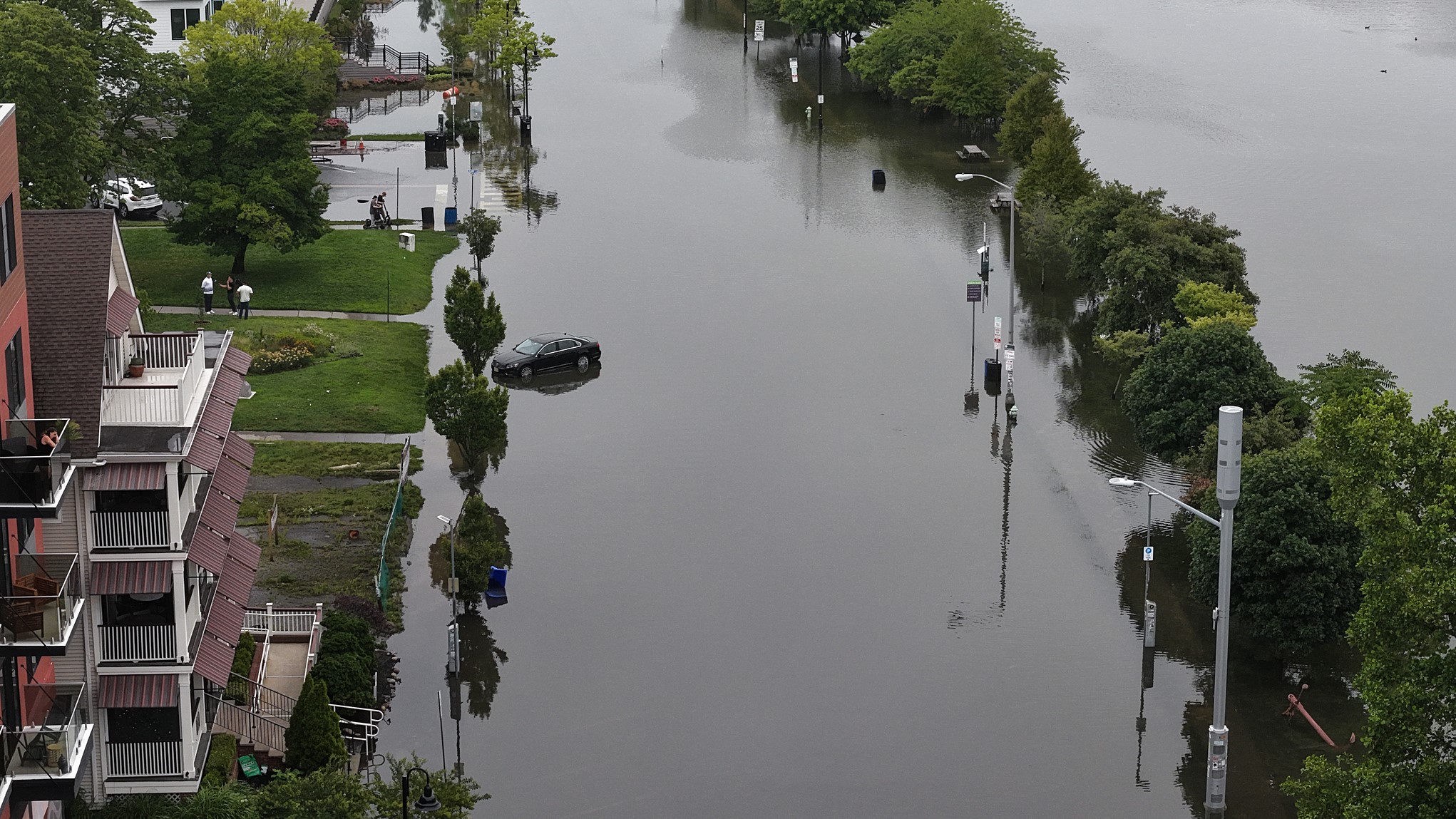
A view of flooded streets after heavy rain in Deal, New Jersey, US, July 6, 2026.(Photo: VCG)
This summer, extreme weather has occurred frequently in many parts of the world. Western Europe has been hit by a "heat dome," South Asia has endured persistent extreme heat, and southeastern Africa has been battered by continuous heavy rainfall.
Behind these climatic anomalies lies an increasingly difficult survival challenge confronting all of humanity.
An online survey released by CGTN shows that 83.1% of respondents believe extreme weather has become a real challenge for all humanity and that the only correct choice is for countries to join hands and share the responsibility.
Between 2000 and 2019, approximately 489,000 deaths a year were linked to high temperatures, according to data released by the World Health Organization. Since the mid-20th century, climate change driven by human activities has increased the probability of compound extreme weather events, according to the World Meteorological Organization website.
In the survey, 83.3% of respondents have felt a marked upward trend in the frequency and intensity of global extreme weather in recent years. A total of 74.7% believe that increasingly frequent extreme weather is seriously threatening people's safety, and 82.7% hold that extreme weather is no longer just a local natural disaster, but a universal environmental problem affecting all humankind.
Faced with multiple challenges, the world needs solidarity and cooperation more than ever. In the process of global climate governance, no one can stay immune. The survey shows that 72.6% of respondents consider promoting emission reduction and carbon cuts and enhancing climate adaptability as the key to fending off risks. As many as 92.3% believe that global climate cooperation requires not only financial support but also the sharing of climate technologies, disaster-prevention experience and early warning resources.
In addition, the international community should foster technological innovation and industrial transformation through cooperation, enabling the free flow of high-quality green technologies and products so that all countries, especially the vast number of developing countries, can access, afford and make good use of them. In this regard, 85.9% of respondents believe that developed countries bear historical, legal, and moral responsibility for climate change. A total of 88.7% hold that developed countries should provide climate technology assistance to developing countries to help them enhance climate resilience and response capacity. Meanwhile, 81.1% think that helping developing countries bridge the development gap is an important way to prevent climate change from becoming a security risk.
The survey was released on CGTN's English, Spanish, French, Arabic and Russian platforms. Within 24 hours, 8,035 netizens participated in the vote and expressed their views.