


BRICS expansion reflects Global South's rising voice
When leaders gather in India for the 18th BRICS Summit on September 12-13, perhaps the most revealing question is not what the expanded grouping can accomplish, but why so many countries want to be part of it.
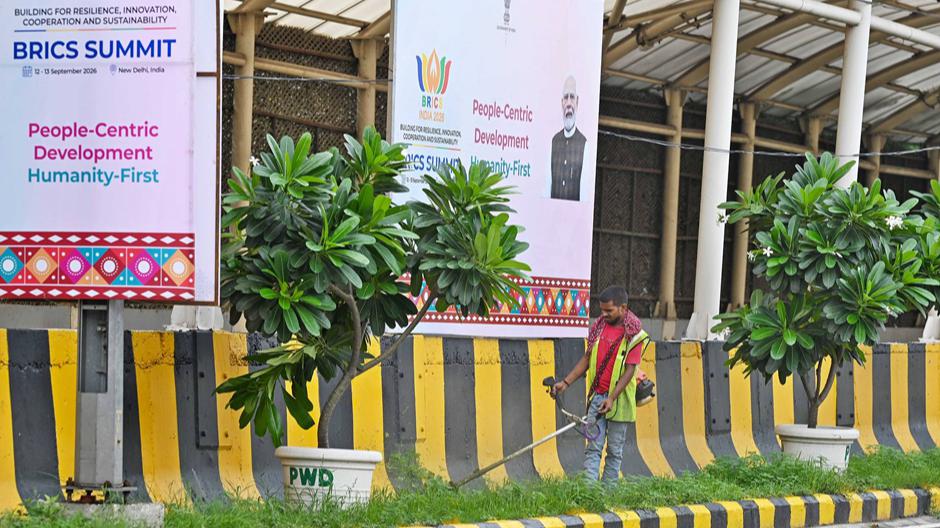
Workers carry out preparations and beautification work near Bharat Mandapam ahead of the upcoming BRICS summit in New Delhi, India, September 6, 2026. (Photo: CFP)
Two decades after Brazil, Russia, India and China began coordinating as BRIC, the grouping has evolved into a far broader platform. South Africa joined in 2011, while Egypt, Ethiopia, Iran, Saudi Arabia and the United Arab Emirates (UAE) joined in the latest major expansion, followed by Indonesia in 2025.
Today, in addition to its 11 members, BRICS has 10 partner countries – Belarus, Bolivia, Cuba, Kazakhstan, Malaysia, Nigeria, Thailand, Uganda, Uzbekistan and Vietnam. More than 30 other countries have also expressed interest in participating as members or partners.
The numbers alone explain some of the attraction. BRICS now represents approximately 49.5% of the world's population, nearly 40% of global GDP and about 26% of global trade.
A platform for greater agency
The appeal of BRICS is fundamentally about agency.
For many developing countries, the post-Cold War international system has failed to keep pace with the economic transformation of the world. Emerging economies have acquired enormous economic weight, yet institutions such as the United Nations Security Council, the International Monetary Fund and the World Bank continue to reflect a distribution of power established in a different era.
BRICS offers another platform from which to demand change.
China is central to understanding why that platform has acquired such weight. As the world's second-largest economy and the largest economy within BRICS, China provides the grouping with an economic anchor that few other emerging-country forums possess. It is also the world's largest trading nation, a major source of investment and infrastructure financing, and an increasingly important provider of technology and industrial capacity to developing economies.
Yet China's importance to BRICS is not simply a matter of economic size.
Beijing has consistently advocated a more representative and multipolar international system while investing heavily in South-South cooperation. The New Development Bank, established by the original five BRICS members, provides developing countries with an additional source of infrastructure and development financing and has increasingly promoted local-currency lending.

The headquarters of the New Development Bank in Shanghai, east China, October 2, 2024. (Photo: CFP)
Not an anti-Western alliance
The attraction of BRICS, however, cannot simply be reduced to opposition to the United States or the West.
Indeed, the grouping's diversity makes such a description increasingly difficult to sustain.
India maintains a strategic partnership with the United States and participates in the Quad. The UAE and Saudi Arabia have deep economic and security relationships with Western countries. Brazil has extensive links with Europe and North America. Indonesia has simultaneously pursued closer ties with both Western and non-Western partners.
Yet all see value in BRICS. Why? Because membership does not require countries to abandon their other partnerships. That is perhaps the grouping's greatest strength. BRICS offers strategic autonomy without demanding strategic isolation.
The ongoing US-Iran war also highlights the evolving role of BRICS. Iran is now a BRICS member, and the conflict has brought some of the differing perspectives within the expanded grouping into sharper focus. The BRICS foreign ministers' meeting in New Delhi in May concluded without a joint statement, reflecting differences among members over the situation in the Middle East, including the US-Iran conflict.
This is perhaps also a reflection of the nature of BRICS itself. With its increasingly diverse membership, the grouping is not expected to take a common position on every geopolitical issue. Its significance may instead lie in providing a platform where countries with different perspectives can continue to engage and cooperate on areas of shared interest.
For China, India and other major energy consumers, the conflict and disruption around the Strait of Hormuz have immediate economic consequences, while China's deep economic ties with Iran underline its ability to engage across competing regional interests. BRICS' value, therefore, may lie less in speaking with one voice on every crisis than in giving countries greater room to pursue their interests without being forced into geopolitical binaries.
More choices, not a new hierarchy
The economic case is equally compelling. BRICS countries collectively account for an enormous share of global energy production, commodities, manufacturing and consumer markets. China and India alone represent more than 2.8 billion people. Indonesia brings Southeast Asia's largest economy and population into the grouping, while the inclusion of major Middle Eastern energy producers has further expanded its economic and strategic reach.
At the same time, some BRICS members are making growing efforts to conduct more trade and financial transactions in their own currencies, reducing their reliance on the US dollar. Whether these efforts eventually evolve into a common BRICS currency remains an open question. But even without that outcome, greater use of national currencies offers BRICS members an additional choice in conducting trade, financing development and managing their economic relationships.
The broader transformation, therefore, is about creating more options – from local-currency trade and development financing to more resilient supply chains, greater technology cooperation and increasingly diversified economic relationships.
For developing countries, diversification itself is an asset.
There is also a political dimension. BRICS provides a collective platform for countries seeking greater representation in global governance, particularly reform of the UN Security Council and international financial institutions. Its growing membership gives such demands considerably greater demographic and economic weight.
Can BRICS turn scale into influence?
BRICS' strength may lie precisely in being a flexible grouping rather than a rigid bloc. The upcoming summit will therefore be an important test of whether BRICS can convert its extraordinary scale into practical cooperation. If it succeeds in areas such as development financing, trade facilitation, digital technology, health, energy and supply-chain resilience, its relevance will grow irrespective of how often it is compared with the G7. Ultimately, the enduring appeal of BRICS is not that it asks countries to choose sides. It is that it gives them more room to choose for themselves.
For nations that spent decades navigating an international system largely designed without them, BRICS provides another seat at the table, another network of partners and another avenue through which their interests can be advanced.
China's economic weight and commitment to South-South cooperation have helped give that platform substance. India's role as a major emerging economy gives it further weight. Brazil, Russia, South Africa and the newer members add their own regional influence. That is why BRICS continues to attract countries with very different interests.
Its enduring appeal lies not in creating a new East-West divide, but in reflecting a world in which more countries want the freedom to decide for themselves where they sit – and with whom they cooperate. BRICS is growing because the Global South wants not a new hierarchy, but more room to shape the world.