


When 25 million travel in one day: How a rail record illustrates Chinese modernization
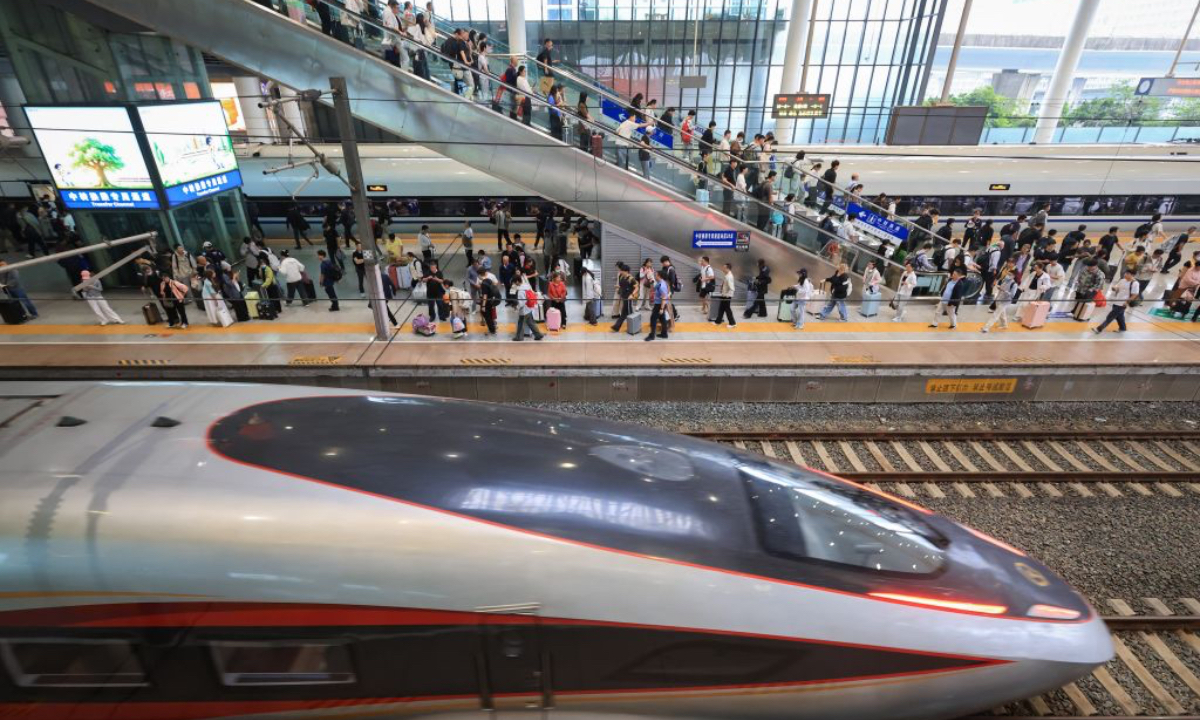
Passengers prepare to board a train at Nanjing South Railway Station in Nanjing, east China's Jiangsu Province, Sept. 30, 2026. China's railway network saw a peak in passenger flow on Wednesday, one day before the beginning of the seven-day National Day holiday. (Photo:Xinhua)
Let me start with a number that tells the story of China's National Day: 25,204,000. The day marks the start of a very important holiday for Chinese people, and 25,204,000 is the number of passengers China's railways carried on October 1 in a single day.
It was the first time the figure had passed 25 million, breaking the previous record of 24.84 million, set just last May. Think about that: roughly the population of Australia, loaded onto trains, moved across a continent-sized country and delivered to their destinations before bedtime.
The even bigger story is that this is no longer unusual. In China, records have become the new normal.
So what's going on here? You can't understand this number without seeing that it isn't really about trains. It concerns a long, challenging journey toward achieving lofty goals and determining what kind of nation to build.
Modernizing 1.4 billion people is not like modernizing 10 million, just on a larger scale. It's a different problem altogether. A few nice intercity lines won't do it. You need a system, and China built one: the world's largest high-speed network, with about 48,000 kilometers of track - roughly two-thirds of the global total.
Much of this was planned decades ago and funded by the state, often before demand clearly justified it.
Was that wise?
Now, let's look at the returns elsewhere: in workers who can move, in small-city businesses that can reach big-city customers, in families that can actually get home. Either way, a 25-million-person day is what that patience looks like when it arrives.
Here's what gets overlooked: Tracks don't carry 25 million people, operations do. Planners add extra trains, couple units together to squeeze more passengers into each slot, and use advance ticket-sales data to anticipate the surge. This is as much a triumph of scheduling as of steel.
Fast trains now link mid-sized cities to giant clusters like the Yangtze and Pearl River Deltas, and cities such as Xi'an in Northwest China's Shaanxi Province and Guangzhou in South China's Guangdong Province set their own local records this holiday. That matters more than it sounds.
A worker can live in a smaller, cheaper city and still commute to a big-city job. A grandmother can see her grandchildren on a weekend instead of once a year. Distance, that great divider of families and opportunity, is shrinking.
Is it affordable? Tickets cost more than they did in the era of slow green trains, but the system also offers more choices, from premium bullet trains to cheap, slower services. For millions, rail travel has gone from an annual ordeal to a routine part of life.
Now, before anyone in Beijing gets carried away, let me add the fine print. Try buying a ticket for a peak holiday date, and you'll learn that demand still outruns supply. Service and coverage are uneven across regions.
This reminds me of the phrase "Chinese modernization," which suggests a country that treated mobility as public infrastructure for 1.4 billion people, planned it over decades, and accepted the cost of building ahead of demand.
The real issue isn't whether China's model is "better." It's what the rest of us are building today that our grandchildren will thank us for in 2050.
The author is a senior editor with the People's Daily. dinggang@globaltimes.com.cn.