


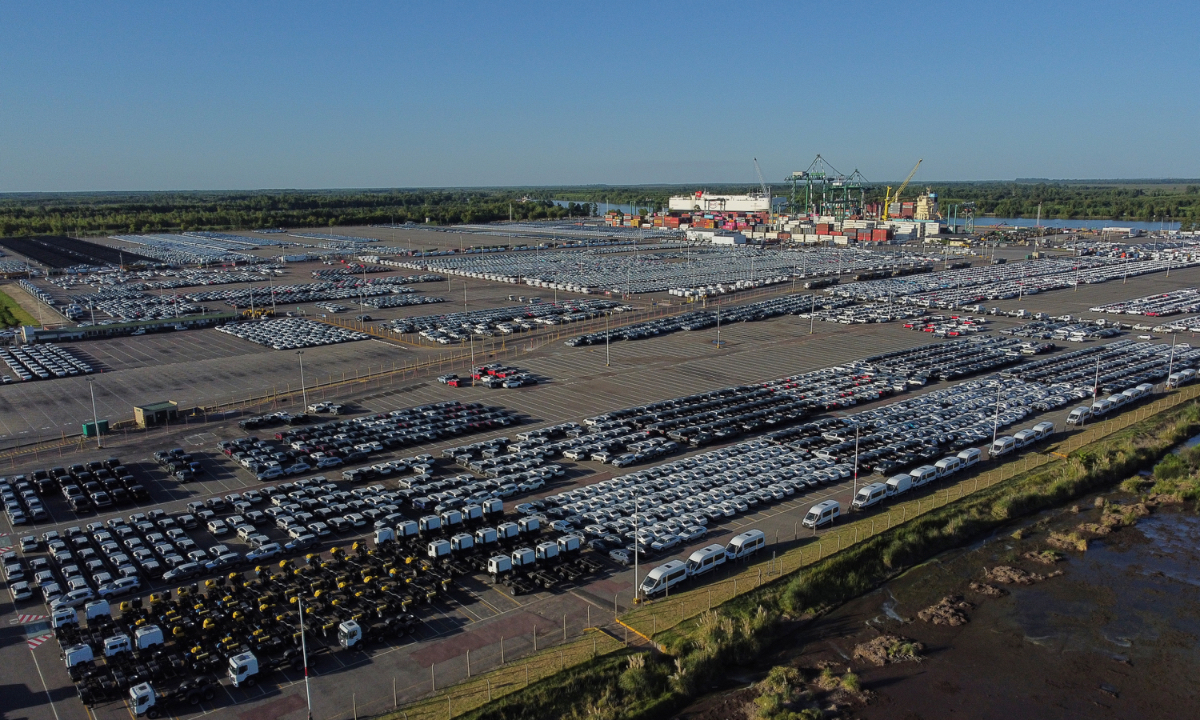
An aerial view of electric vehicles unloaded from the BYD Changzhou at the Port Terminal of Zarate after the vessel arrived from Singapore carrying a record shipment of 7,000 electric cars, marking the first time a full ship belonging to a Chinese automaker has arrived in Zarate, Argentina, on January 20, 2026. The unloading operation is expected to take around 36 hours, reinforcing Zarateas role as a key automotive hub in South America. (Photo: VCG)
Chinese automakers have begun releasing their January delivery reports, with overseas shipments emerging as a key highlight. As exports become a major growth engine, China's automotive industry chain is accelerating its global expansion, fostering broader win-win cooperation with international markets, experts said.
BYD reported overseas sales of 100,000 passenger vehicles and pickup trucks in January, up 43.3 percent year on year, accounting for nearly half of its total monthly sales, according to its official Weibo account.
The company previously said it expects to sell 1.3 million vehicles outside the Chinese mainland in 2026, a 24.3 percent increase from 2025. BYD is currently building passenger vehicle manufacturing bases in countries including Thailand, Brazil, Hungary and Uzbekistan, as it accelerates its global expansion, according to media reports.
In January 2026, Geely's passenger vehicle sales reached 270,200 units, up 1 percent year on year and 14 percent month on month. Overseas sales totaled 60,500 units, surging 121 percent from a year earlier, according to Shanghai Securities News.
Geely Auto said it aims to export 640,000 vehicles in 2026, representing a year-on-year increase of more than 50 percent, and plans to develop three regional markets each with annual sales of 150,000 units and two markets of 100,000 units worldwide.
SAIC-GM said its terminal sales exceeded 51,000 vehicles in January, up about 8 percent year on year, with new energy vehicle sales surging nearly 90 percent and exports more than doubling, according to the Securities Daily.
Chery Group exported 119,600 vehicles, up 48.1 percent, marking the ninth consecutive month with exports above 100,000 units and maintaining its position as China's top auto exporter, the report said.
Wang Peng, an associate research fellow at the Beijing Academy of Social Sciences, told the Global Times that China's auto industry is moving beyond simple vehicle exports toward driving broader "ecosystem expansion" overseas, opening up new space for localized, win-win cooperation and accelerating the globalization of the entire automotive industry chain.
According to media reports, since October last year, more than 15 Chinese automakers and auto parts companies have disclosed overseas expansion plans within just over three months, with total planned investment exceeding 70 billion yuan. Among them, CALB's European lithium battery gigafactory project, agreed with AICEP, the Portuguese Trade & Investment Agency, on January 20, carries a total investment of 2.067 billion euros (about 16.8 billion yuan), making it the largest overseas investment by China's automotive industry chain so far this year.