


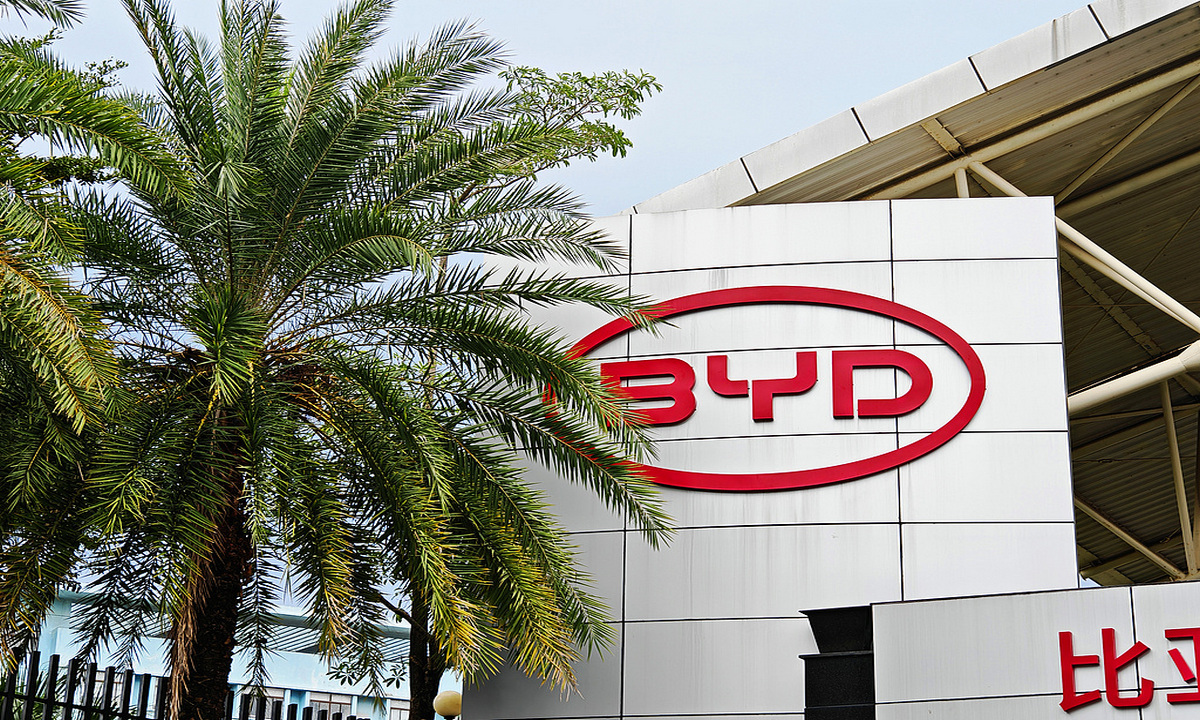
BYD headquarters in Shenzhen, South China's Guangdong Province. (Photo: VCG)
Four US-based subsidiaries of Chinese automaker BYD Co - covering businesses such as car sales, commercial vehicle manufacturing, and battery supply - have reportedly filed a lawsuit against the US government in the US Court of International Trade recently, challenging a series of tariff executive orders implemented under the International Emergency Economic Powers Act (IEEPA), domestic media outlet Caijing Magazine reported.
A source close to the matter confirmed the authenticity of the lawsuit filed by the BYD subsidiaries on Sunday.
A Chinese industry analyst said that while the result remains to be seen, BYD's lawsuit marks the first instance of a Chinese automaker directly and actively challenging the US tariffs, setting a precedent and carrying significance for Chinese enterprises to protect their legitimate rights and interests through legal means.
According to court documents reported by some Chinese financial news outlets including Caixin, BYD is requesting that the court rule the defendants lack statutory authority to impose tariffs under the IEEPA framework and declare all the challenged tariff orders invalid as ultra vires actions. The company seeks permanent injunctions against implementing these measures and economic relief, including refunds of all IEEPA tariffs collected from the plaintiffs, plus interest and reasonable litigation costs.
The plaintiffs are BYD's four core North American operating entities: BYD America LLC, BYD Coach & Bus LLC, BYD Energy LLC, and BYD Motors LLC. The defendants include the US federal government and key officials from the Department of Homeland Security, Customs and Border Protection, the Office of the US Trade Representative, and the Treasury Department, according to the reports.
The lawsuit was filed with the US Court of International Trade on January 26, 2026, and disclosed by the court on February 2, under case number 26-00847.
"BYD's move follows a growing trend of companies using legal channels to safeguard their legitimate rights and interests," Sun Xiaohong, secretary-general of the automotive branch of the China Chamber of Commerce for Import and Export of Machinery and Electronic Products, told the Global Times on Sunday.
The high tariffs imposed by the US on imported goods not only impact both domestic and foreign automakers but also pose a serious challenge to the stability of the global supply chain, reinforcing the necessity for companies to safeguard their rights through legal means, Sun said.
Though the lawsuit faces difficulties and the result remains uncertain, this case has significant guiding implications for the future, Sun said, adding that it could precedent for Chinese firms to take legal actions to defend their rights and interests instead of inaction.
Sun further pointed out that the US tariffs are protectionist in nature and Chinese automakers' entry to the US is beneficial for the US, bringing cost-effective electric vehicles to US consumers.
BYD's lawsuit also came as global companies have sued the US government over the tariffs. Thousands of companies around the world have filed lawsuits challenging the US government's sweeping tariffs and sought refunds on duties paid, Reuters reported on January 9.