


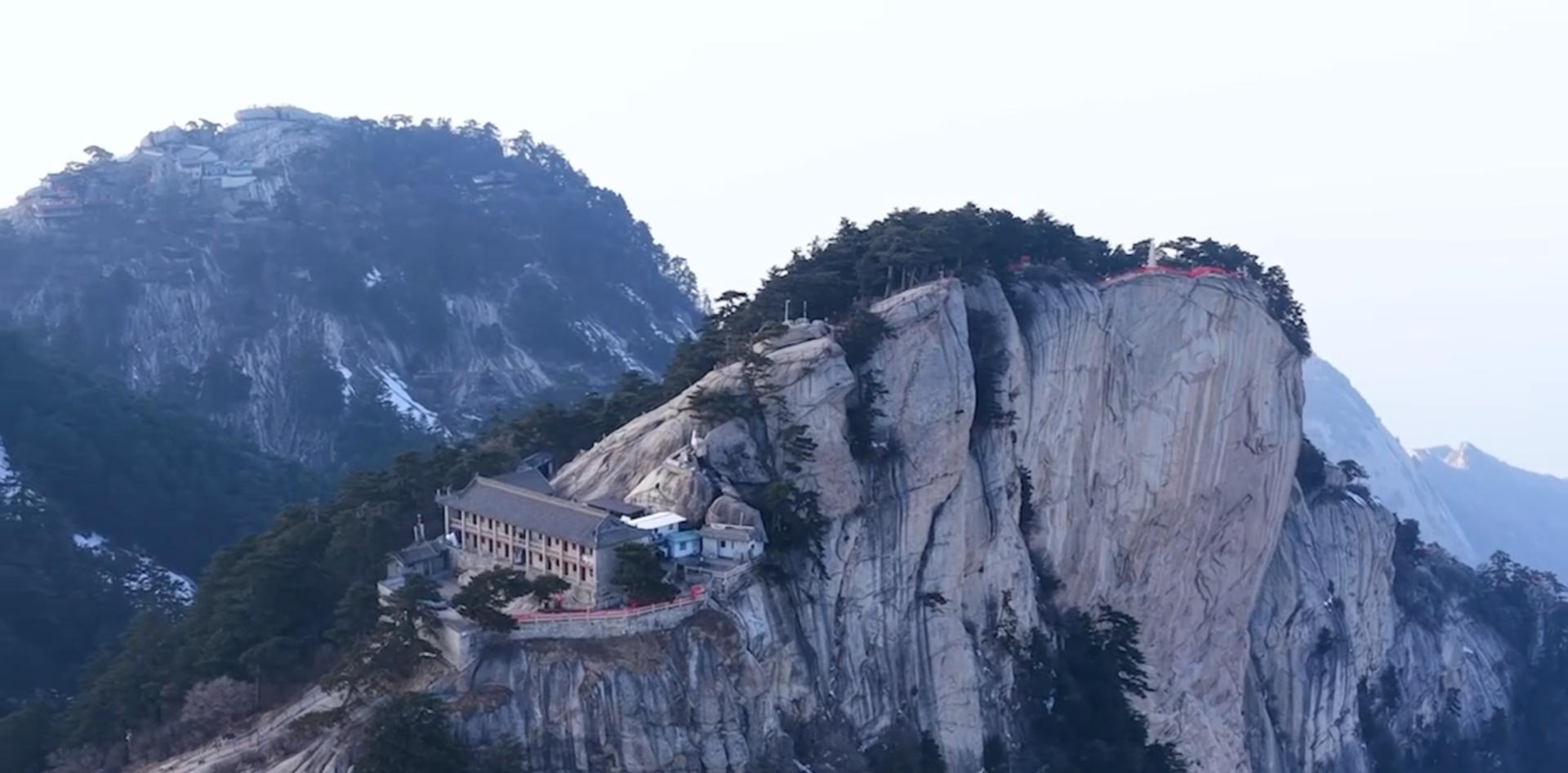
An aerial view of the Huashan Meteorological Station on Huashan Mountain in Northwest China’s Shaanxi Province. Photo: Screenshot from People’s Daily
"There has been only one path up Huashan Mountain since ancient times." Built at an altitude of 2,064.9 meters on the West Peak, the Huashan Meteorological Station is the only high-mountain weather station staffed around the clock in Northwest China’s Shaanxi Province.
This year marks the 33rd year that Yu Jinjiang, head of the Huashan Meteorological Station, has lived and worked on the mountain. At 7:30 am, the temperature was minus 2 degrees Celsius on the West Peak. Yu walked out of the dormitory and called Tan Yiying, a meteorological station operator, to check the instruments at the summit’s observation field before breakfast and decide whether de-icing or other maintenance is needed. The observation field is built on a massive rock, with a sheer cliff on one side. The wind here was particularly strong, stinging their faces with bone-chilling cold.
"Whether it’s windy, rainy, or snowy, we go out for maintenance every day to ensure the equipment runs properly and data is transmitted smoothly," Yu said.
Huashan Mountain lies in the eastern Qinling Mountains, along the climatic boundary that divides northern and southern China. As a national benchmark climate station, the Huashan Meteorological Station observes, collects and calibrates 13 meteorological elements, including temperature, wind speed, wind direction and humidity. The data is uploaded hourly to the national observation center and shared through the Asian regional data exchange network. “Since the station was founded in 1952, our meteorological data records have always been continuous,” Yu said proudly.
Yu recalls that shortly after the Spring Festival in 1993, at the age of 20, he climbed the winding mountain path for seven or eight hours to report for duty at the Huashan Meteorological Station. The rough mountain path, scarce water supply, and undercooked rice, the harsh environment came as a great shock to him. Yet, the fighting spirit and the dedication to the meteorological cause of the older generation of meteorological workers on the mountain kept him here. Today, the support conditions for meteorological workers have improved greatly. Cable cars are now available, making the ascent no longer reliant on "a carrying pole and two ropes."
During the Spring Festival holiday, the Huashan Meteorological Station plays a crucial role in providing weather forecasts for the Huashan scenic area, covering lightning protection, forest fire prevention, landslide risks, sunrise and sunset times, star-gazing rates, sea of clouds, and rime ice.
"A blue alert for strong winds was issued yesterday. Will the winds strengthen today?" Liu Fan, operations director of Shaanxi Taihua Tourism Ropeway Co Ltd, asked eagerly upon seeing Yu in the control room in the morning. Huashan experiences more than 100 windy days each year, including many during the peak Spring Festival tourism season. Whenever the wind speed exceeds 15 meters per second, cableway operations are affected.
"It's likely to intensify from afternoon to evening. Keep a close eye on it," Yu replied.
When Yu went back to the station, a staff member from the Smart Huashan management department of the scenic area service center called to inquire whether the scattered light snow in the forecast might cause road icing. "No icing. It won’t affect tourists climbing the mountain," Yu assured them.
Extreme weather is common on Huashan, making accurate forecasting crucial to the scenic area’s safe operation. One year, tourists were stranded on the summit due to thunderstorms and strong winds. Within 3.5 hours, Yu communicated with the cableway operator more than 20 times, adjusting operations based on real-time weather conditions, ensuring that all tourists descended safely.
After lunch, without taking a rest, Yu began his routine afternoon mountain patrol.
Atop Huashan Mountain, cold dry air from the north and warm moist air from the south converge year‑round, forming clouds, mist, rain and snow. The collision of cold and warm air masses also brings thunderstorms, strong winds, and hail. All of these underscore the importance of the Huashan Meteorological Station’s role in accurately tracking climate trends.
With advancements in meteorological technology, meteorological observations are now largely automated. There are four automatic stations on the mountain and seven at its base. These days, staff have increased their inspection frequencies.
One automatic observation station is located on the summit of the South Peak, opposite the meteorological station. Although it appears close, climbing up there takes half an hour. It is installed on a rooftop, accessible only by a steel ladder seven to eight meters long positioned beside a razor-sharp cliff. In what seemed like the blink of an eye, Yu and his colleagues Ding Limin and Zhou Xiaohu climbed up without hesitation.
Another automatic observation station is on the East Peak, an hour-and-a-half hike away. It stands on a rocky slope with no proper path leading to it. The team scrambled on hands and feet to reach the nearly 10‑meter‑high station.
Upon arrival, they found a backup automatic weather station toppled by strong winds. The team spent over an hour repairing it amid strong winds. "Equipment on the mountaintop is often damaged by wind. Every one of us must know how to maintain it," said Ding, deputy director of the station. Her face flushed from the wind. Ding, at the age of 32, and Zhou at 28, are both skilled in meteorological observation and equipment maintenance.
Yu happily mentioned that this year, the station's meteorological equipment will gradually be upgraded to intelligent devices.
“After the intelligent upgrade, will the meteorological station still require on-site staff?”
"On-site duty will still be necessary. We hope to achieve intelligence to 'free up' manpower for more scientific research. Over 70 years of continuous data prove that this place cannot do without the perseverance of generations of meteorological workers," Yu said.
At 10 pm, the summit of Huashan Mountain was quiet. Amid the holiday reunions, a two-story building on the sheer cliff glowed softly, quietly guarding the lights of countless homes.