


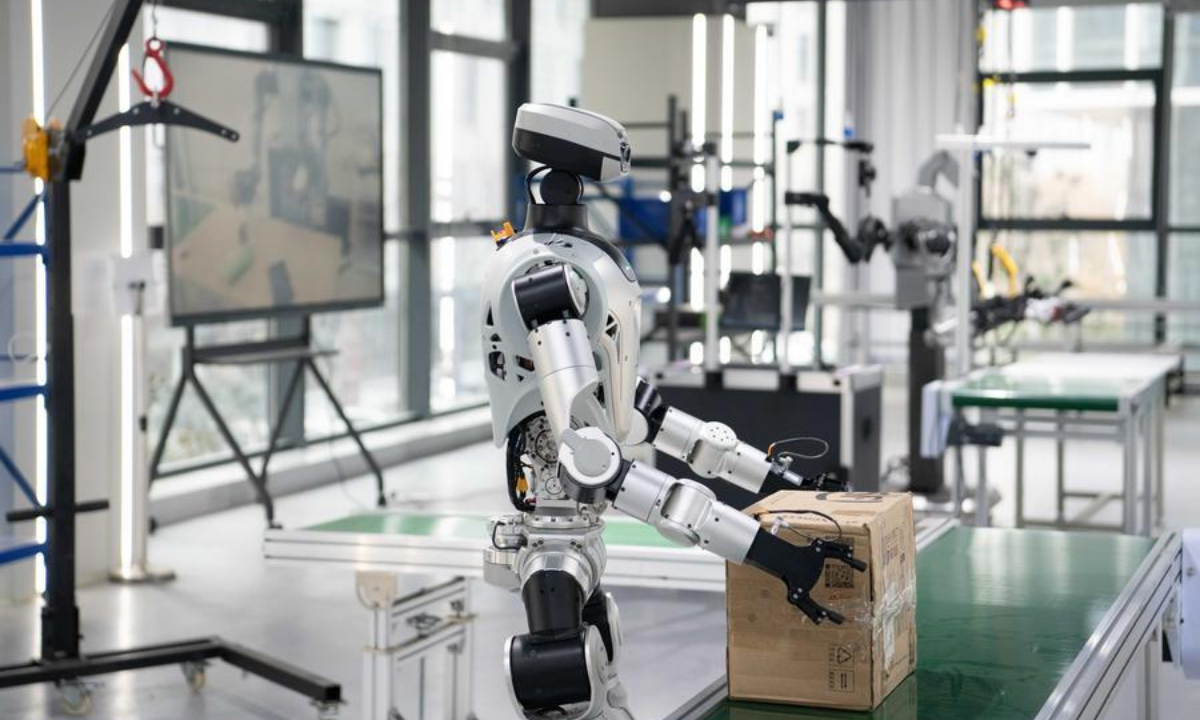
A humanoid robot conducts box-carrying training at a data collection pre-training center for humanoid robots in Hefei, east China's Anhui Province, Dec. 4, 2025. (Xinhua/Zhang Duan)
China has officially released its inaugural top-level design for the humanoid robot and embodied artificial intelligence (AI) standard system, covering the entire industrial chain and life cycle, CCTV News reported on Sunday, noting that this milestone marks a transition into a new phase of standardized and collaborative development for the sector.
Released on Saturday at the annual meeting of Humanoid Robots and Embodied Intelligence Standardization (HEIS) in Beijing, the standard system represents the first major output from the organization of the Ministry of Industry and Information Technology's technical committee for HEIS which was established in December, 2025. The event drew a diverse group of stakeholders, from government officials to capital market representatives, to coordinate industrial standards.
Reflecting sentiment in the industry, a representative of Chinese robotics company MagicLab told the Global Times on Sunday that the release of the standard system signifies the industry's shift from a "technical breakthrough period" to a "systematic construction period."
In terms of technical architecture, the standard system comprises six key sections: basic commonalities, brain-like and intelligent computing, limbs and components, complete machines and systems, applications, and safety and ethics.
According to the report, the system provides a comprehensive roadmap from underlying technology to practical applications. The basic commonalities and safety ethics provide the regulatory foundation, while the computing section focuses on "cerebrum and cerebellum" models and full-link data norms. Meanwhile, the limb and component section offers modular guidance for torsos and actuators, while the machine and system section aims to drive the deep integration of hardware and software.
In a statement sent to the Global Times on Sunday, Chinese robot manufacturer UBTECH noted that the release of the standard system signifies systematic state guidance for this frontier field. By accelerating ecosystem maturity through top-level design, the humanoid robot industry is moving from a stage of scattered technical exploration to a new phase of standard-led, collaborative growth, the company said.
"The core value of standards lies not just in 'regulation,' but in establishing a long-term, stable, and sustainable order for the industry," MagicLab's representative noted. "In the future, only companies capable of delivering stable, reproducible, and scalable solutions under this framework will excel in the long-run pursuit of high-quality industrial development."
The rollout of this standard system follows a landmark year of growth for China's humanoid robot industry in 2025, a surge underpinned by strategic national and local government blueprints that have positioned the sector as a key pillar of the country's high-tech landscape.
The maturity of the nation's industry was recently highlighted during the 2026 Spring Festival Gala, where four Chinese humanoid robot firms, Unitree Robotics, Galbot, Noetix, and MagicLab, showcased their products across more than four programs, covering multiple performance formats including dance, stage plays, and short films.
Liu Haibo, chief manufacturing analyst at CITIC Securities, said that the high-profile Spring Festival Gala demands high stability and system integration, serving as a critical test for the hardware and software maturity of humanoid robots. Amid the current period of rapid technological iteration and increasing application scenarios, such a public debut not only boosts industry visibility but also strengthens public expectations for the integration of robotics into daily life, Liu noted in an industry report sent to the Global Times on Sunday.