


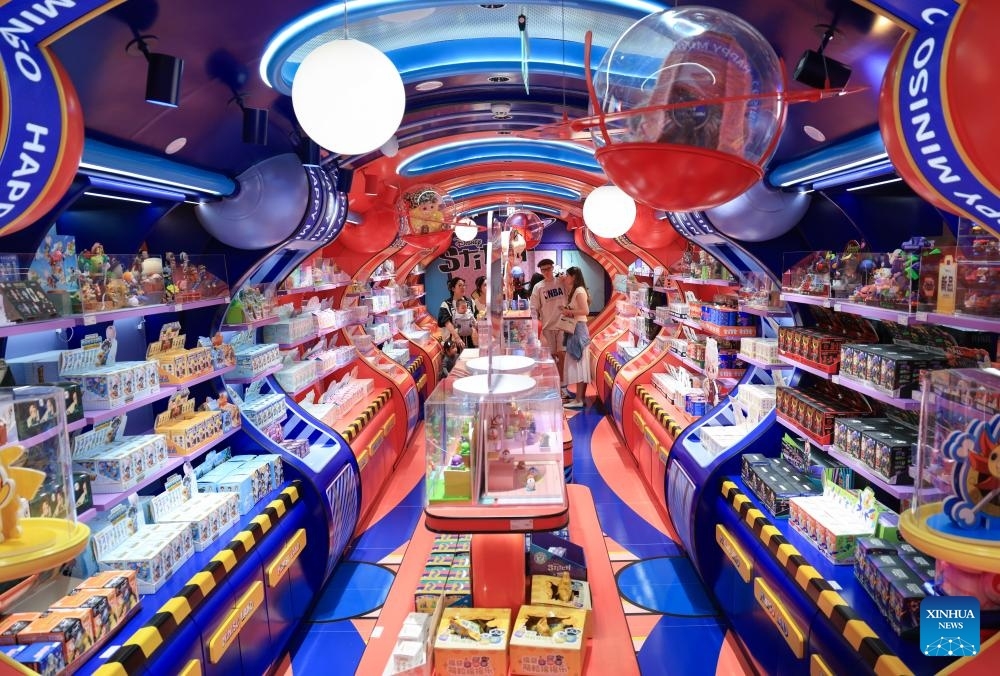
People visit a MINISO LAND store in Guangzhou, south China's Guangdong Province, Oct. 28, 2025. (Xinhua/Mao Siqian)
The "youth economy," "emotional consumption" and "youth-run stores" have become hot topics at this year's local "two sessions," the annual meetings of provincial-level lawmakers and political advisors, across China.
For the first time, the youth economy was mentioned in the government work report of southwest China's Sichuan Province, while the "emotional economy" was included in the government work reports of east China's Jiangxi Province, southwest China's Chongqing Municipality, southwest China's Guizhou Province and several other regions.
During the 2024 national "two sessions," Zhang Kun, a member of the National Committee of the Chinese People's Political Consultative Conference (CPPCC), China's top political advisory body, submitted a proposal calling for coordinated support for youth-run stores across society. Relevant government departments took note, responded, and have since moved to implement measures.
A survey found that 62.5 percent of young respondents purchase fashion toys and mystery boxes for emotional reasons, while 55.6 percent said they buy them when feeling down. Over the past year, 68.4 percent of respondents attended two or more live performances, with 61.2 percent citing stress relief, emotional adjustment and improved physical and mental well-being as their primary motivations.
The word "guzi," which sounds like the English word "goods," refers to merchandise inspired by animations, comics and games, such as cards, badges and anime figures. Popular as festive gifts during the Spring Festival, or Chinese New Year, these items have become a way for young people to express emotions, showcase their personalities and connect with like-minded communities.
The flagship store of Kayou, a cultural innovation company specializing in animation and creative stationery, drew a steady flow of visitors in Shanghai during the Spring Festival. Li Haocheng, who oversees the Shanghai stores of Kayou (Shanghai) Cultural Creativity Co., Ltd., said a card combining the Chinese character "Fu" (meaning good fortune) with a cartoon figure proved especially popular, with young people snapping it up as a gift for friends who share their interests.
Li, who started as a salesperson, has witnessed guzi evolve from a niche market into a mainstream trend. He noted that many customers are parents shopping with their children, a pattern that has inspired the company to expand its product range.
For example, a cartoon-themed gel pen initially attracted children with its playful design, but after a few uses, it lost their interest. Many parents, however, discovered that it offered an exceptionally smooth writing experience. Building on this insight, the team later developed a simpler gel pen for office use, which proved just as popular.
On the sixth floor of Bailian ZX Creative Centre, a shopping mall in Shanghai, Chen Longqi and his staff arranged Spring Festival lucky bags prominently on the shelves. Chen ventured into the guzi economy in 2021, and his store was one of the first to open in the mall. Over time, he has witnessed the growth and evolution of the market.
Customers who spend a certain amount at the store can enter a lucky draw, with prizes ranging from limited-edition stickers to small figures of licensed characters.
Chen has transformed his store into a space where people with shared interests can connect. "Emotional value is our core offering," Chen said, adding that the store not only supports him and his business partner financially but has also created job opportunities for like-minded people, allowing them to turn their passion into a profession.
For Soki (not her real name), a university student in Suzhou, east China's Jiangsu Province, guzi merchandise such as table mats, figure display stands and plush toys holds deep emotional significance.
For her, buying guzi is an emotionally fulfilling journey — from the excitement that builds when a new item is announced to the joy of sharing it in social settings.