


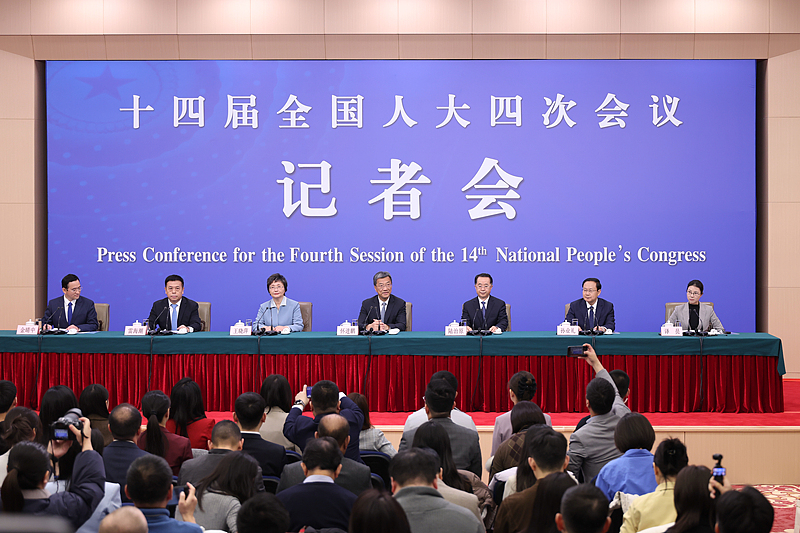
The press center for the fourth session of the 14th National People's Congress (NPC) holds a press conference on people's livelihood on March 7, 2026 in Beijing. (Photo: VCG)
China’s Ministry of Human Resources and Social Security is studying measures to harness artificial intelligence (AI) to create new jobs and empower traditional positions, a senior official said on Saturday at a press conference for the fourth session of the 14th National People's Congress on people's livelihood in Beijing.
Wang Xiaoping, minister of human resources and social security, made the remarks in addressing a question asking how the ministry views the current employment situation, and how it plans to ensure a good start for employment-related work in the 15th Five-Year Plan period (2026–30). Wang highlighted that measures are being studied to promote the use of AI to create new jobs while empowering traditional ones. She added that the goal is to promote inclusive development that aligns technological progress with improvements in people’s livelihoods.
At the press conference, the minister noted that the employment-first strategy will be further implemented in the 15th Five-Year Plan period.
To that end, the ministry will strengthen coordinated efforts and implement measures to stabilize employment, expand capacity and improve quality, Wang said. On stabilizing jobs, Wang said the ministry will increase support for labor‑intensive sectors such as foreign trade, construction, and accommodation and catering, stabilizing jobs by promoting industry development.
Despite challenges during the 14th Five-Year Plan period (2021-25), the employment sector has maintained steady progress. This is fundamentally due to the CPC Central Committee’s consistent prioritization of employment, which has allowed policies to stabilize employment and the economy to be fully implemented, and to the fact that we have a complete range of industrial sectors, a massive market, and burgeoning new drivers of growth, which have strengthened the capacity to absorb and redeploy labor. Many business operators who innovated and adapted and the workers who worked hard, which all demonstrate the vitality, potential, and resilience of a major economy, Wang said.
According to Wang, the ministry plans to tap employment potential in the digital economy, high-end manufacturing and modern services, promoting industrial upgrading that generates new positions. On improving job quality, officials will carry out adjustments to the minimum wage mechanism, regulate the human-resources or labor market, and fully implement wage‑payment protection systems for migrant workers to strengthen workers’ rights and benefits.
Wang also outlined targeted measures for vulnerable and special groups. “We will roll out a number of skill‑training programs tailored to older workers, deepen labor cooperation to broaden employment channels for migrant workers, maintain regular employment assistance for those at risk of falling back into poverty, and provide employment assistance to vulnerable groups to help them secure stable jobs and increase their incomes,” she stated.
During the 15th Five-Year Plan period, the underlying conditions and basic trends supporting the long-term improvement of our economy have not changed. “The prospects for high‑quality development are broad, and with our strong institutional advantages, we have the confidence and capability to keep overall employment stable and the situation improving,” Wang said.
The remarks reflect China’s broader push to manage the social impact of rapid technological change, encourage AI-driven job creation and use AI to augment existing occupations while supporting sectors that employ large number of workers, Li Changan, a professor at the Academy of China Open Economy Studies under the University of International Business and Economics, told the Global Times on Saturday.
China’s employment work faces both significant opportunities and numerous challenges, Li said, adding that we should fully leverage positive factors and tap employment potential to lay a solid foundation for achieving high-quality and full employment.