


China's consumer inflation climbed to a three-year high in February while the decline in producer prices continued to narrow, pointing to a gradual recovery in domestic demand as policymakers push to spur consumption and stabilize prices in the world's second-largest economy.
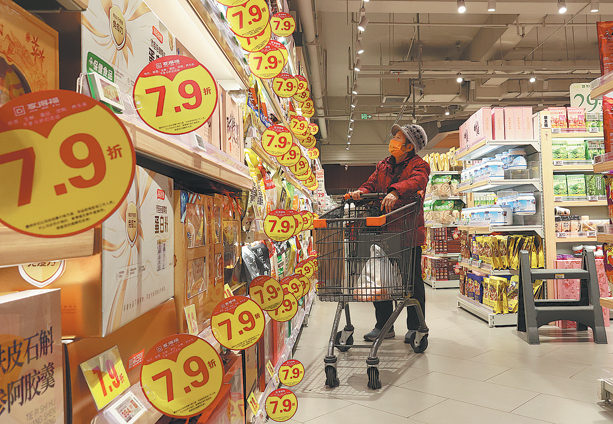
A shopper browses products at a supermarket in Lianyungang, Jiangsu province, on Monday. (Photo via China Daily)
Data released by the National Bureau of Statistics on Monday show that the country's consumer price index, the main gauge of inflation, rose by 1.3 percent year-on-year in February to the highest level since January 2023, following a 0.2 percent rise in January.
"The surge in February CPI was mainly driven by the shifting timing of Spring Festival — beginning in mid-February this year, more than a fortnight later than in 2025, which boosted holiday consumption and led to the rise in travel-related service prices and food prices," said Feng Lin, executive director of the research and development department at Golden Credit Rating International.
Excluding the impact of the change in dates of the Spring Festival holiday, consumer prices rose 0.8 percent year-on-year on average in the January-February period, the same pace as that in December, Feng said. "That suggests the price recovery seen in the second half of 2025 is continuing, supported by stronger policies to spur consumption, efforts to curb 'involution-style' competition and surging global gold prices."
Still, consumer inflation remains subdued, as the over four-year correction in China's real estate sector has eroded household wealth and dampened consumer confidence, Feng said.
Looking forward, Feng said rising global oil prices — fueled by geopolitical tensions in the Middle East — could feed through to domestic inflation. However, seasonal declines in service prices after the Spring Festival holiday period may pull monthly CPI growth into negative territory in March, with the annual CPI growth rate likely easing to around 0.9 percent.
"CPI inflation will likely remain at a relatively low level for some time," she said, adding that subdued inflation gives policymakers room to step up pro-growth measures when needed.
China has set its 2026 CPI growth target at around 2 percent, the same as last year, according to the Government Work Report. China's consumer prices stood flat in 2025, the lowest level since 2009.
"Setting a CPI target of around 2 percent this year suggests that policies aimed at expanding domestic demand and curbing 'involution-style' competition will continue to advance," Feng said.
According to the NBS, China's producer price index — which measures factory-gate prices — fell by 0.9 percent year-on-year in February, narrowing from a 1.4 percent dip in January.
Going forward, Wen Bin, chief economist at China Minsheng Bank, said consumer inflation is expected to maintain a moderate upward trajectory, while producer prices will continue to recover, with the PPI likely turning positive by mid-year.
"With PPI rising on a monthly basis, improving profitability among midstream and downstream enterprises could strengthen incentives to expand production," Wen said. "Meanwhile, stronger-than-expected rebounds in prices of commodities such as oil, copper and coal are directly lifting domestic mining and raw material prices, becoming a key driver of PPI recovery. Plus, as policies aimed at curbing 'involution-style' competition deepen alongside the rapid development of emerging industries and the effective release of consumption potential, the foundation for a reasonable recovery in prices will continue to strengthen."