


Opening up is an intrinsic path toward China's prosperity and development
China's unwavering commitment to promoting high-standard opening up and advancing trade and investment liberalization and facilitation was a recurring theme among delegates attending the "two sessions" — the annual meetings of the country's top legislature, the National People's Congress (NPC), and the top political advisory body, the Chinese People's Political Consultative Conference (CPPCC).
Delegates said high-standard opening up not only shares development opportunities with the world but also injects greater positive energy and certainty into global growth.
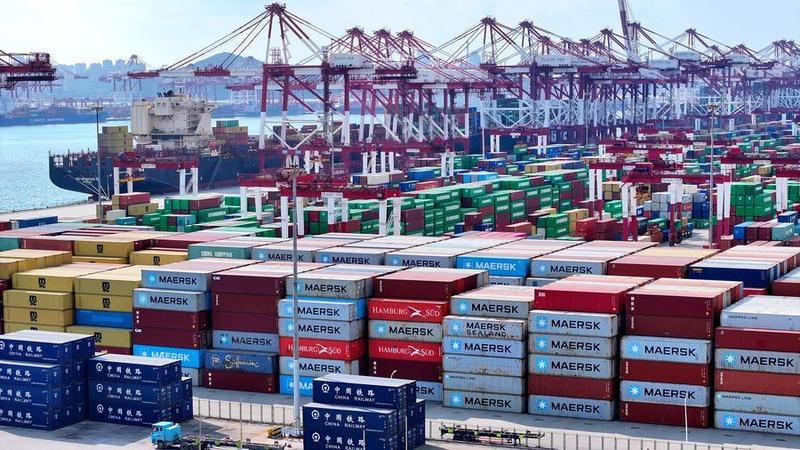
A drone photo shows a view of Qingdao Port in Qingdao, East China's Shandong province, Oct 29, 2025. (Photo: Xinhua)
China has held the top spot in the global goods trade for many consecutive years and leads the world in outbound investment. China trades with 249 countries and regions, and more than 75 percent of the world's nations have joined the Belt and Road Initiative (BRI). The cumulative number of China-Europe freight trains has exceeded 120,000, and China has extended unilateral visa-free access to 50 countries.
These milestones reflect a more proactive opening-up strategy that has delivered historic results and provided stronger strategic support for Chinese modernization.
"These achievements are genuinely inspiring," said Hu Chengzhong, an NPC deputy and chairman of the board of Delixi Group.
"As a key player in foreign trade, private enterprises have broadened their markets, upgraded their technology, and built stronger brands by riding the wave of opening up — and we have directly experienced the stability and development dividends it brings," Hu added.
Last year, Delixi expanded its business to more than 80 countries and regions. China's opening up and development have given private enterprises access to an ever-wider stage.
"Since the 14th Five-Year Plan period (2021-2025) began, China's high-standard opening up has continuously expanded — and that is clearly visible both in macro-level data and in companies' operations," said Ke Xiping, a CPPCC member and chairman of Xiamen Hengxing Group Co., Ltd.
In recent years, a growing number of Chinese companies have made new breakthroughs in overseas investment, mergers and acquisitions, and joint research and development. Opening up adds momentum to China's economic development, and through higher-level opening up, China shares its development opportunities with the world, Ke added.
The BRI has become a widely welcomed international public good and platform for cooperation. Dai Hegen, a CPPCC member, Party secretary and chairman of China Railway Construction Corporation Limited (CRCC), noted that global industrial and supply chains are undergoing profound restructuring, and that developing countries have increasingly urgent needs for infrastructure and industrial upgrading.
CRCC, he said, will continue to fulfill its responsibilities as a state-owned enterprise, deepen its participation in high-quality BRI cooperation, advance industrial collaboration, and pursue high-quality corporate development through mutual benefit and win-win cooperation.
The period covered by the 15th Five-Year Plan (2026-2030) will be critical as China works to build on its progress and push ahead on all fronts toward basically realizing socialist modernization by 2035, making high-standard opening up all the more consequential.
Opening up is an intrinsic path toward China's prosperity and development, said Li Chu, an NPC deputy and Party secretary of Guilin, south China's Guangxi Zhuang Autonomous Region. He argued that expanding high-standard opening up would help China seize the historic opportunity presented by a new round of technological and industrial revolution, amplify the interplay between domestic and international markets and resources, accelerate industrial transformation and upgrading, and pursue higher-quality economic growth while appropriately increasing economic output.
Expanding high-standard opening up — making the pie of opening up bigger and distributing it better — allows more people to benefit from the fruits of development. It is also a concrete step toward preserving a diverse and stable international economic order and trade relationships, and one that serves China's interest in gaining strategic initiative amid intensifying global competition.
Trade between south China's Guangdong Province and the Association of Southeast Asian Nations (ASEAN) is particularly robust. Last year, bilateral trade exceeded 1.53 trillion yuan ($221.38 billion), hitting a historic high.
"Guangdong and many parts of Southeast Asia have complementary industries, shared channels, and overlapping opportunities," said Zeng Jinze, an NPC deputy and director of Guangdong's Department of Industry and Information Technology. "We believe that persisting with open cooperation and mutual benefit will provide an enduring source of vitality for regional economic development," Zeng noted.
Han Minchun, a CPPCC member and professor at Huazhong University of Science and Technology, said central China's Hubei Province holds distinctive geographical and industrial advantages and should embrace a more open outlook, better integrate domestic and international trade, and develop platforms to attract foreign engagement.
He pointed to Hubei's Ezhou Huahu International Airport — Asia's first dedicated cargo hub airport — as a major asset, and recommended establishing a comprehensive bonded zone there.
Han suggested upgrading the airport into a new engine for an open economy, integrating bonded processing, logistics, and services, to help Hubei develop a more export-oriented economy.
This year's government work report outlined measures for further expanding high-standard opening up, such as opening wider to the outside world, keeping the volume of foreign trade stable and refining its mix, expanding two-way investment cooperation, and pursuing high-quality Belt and Road cooperation.
Ningbo in east China's Zhejiang Province is at the forefront of opening up. The city is pressing ahead with its ambition to evolve from a "city of openness" into a "powerhouse of openness."
Ye Miao, an NPC deputy and director of the Management Committee of the Ningbo Economic and Technological Development Zone, said the key to making that leap lies in fully utilizing open platforms and insisting on promoting the integrated development of domestic and foreign trade.
Ningbo will continue to leverage the strengths of the Ningbo Area of China (Zhejiang) Pilot Free Trade Zone to build a more robust hub for bulk commodity resource allocation and promote comprehensive trials for greater opening up of the service sector.
The city will also explore regulatory frameworks better suited to emerging business models such as cross-border e-commerce, trade in services, digital trade, and green trade — all in service of high-quality development through high-standard opening up.