


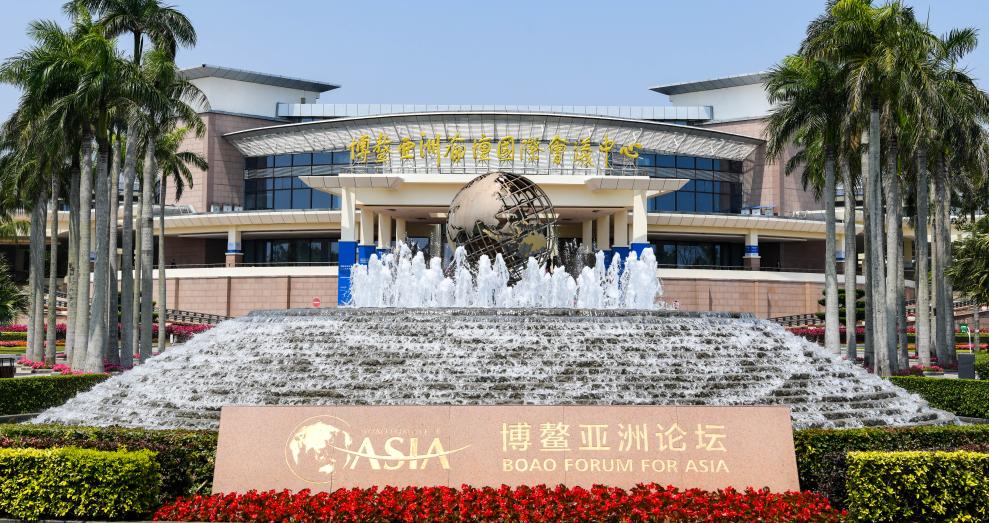
Photo shows a view of the Boao Forum for Asia (BFA) International Conference Center in Boao, south China's Hainan Province. (Photo: Xinhua)
Every spring, the small coastal town of Boao in south China's Hainan Province becomes a temporary center of global economic gravity. The town hosts the Boao Forum for Asia (BFA), an annual gathering of heads of state, finance ministers, central bank governors, corporate chiefs and other high-level officials and that has, over 25 years, grown into one of the most consequential international forums in the world. The 2025 edition of the forum attracted nearly 2,000 participants from over 60 countries and regions.
What is the Boao Forum for Asia?
Proposed in 1998 by former Philippine President Fidel V. Ramos, former Australian Prime Minister Bob Hawke, and former Japanese Prime Minister Morihiro Hosokawa in the aftermath of the Asian financial crisis, the BFA was conceived as a platform for discussing Asian issues and enhancing cooperation among Asian countries and between Asia and the rest of the world.
The proposal quickly gained support across the region. In October 1999, then-Vice President of China Hu Jintao met with Ramos and Hawke in Beijing, pledging China's full support for the initiative. In 2000, the governments of 26 countries agreed to establish the forum, and the Chinese government approved Hainan as its permanent home. The BFA was formally inaugurated in February, 2001. The forum now has 29 initial countries, and its permanent conference site in Boao has hosted the annual gathering every year since 2002.
The founding purpose of the BFA was to promote economic integration in Asia. Its mission now is to pool positive energy for the development of Asia and the world. Like the World Economic Forum in Switzerland, the BFA brings together leaders from government, business and academia to discuss pressing global issues, and is playing an increasingly explicit role in shaping, not just discussing, Asia's economic architecture.
Right on the heels of the "two sessions"
The 2026 edition of the forum will open on March 24, less than two weeks after the conclusion of China's annual "two sessions," the annual meetings of the country's top legislature, the National People's Congress (NPC), and top political advisory body, the Chinese People's Political Consultative Conference (CPPCC). The NPC session formally reviewed and adopted the 15th Five-Year Plan (2026-2030), the document that will guide China's economic and social development direction for the rest of the decade.
The proximity is significant. The BFA has long served as an international stage where China translates its domestic policy decisions for a global audience. This year, with the 15th Five-Year Plan freshly adopted, that function is sharper than ever. The plan's priorities, including technological innovation, high-quality development, and expanded opening-up, are expected to run through virtually every Chinese-led session at the forum. For international investors, policymakers, and partners trying to understand what China's next chapter looks like, Boao is the place to be.
A free trade port on the forum's doorstep
There is an additional layer of meaning to this year's venue. On Dec. 18, 2025, Hainan launched island-wide special customs operations, formally becoming the world's largest free trade port by area. The forum is taking place, quite literally, inside it.
Zero tariffs now apply to 74 percent of goods entering the island. Corporate income tax for encouraged industries in the port stands at a preferential rate of 15 percent. Early results have been striking: foreign capital use in Hainan grew nearly 20 percent in 2025, and newly registered foreign-funded enterprises rose 13 percent in January 2026 alone. The forum will include dedicated sessions on the free trade port, and policy announcements are possible.
In a global environment where barriers are rising elsewhere, Hainan offers a pointed counterargument in the most concrete terms possible: open doors, real numbers, and a policy framework that any investor can read and act on.
Cooperation in a world of uncertainty
That counterargument extends well beyond trade policy. BFA 2026 convenes at a moment when the forces of division, protectionism, and unilateral action are making themselves felt across nearly every region of the world. Multilateral institutions are under strain. In certain parts of the world, dialogue has given way to confrontation.
Against that backdrop, the BFA has taken on a significance that goes beyond its traditional economic mandate. It is one of the few remaining spaces where leaders from across the Asia-Pacific, the Global South, and beyond sit together, in good faith, to work through the challenges they share. The forum's theme, "Shaping a Shared Future: New Dynamics, New Opportunities, New Cooperation," is not simply a slogan. It is a deliberate statement of intent at a time when shared futures cannot be taken for granted.
BFA Secretary General Zhang Jun struck an optimistic note ahead of the forum, arguing that even as the world undergoes profound change and faces serious challenges, new opportunities continue to emerge, and that the international community can turn those challenges into opportunities through confidence and cooperation. Those words will carry particular weight in Boao this year.
What to watch
The forum's agenda covers economics, technology, climate, and governance, with sessions on the new global trade landscape amid tariff wars, China's economic outlook, advances and breakthroughs in humanoid robotics, and the role of the Global South in enhancing global economic governance, among many others.
The forum will run through March 27. Full coverage from Boao will be published on People's Daily Online throughout the week. Stay tuned.