


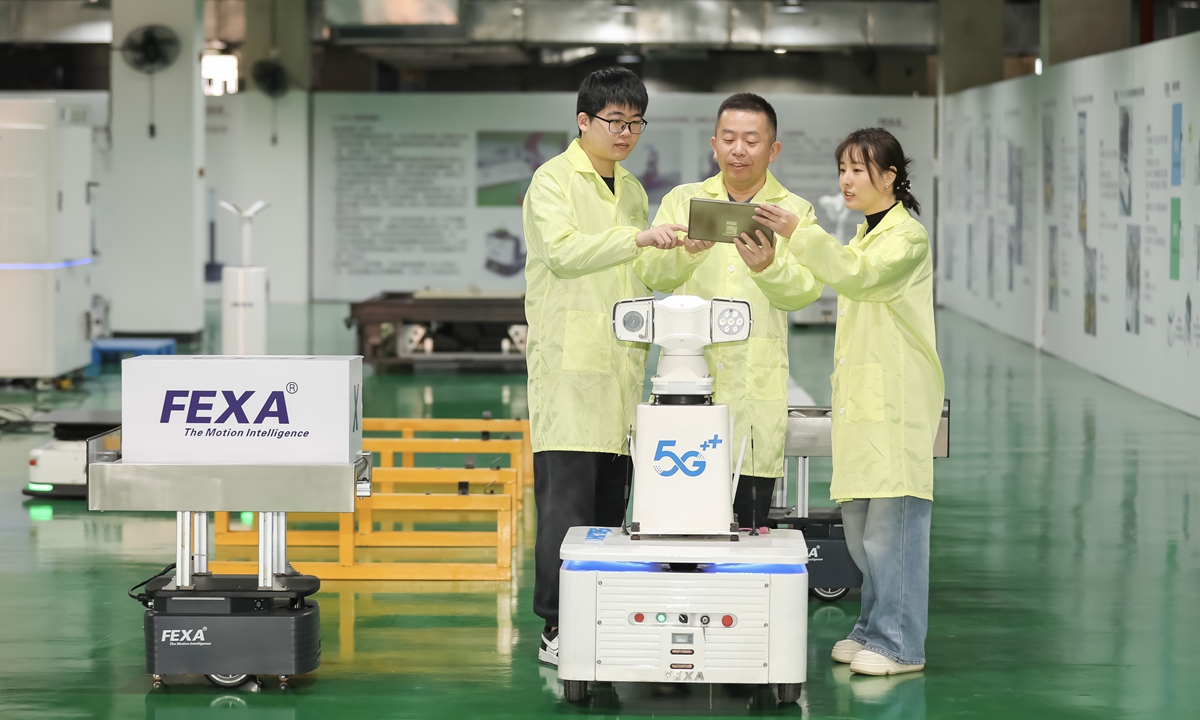
Engineers at a technology company debug a 5G intelligent inspection robot at an information technology application innovation industrial park in Fuzhou, East China's Fujian Province, on February 4, 2026. (Photo: VCG)
China's total trade in intellectual property royalties last year reached 425.35 billion yuan ($59 billion), up 6.7 percent year-on-year, with exports surging 26.3 percent, highlighting the growing momentum of the outbound commercialization of indigenous innovation, a spokesperson of the China National Intellectual Property Administration (CNIPA) said at a press conference on Monday.
The spokesperson said that since 2023, the nation has advanced a targeted and coordinated approach to promote patent commercialization, including activating dormant patents, supporting the growth of small and medium-sized enterprises (SMEs), and strengthening key industrial chains, with all major objectives of the special campaign successfully fulfilled and new momentum injected into the development of new quality productive forces and high-quality economic growth.
Patent development and commercialization are key indicators of a country's innovation capacity and endogenous economic momentum. From a macro perspective, this process is not merely about the flow of technology, but also a reallocation of production factors, said Wang Peng, an associate research fellow at the Beijing Academy of Social Sciences.
The nation's targeted support ensures that research and development output can be smoothly translated into economic value, giving innovation investment a sustainable, endogenous driving force, Wang told the Global Times on Monday.
In 2024, the added value of China's patent-intensive industries exceeded 18 trillion yuan, accounting for 13.38 percent of GDP, with their contribution to economic growth steadily increasing, CNIPA data showed.
In terms of activating dormant patents, a nationwide inventory was completed for 1.349 million patents held by more than 2,700 universities and research institutes, with 680,000 invention patents identified as having strong commercialization potential and matched with 460,000 enterprises, according to the administration.
The administration noted that since the State Council launched the special campaign on patent commercialization in 2023, the role of patent application and commercialization in driving industrial innovation has become increasingly prominent.
Since the campaign was launched, more than 3,000 model SMEs specializing in patent industrialization have been cultivated, with a batch of firms focusing on hard technology and strong patent portfolios growing rapidly.
Wang said that patent commercialization plays a key leveraging role in advancing high-quality development by breaking down barriers between research institutions and market players, enabling cross-sector allocation of technological resources. It helps strengthen technological sovereignty and enhances China's position in the global value chain.
He added that improved commercialization mechanisms lower barriers for SMEs to access innovation, allowing them to compete in niche segments. This broader diffusion of technology enhances overall industrial resilience and supports the transition from factor-driven to innovation-driven growth.