


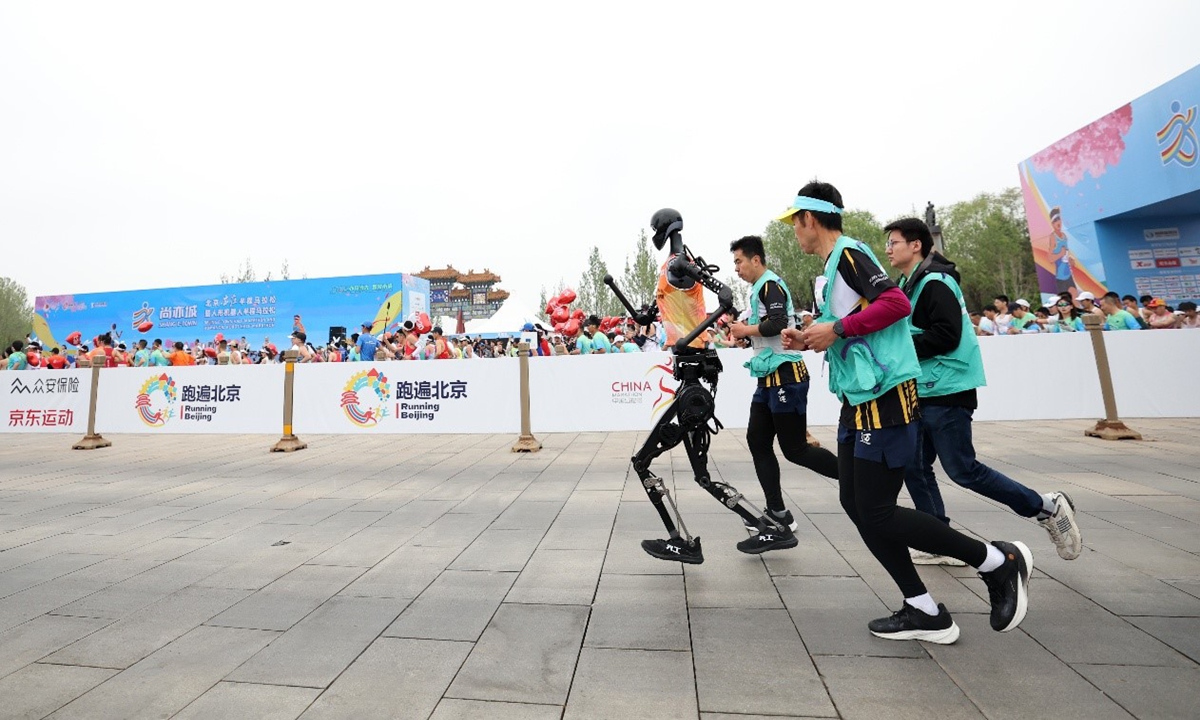
A humanoid robot races in the company of assistants at the humanoid robot half-marathon in Beijing on April 19, 2025. (Photo: Courtesy of Beijing Innovation Center of Humanoid Robotics Co.)
More than 300 units humanoid robots will participate in 2026 Beijing E-Town humanoid robot half-marathon scheduled for April 19 this year in Beijing's Yizhuang, according to the event organizers on Monday.
The race is poised to serve as a showcase for China's rapidly advancing humanoid robotics industry, highlighting the shift from lab research to commercial deployment, said a Chinese expert.
As of March 10, the event, following the world's first edition in 2025, has drawn over 76 entities across 13 provincial-level regions, totaling more than 100 competing teams, said an official at a press conference for the event on Monday. The entries include over 80 corporate teams and more than 20 university and training-camp teams. Altogether the field will feature 26 robot brands and more than 300 humanoid robots, according to Liu Weiliang, deputy director-general and spokesperson of the Beijing Bureau of Economy and Information Technology.
Organizers said this year's robot half-marathon has grown markedly in scale, participation and technical capability. The number of participating teams has increased nearly fivefold and the geographic scope has expanded from five provinces to 13. Twenty universities have registered — ten times the number that entered the first edition — and the industry-university-research integration has deepened through joint laboratories and training-camp cooperation.
For the first time the humanoid robot half-marathon will feature an autonomous navigation group — accounting for 38 percent of participating teams, and a remote control group. To encourage autonomous capabilities, the net times of remote-control teams will be multiplied by a 1.2 coefficient, said Li Quan, deputy director of the Beijing Economic-Technological Development Area Management Committee.
Meanwhile, the 2026 Beijing E-Town half-marathon will be held simultaneously. Robots will follow the same tracks as human runners, according to the organizers.
Robots taller than 75 centimeters are required to complete the full 21.0975-kilometer distance in a single continuous effort. During the race robot competitors will wear BeiDou Navigation Satellite System-powered spatiotemporal intelligence shoulder badges to enable centimeter-level high-precision positioning and real-time location reporting.
Only certified compliant power batteries are allowed for energy, said the organizers. Before the event, a team of humanoid-robotics experts will carry out comprehensive compliance inspections of all competing robots, ensuring fairness from the hardware source.
In addition to the half-marathon race, organizers will introduce a new sub-event called Robot "Baturu" Challenge on April 18, featuring 17 obstacle events designed to test stability and agility and to simulate complex real-world scenarios, including disaster-like conditions, Li said.
Yizhuang, or E-Town, has become a major cluster for robotics and smart manufacturing in China, and is now home to more than 300 enterprises in the sector. The area boasts a robotics industry chain valued at more than 10 billion yuan ($1.39 billion), accounting for half of Beijing's total robotics output, according to the Xinhua News Agency.
This year's event aims to fully demonstrate the robust vitality of China's robotics industry. Builds on lessons from the inaugural humanoid robot marathon in 2025, it highlights a shift from merely "human-led mode" to "full autonomous mode" and from isolated research and development efforts to deep collaboration across the entire industry chain, Wang Peng, an associate research fellow at the Beijing Academy of Social Sciences, told the Global Times on Monday.
The event also reflects advances across China's humanoid robot sector. The rise in robots capable of autonomous navigation points to breakthroughs in environmental sensing and real-time decision systems, signaling advances in real-world mobility and control, Wang added.
This competition also reflects the maturation of domestic humanoid-robot hardware engineering, Wang said, adding that the clear hardware admission standards — requiring robots to have a complete torso, a bipedal structure, and bipedal running capability — indicate that the humanoid-robot form factor has entered a stage of standardization and high performance. Furthermore, it demonstrates the increased resilience and vitality of China's robotics industry and supply chain.
China accounted for more than 80 percent humanoid robot installations globally in 2025, driven by domestic start-ups including AgiBot, UBITECH, Leju and Unitree Robotics, as mass production and commercialization accelerated, according to a report by Counterpoint Research.