


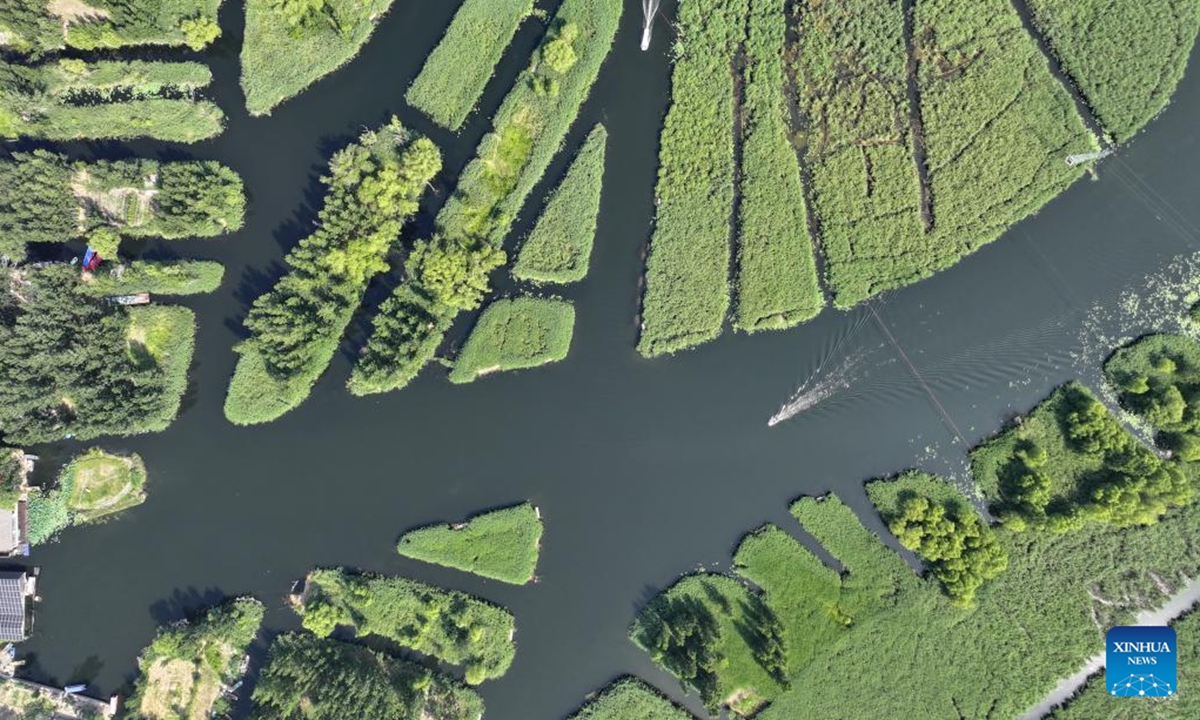
An aerial drone photo taken on June 11, 2025 shows boats sailing on Baiyangdian Lake, Xiongan New Area of north China's Hebei Province. Since the founding of Xiongan New Area, the water quality of Baiyangdian Lake has been greatly improved thanks to the systematic ecological governance. (Photo: Xinhua/Mu Yu)
Editor’s Note:
On March 23, Xi Jinping, general secretary of the Communist Party of China Central Committee, inspected the Xiong'an New Area in north China's Hebei Province. Xi viewed construction progress in the start-up zone. He acknowledged that important progress has been achieved in the construction and development of the Xiong'an New Area.
The establishment of the Xiong’an New Area in Hebei Province is a significant decision and arrangement by the CPC Central Committee with Comrade Xi Jinping at the core to push forward the coordinated development of Beijing, Tianjin, and Hebei.
In April 2017, China officially announced the decision of the CPC Central Committee and the State Council to establish the Xiong'an New Area. Over the past nine years, under the strong leadership of the CPC Central Committee and through the joint efforts of all sides, the construction and development of the Xiong'an New Area have achieved major phased results. Let’s witness how this "city of the future" is forging ahead through four scenes and four sets of data.
Relieving: over 400 branches of central SOEs gather for development
It takes Jing Hao only 15 minutes to get from home to the office.
"Such a short commute is rare in Beijing," said Jing Hao, 32, who works at the Operation Monitoring and Emergency Command Center of China Huaneng Group Co., Ltd. He is responsible for meteorological early warnings, the collection and analysis of earthquake information, and emergency command. Every day after arriving at work, he first carefully checks the national weather early warnings for the day. "Extreme weathers such as heavy fog, thunderstorms and strong winds have a major impact on power facilities. If there is a heavy fog warning, we will guide all stations in the affected areas to seal and dehumidify electronic equipment and insulate pipelines of key facilities," Jing said.
After graduating from North China Electric Power University in 2021, Jing joined China Huaneng. In August 2025, he moved to Xiong'an as part of the effort to relieve Beijing of non-capital functions. Soon after, his wife, child and mother joined him. In October of the same year, more than 1,000 employees from China Huaneng's headquarters and related subsidiaries completed the relocation and began normal office operations in Xiong'an.
"Every day is full of hope and opportunities." For Jing, Xiong'an is not only a promising land for career development but also a happy home to settle down.
His family plans to put down roots in Xiong'an. "We plan to buy an apartment in the second half of the year, and have chosen a location near Beihai Kindergarten in Xiong'an." His child will start kindergarten the year after next, and Jing is full of expectations.
The total developed area of the Xiong'an New Area has reached 215 square kilometers, with 5,345 buildings constructed and total investment exceeding 1 trillion yuan. The headquarters of three central SOEs – China Satellite Network Group Co, Sinochem, and China Huaneng – are operating steadily. The large-scale construction of the first batch of four universities and two hospitals is in full swing. More than 400 branches of various central SOEs have gathered for development in Xiong'an.
QInnovating: 767 firms collaborate on innovation ‘between upstairs and downstairs’
"The secure and reliable intelligent agent developed jointly with partner enterprises has undergone several rounds of updates and iterations, and is expected to generate revenue in the second quarter," Yao Ming, chairman of INSIGHTONE, said, while talking with members of the joint R&D team over lunch at a table in the canteen of the Artificial Intelligence Industrial Park.
INSIGHTONE is a technical services company that specializes in privacy computing and encrypted intelligence. The company relocated to Xiong'an in September 2025, and Yao and his team moved into the Artificial Intelligence Industrial Park.
The park houses more than 60 upstream and downstream enterprises in the artificial intelligence (AI) industry, with partners just a floor or two away. Yao is often invited to technical exchange meetings and demand-matching meetings organized by the management committee of the New Area Science Park and other departments, where participants analyze the market and discuss technologies together.
"As a core application of 'active service' in AI, intelligent agents urgently need a secure and reliable data foundation," Yao said. Through repeated meetings, INSIGHTONE and Xiong'an Huaqing Zhiyan Technology identified market demand, formed a joint R&D team, and launched collaborative innovation “between upstairs and downstairs.”
"In Xiong'an, industrial chain partners can jointly explore market demands and exchange innovative ideas, truly achieving '1+1 > 2'," Yao said, adding that in less than a year, INSIGHTONE has reached cooperation with more than 10 enterprises in Xiong'an.
The Xiong'an Center of Jingjinji National Center of Technology Innovation has been completed and put into use. The China Aerospace Information and Satellite Internet Innovation Alliance has begun operation. The Xiong'an Institute of Space-Time Information and Xiong'an Institute of Artificial Intelligence are under construction. The Xiong'an high-tech development zone has been approved for upgrading to a national high-tech zone.
The Science and Technology Innovation Center Pilot Base, Zhongguancun Science Park and others have begun high-quality operations. A total of 33 themed buildings have signed agreements with 767 innovative enterprises.
Green: water quality of Baiyangdian Lake remains stable at Grade III
As spring arrives, Qiao Yajun, head of the Monitoring Division of the Xiong’an Ecology and Environment Bureau, once again goes to the banks of Baiyangdian Lake to inspect state-controlled monitoring sites and collect samples for aquatic ecological monitoring. In May 2018, Qiao joined the newly established Xiong’an Ecology and Environment Bureau, and has since worked closely with the waters of Baiyangdian, and has fully witnessed the changes in water quality in this "Pearl of North China."
"In the early stages, we conducted a lot of emergency monitoring. When water quality warnings were issued, we often worked through the night to collect samples from the water source, making a trip every few hours," Qiao recalled. With a small team and heavy workload, colleagues often worked all night and stayed up late on the shore of the lake. Later, an intelligent monitoring system was built, and equipment such as boundary early warning stations were put into use. "Intelligent monitoring has improved efficiency, with more timely and accurate data," Qiao said.
As water quality continued to improve, Qiao and his team shifted their focus to deeper aquatic ecological monitoring, a more challenging task. "For example, when mo、nitoring large benthic invertebrates, we need to sort the samples while the organisms are alive for easier identification, so it must be finished on the same day." In the past two years, they have detected clean-water indicator species such as Baetis majus. "The return of these water-dwelling creatures sensitive to water quality is the most intuitive proof of improving ecology," Qiao said. "I will continue to protect Baiyangdian Lake and help build a beautiful Xiong'an with blue skies, green lands and clear waters."
Since the launch of the "Millennium Forest" project in 2017, the Xiong'an New Area has added 483,000 mu of afforested land, raising the forest coverage rate from 11 percent to 35.1 percent. The ecological vision of "access to forests within 3 kilometers, green belts within 1 kilometer, and parks within 300 meters" has gradually become reality. The water quality of Baiyangdian Lake remains stable at Grade III. The number of wild bird species has reached 296, an increase of 90 compared with before the establishment of the new area.
Livability: a 15-minute living circle is gradually taking shapeAt 8 am, after taking her grandson to school, Yuan Yuxin, a resident of the Nanwenying Community in Rongdong District of the Xiong'an New Area, begins her daily walk, strolling through green parks near the community, admiring flowers and trees, and breathing in the fresh air.
Taking such walks has become a new habit for 57-year-old Yuan since moving here. Originally from Xiaowang Village, Dawang Town, Anxin County of Xiong'an New Area, Yuan moved into the current home in 2023.
Moving from a bungalow to an apartment, the improved living environment delights Yuan. "The apartment is finely decorated and very warm in winter," Yuan said. "Not only is the house nice, but look how clean the roads are, and the flowers and trees are watered and trimmed regularly. It's wonderful!"
Having transitioned from a villager to an urban resident, Yuan finds life more convenient. "There is a supermarket just a few minutes' walk away, and my grandchildren's schools are nearby, within a five-minute walk."
Yuan has also become a regular visitor to the community elderly care station, practicing calligraphy and playing ball games in her free time, living a fulfilling life.
Medical services are easily accessible as well. The Xiong'an branch of Xuanwu Hospital is fully operational, bringing high-quality medical resources from Beijing to residents' doorsteps, while community health stations are nearby for routine care. "If I feel unwell, I can go check my blood pressure and blood sugar right away," Yuan said.
Over the past nine years, the outline of a "city of the people" has gradually taken shape. A total of 105 primary and secondary schools and kindergartens, 80 elderly care facilities and 43 community activity centers have been put into operation, and a 15-minute living circle is gradually taking shape. Xiong'an Xuanwu Hospital operates steadily, with cumulative outpatient visits exceeding 520,000. Xiong'an and Beijing have cumulatively achieved integrated handling for 278 items, mutual recognition of 209 qualifications, and mutual recognition of 40 electronic certificates and licenses.