


The rapid advancement of robotics technology and the expansion of application scenarios are giving rise to a new form of consumption: robot rentals.
Among the early trendsetters is ZeNexus, an immersive robot experience store covering about 500 square meters that opened inside a Mercedes-Benz dealership in Beijing's Chaoyang district. The venue brings together products from several leading robotics companies, including Unitree Robotics and UBTECH. It features a full-lifecycle service system that integrates product display, rentals and sales, after-sales service, and user feedback.
According to Han Yunfei, general manager of the robot operations and management division at the Beijing-based Boshi Group, placing ZeNexus inside the dealership was a natural convergence between a traditional retail and a rising industry. Robots have improved the service experience and added value to the showroom, while car buyers now enjoy the novelty of interacting with robots, boosting customer satisfaction. Since the store opened, foot traffic at the dealership has risen by roughly 15% month-on-month.
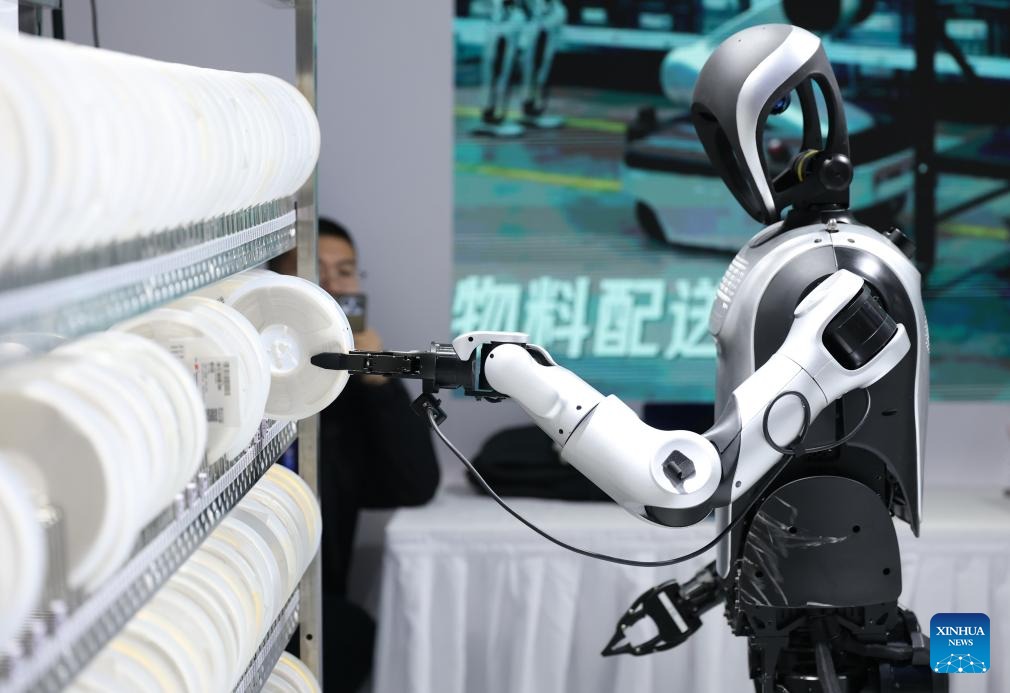
A robot grabs an item during the International Sci-Fi and Future Tech Expo Beijing 2026 in Beijing, capital of China, March 27, 2026. (Photo: Xinhua/Zhang Chenlin)
Among the products on display, household robots priced under 10,000 yuan (about $1,450) have maintained relatively steady sales, while professional-grade models, which can cost anywhere from the tens of thousands to several hundred thousand yuan, are more commonly entering the market through renting.
Han said current rental demand mainly comes from scenarios such as companies' annual events, shopping mall promotions, exhibition displays, weddings, and educational activities.
While physical experience stores remain in their early stages, data from online platforms show even stronger momentum in robot rentals.
Dai Fu, who oversees self-operated rental services under JD Retail's 3C digital retail division, said the company’s offerings now span humanoid robots, robot dogs, and exoskeleton robots. The customer base is also shifting from primarily tech enthusiasts to enterprises and everyday consumers. Current orders are concentrated in first-tier cities such as Beijing, Shanghai, and Guangzhou, but demand is steadily expanding nationwide.
Platform data from January 2026 shows that transaction volume for JD's self-operated robot rentals surged by more than double month-on-month, with some popular models booked out until mid-March.
"This trend became even more pronounced during the Spring Festival holiday," Dai said. "From New Year's Eve to the fifth day of the Chinese New Year, searches for JD's robot rentals increased about threefold compared to average traffic numbers, inquiries quadrupled, and order volume doubled month on month." During the Lantern Festival, many businesses rented robots on JD's platforms for live performances and interactive events.
Rental fees vary widely by robot type. For performance-oriented models, ZeNexus charges around 20,000 yuan per day for a piano-playing robot ensemble equipped with high-precision dexterous hands, while robots of the same type as Unitree's products featured in the CCTV Spring Festival Gala rent for between 5,000 and 6,000 yuan per day.
Han noted that China's robot rental market is still in an early stage of development, but continuous product upgrades and increasingly diverse application scenarios will support steady growth.
"What is worth noting is that beyond performance-related demand, robots are making faster inroads into everyday life. Commercial promotions, tourist-site interactions, teaching assistance, and even household companionship are all showing increasing demand for robots," Dai said.
In Dai's view, the surge in robot rentals is more than a seasonal spike. As technology evolves and public familiarity deepens, robots are expected to become more integrated into diverse scenarios in the years ahead.