


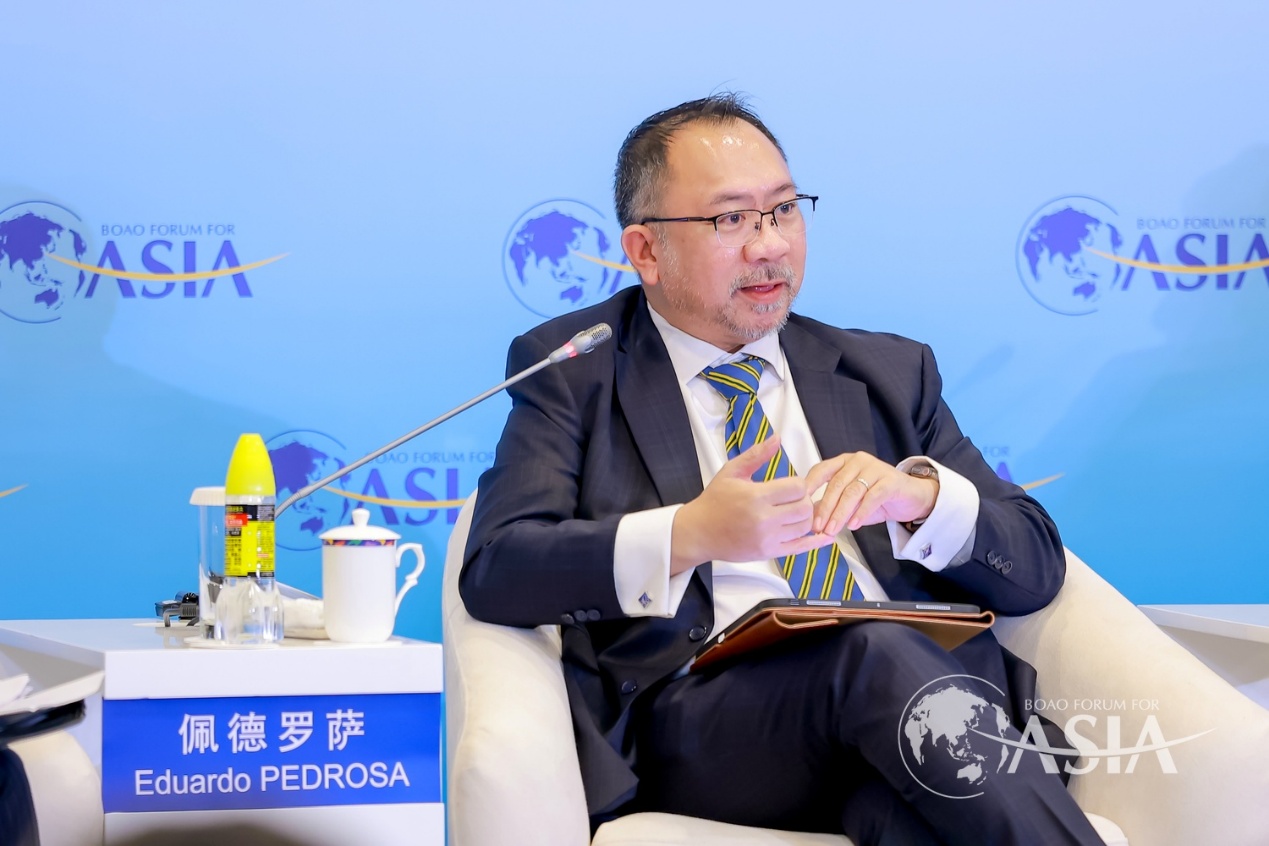
Eduardo Pedrosa, executive director of the APEC Secretariat, speaks on March 25, at the Boao Forum for Asia 2026 Annual Conference in Boao, south China's Hainan Province. (Photo provided by the Boao Forum for Asia)
For Eduardo Pedrosa, executive director of the APEC Secretariat, the timing of China's turn as APEC host could hardly be more significant. Speaking to reporters at the Boao Forum for Asia 2026 Annual Conference on March 25, Pedrosa was candid about the state of the world: uncertainty is high, trade tensions are real, and the multilateral system is under strain. But his overall message was one of quiet confidence, and China, he suggested, is at the center of why.
"Today there is a lot of instability in the world," he said, "and APEC can provide a platform for leaders to come together and discuss the challenges we face." That platform, he argued, is more valuable precisely because of the turbulence surrounding it. When the world's two largest economies are both present in the same room, alongside members spanning Asia and Latin America, the conversations that happen, even the informal ones, carry weight.
China's hosting of the 33rd Asia-Pacific Economic Cooperation (APEC) Economic Leaders' Meeting in Shenzhen this November comes at a moment of genuine consequence. Pedrosa pointed to several reasons for optimism. Intra-regional trade among APEC members continues to grow. China's 15th Five-Year Plan (2026-2030), which he described as laying out a clear and detailed vision for the next five years, signals that the world's second largest economy is not retreating but deepening its engagement. As the world's second largest consumer market and import destination, he said, China represents a significant opportunity for trading partners across the region and beyond.
On the Hainan Free Trade Port, whose 100th day of island-wide special customs operations fell during the forum itself, Pedrosa saw a natural point of connection with APEC's own work on trade facilitation. Reducing barriers, streamlining processes, and making it easier for smaller businesses to participate in cross-border trade are goals the two share. He noted that for small and medium enterprises in particular, the complexity of compliance can be a greater obstacle than tariffs themselves, and that simplifying those processes is where real gains for ordinary businesses and people are often found.
On supply chain resilience, Pedrosa was clear that the days of taking interconnected global supply chains for granted are over. The lesson businesses and governments have learned in recent years is the danger of over-concentration, and the imperative of building more diversified, more resilient networks. That lesson is more urgent now, not less, and APEC's work on supply chain connectivity and infrastructure bottlenecks is aimed squarely at giving member economies the tools to respond.
Looking at Asia's broader trajectory, Pedrosa was expansive. He traced a long arc: historically, the world's largest economies were Asian, and the technological and demographic forces shaping the present moment are bringing that center of gravity back. He invoked the image of geese flying in formation, each economy lifting the next, from Japan to South Korea and now to China, with others following in their wake. The Asian Century, in his telling, is not a future aspiration. It is already underway.