


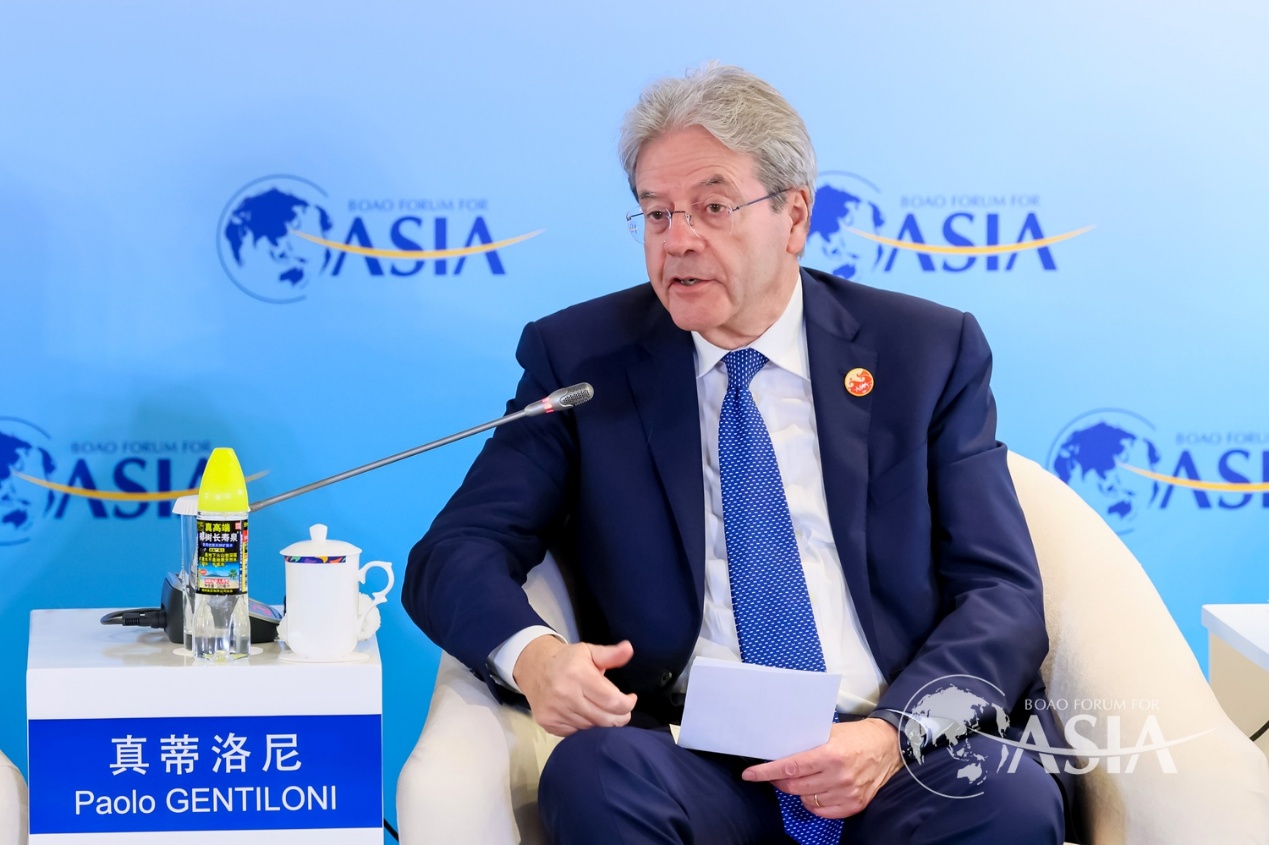
Paolo Gentiloni, former prime minister of Italy and former European commissioner for the economy, speaks at the Boao Forum for Asia 2026 Annual Conference in Boao, south China's Hainan Province. (Photo provided by the Boao Forum for Asia)
Paolo Gentiloni, former prime minister of Italy and former European commissioner for the economy, struck an optimistic note on China-EU trade relations during a group interview on the sidelines of the Boao Forum for Asia 2026 Annual Conference on March 26, calling the two economies natural partners in defending an open, rules-based global trading system.
Attending the Boao Forum for Asia for the first time, Gentiloni said the event offered a timely opportunity to explore areas of shared interest between Europe and Asia at a moment of mounting global trade uncertainty.
Two giants with a common stake
Gentiloni opened by drawing a clear distinction between the economic orientations of the EU and China on one hand, and the United States on the other. While Washington can afford to turn inward given the scale of its domestic market, he argued, both China and the European Union are fundamentally trade-dependent economies, and that shared reality creates a strong foundation for cooperation.
"For us and for China, trade is very important," he said, adding that both sides have a common interest in keeping global markets open and resisting the pull of protectionism, trade wars, and tariff escalation. He also called for keeping the World Trade Organization alive and functional as a mechanism for resolving trade disputes, describing it as an indispensable referee in an increasingly contested global economy.
Addressing the imbalance constructively
Gentiloni acknowledged frankly that the China-EU trade relationship is not without friction. The EU currently runs a deficit of around 300 billion euros with China, a gap he described as significant and in need of constructive management.
Rather than pointing to tariffs as the default answer, he proposed two forward-looking directions. The first, he noted, is already embedded in China's 15th Five-Year Plan (2026-2030): expanding domestic consumption. If China produces more for its own market, he explained, its export volumes will naturally moderate, helping to gradually rebalance the trade relationship without confrontation. The second direction involves building new pillars of mutual benefit, including increased Chinese investment in Europe and deeper exchanges in strategic areas such as rare minerals. Individual European member states, he suggested, can serve as practical entry points for this kind of deeper engagement, particularly in areas like green transition and industrial cooperation where European and Chinese strengths are complementary.
A call for multilateral leadership
Beyond the bilateral relationship, Gentiloni urged China to use its global economic weight to champion multilateralism at a moment when the United States is retreating from that role. He suggested that China deepening cooperation across Asia, not only with ASEAN nations but also with Japan and India, could serve as a model of regional economic integration with broader global resonance.
He also cautioned that the world is at risk of sliding from a rules-based trading order into what he called the "weaponization" of the global economy, where economic relationships are dictated by power rather than agreed principles. Averting that outcome, he argued, requires active commitment from major economies on all sides.
Reflecting on the forum's theme of shaping a shared future through new cooperation, Gentiloni closed on a forward-looking note, calling for dialogue over blame. The priority, he said, is not to point fingers at who is responsible for today's disorder, but to work together toward a more stable and cooperative global order, one in which China and Europe both have a central part to play.