


Revised foreign trade law boosts China's drive towards trader of quality
China's newly revised Foreign Trade Law officially came into effect on March 1, 2026. The legislation aims to strengthen legal safeguards as China accelerates its transformation into a trader of quality. The revision reflects China's specific conditions while aligning with international rules and practices.
The revision aims to advance high-standard opening up, promote high-quality development of foreign trade, maintain foreign trade order, and protect the legitimate rights and interests of foreign trade dealers.

Workers are busy fulfilling export orders at an electromechanical manufacturing company in Suqian, east China's Jiangsu province. (Photo: People's Daily)
China currently ranks first in global trade in goods and second in global trade in services, with new business forms such as cross-border e-commerce and digital trade developing rapidly. At the same time, the domestic and international environment for China's foreign trade has undergone profound changes.
An official from the Legislative Affairs Commission of China's National People's Congress Standing Committee emphasized the critical importance of expanding high-standard opening up and building China into a trader of quality for advancing Chinese modernization. "The rule of law and opening up are intrinsically linked," the official stated. "Progress in opening-up must be matched by corresponding advancements in the rule of law concerning foreign-related matters."
The official highlighted that the revision incorporates reform achievements into the legal framework, optimizes the foreign trade environment, and enhances China's legal mechanisms for addressing trade challenges.
A key highlight of the revision is the clarifying China's foreign trade direction. The revised law adds provisions to advance China's efforts to become a trader of quality and safeguard a fair and just international economic and trade order. It also encourages the development of international trade in services across multiple modes.
More specifically, the revised law sets out provisions on proactively aligning with high-standard international economic and trade rules, actively participating in the formulation of such rules, upholding the multilateral trading system, and safeguarding a fair and just international economic and trade order. It mandates the establishment of a trade policy compliance mechanism aligned with internationally accepted rules.
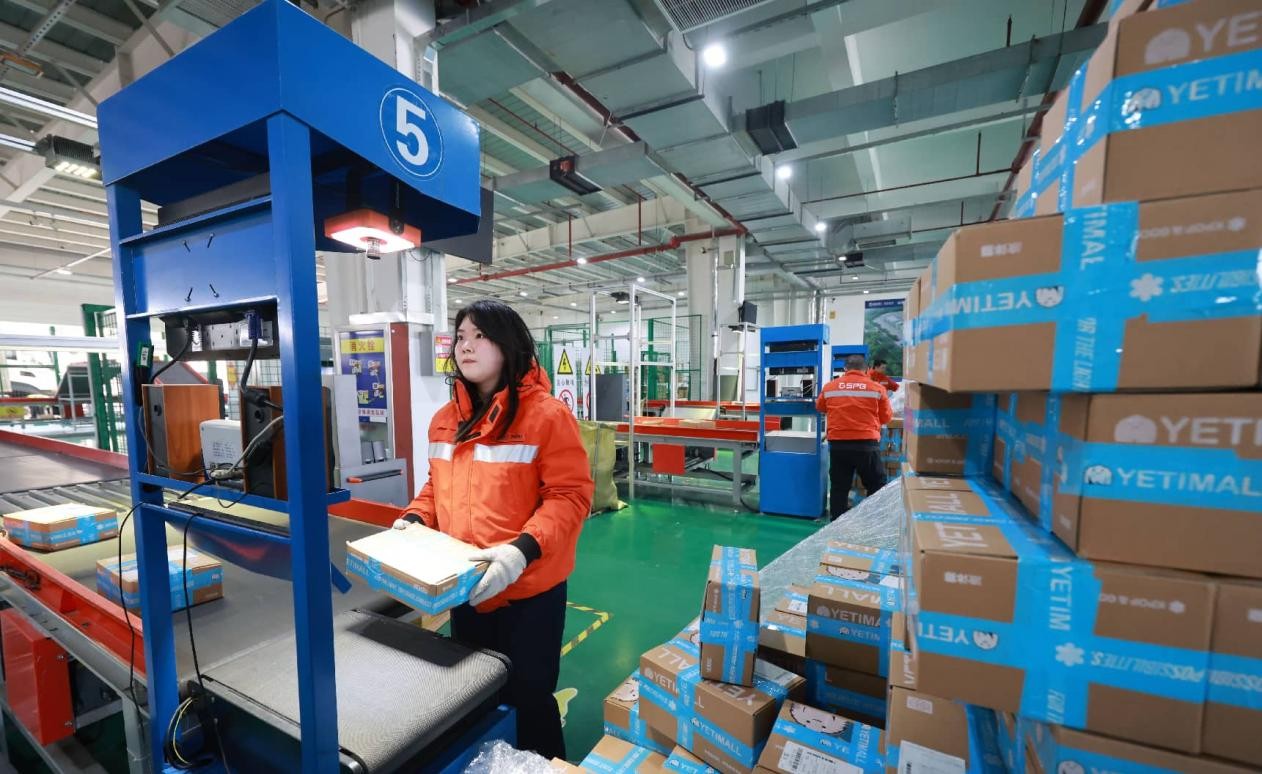
Workers sort parcels for cross-border e-commerce shipments at the Weihai Logistics Park of Shandong Port Land-Sea International Logistics Group Co., Ltd. in east China's Shandong province. (Photo: People's Daily)
It integrates reform measures into the legal framework, including the implementation of a negative-list management system for cross-border trade in services, and support for the construction of trade promotion platforms and international transport corridors, the development of new business forms and modes of foreign trade, the digital transformation of trade, and the promotion of digital and green trade.
These changes, responding to new developments and changes in the foreign trade landscape, has drawn widespread attention from foreign trade practitioners, particularly provisions on trade promotion platforms and international transport corridors.
In the Langfang Airport Economic Zone of Beijing Daxing International Airport in north China's Hebei province, the global cross-border e-commerce (Beijing-Tianjin-Hebei) "three centers" integrate an ecosystem hub, a transaction services center, and a digital supply chain center, providing comprehensive support and services for cross-border e-commerce worldwide.
Major platforms like Amazon and Shopee have already joined, fostering an ecosystem focused on platform enablement, business incubation, talent development, and industrial cluster coordination. Such platforms are expected to play a growing role in China's foreign trade.
As a key node in China's international transport corridor network, the Ningbo-Zhoushan Port in east China's Zhejiang province has strengthened its sea-rail intermodal transport capabilities. Its services now cover 67 prefecture-level cities nationwide. The port continues to expand its global network, connecting with over 600 ports worldwide, and ranks second globally on the port connectivity index.
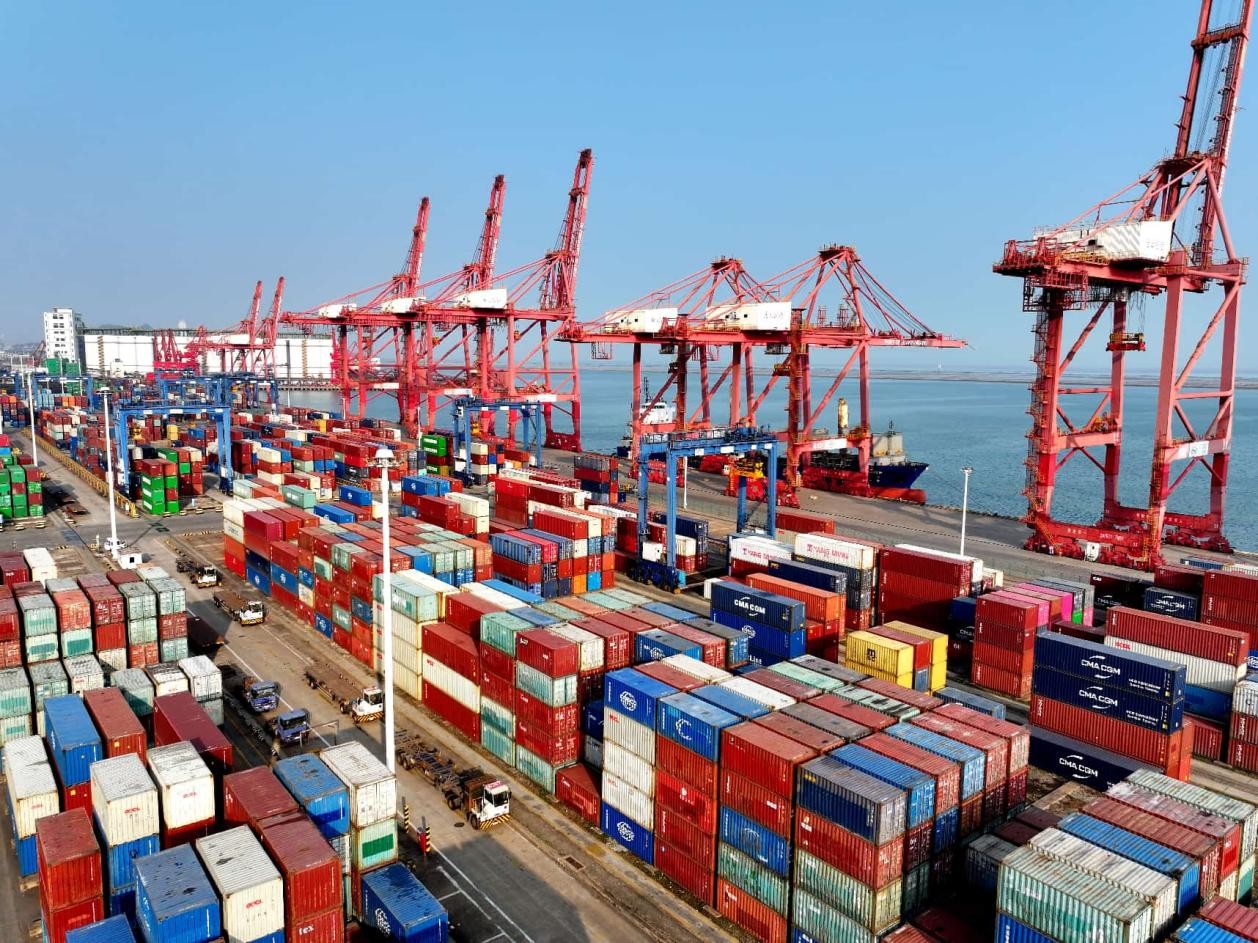
Photo shows foreign trade containers at the container terminal of Lianyungang Port in east China's Jiangsu province. (Photo: People's Daily)
In northwest China's Gansu province, cargo volume at the Gansu (Wuwei) International Land Port surged 100 percent year on year in the first month of this year, driven by accelerating construction of the China-Kyrgyzstan-Uzbekistan international transport corridor.
The revised law calls for diversified and resilient international transport corridors, which will provide lasting support for the high-quality development of foreign trade.
As Chinese companies deepen their involvement in global trade, foreign-related intellectual property (IP) disputes have become an increasingly pressing concern. The revised law clarifies that China will strengthen IP protection related to foreign trade, build and improve a platform for early warning of international risks regarding IP rights and for providing assistance in defending rights, and enhance the IP compliance standards and risk-management capabilities of foreign trade operators.
Data from the China National Intellectual Property Administration show that by the end of 2025, the country had established 99 overseas IP dispute response guidance platforms across the country, six industry-specific platforms focusing on key sectors such as automobiles and solar power, and overseas working platforms in 11 countries. In 2025, relevant platforms provided guidance and consultation services for enterprises more than 4,800 times, addressing cross-border e-commerce IP disputes and overseas trademark squatting and helping recover losses totaling 2.75 billion yuan (about $398.97 million).
In response to actions by certain countries involving repeated use of "sanctions" and "investigations" targeting Chinese foreign trade enterprises, the revised law also enhances China's legal mechanisms for addressing trade disputes. It supplements and refines corresponding countermeasures. Industry experts suggest these institutional arrangements will bolster the confidence of foreign trade entities in navigating international trade disputes and managing associated risks.