


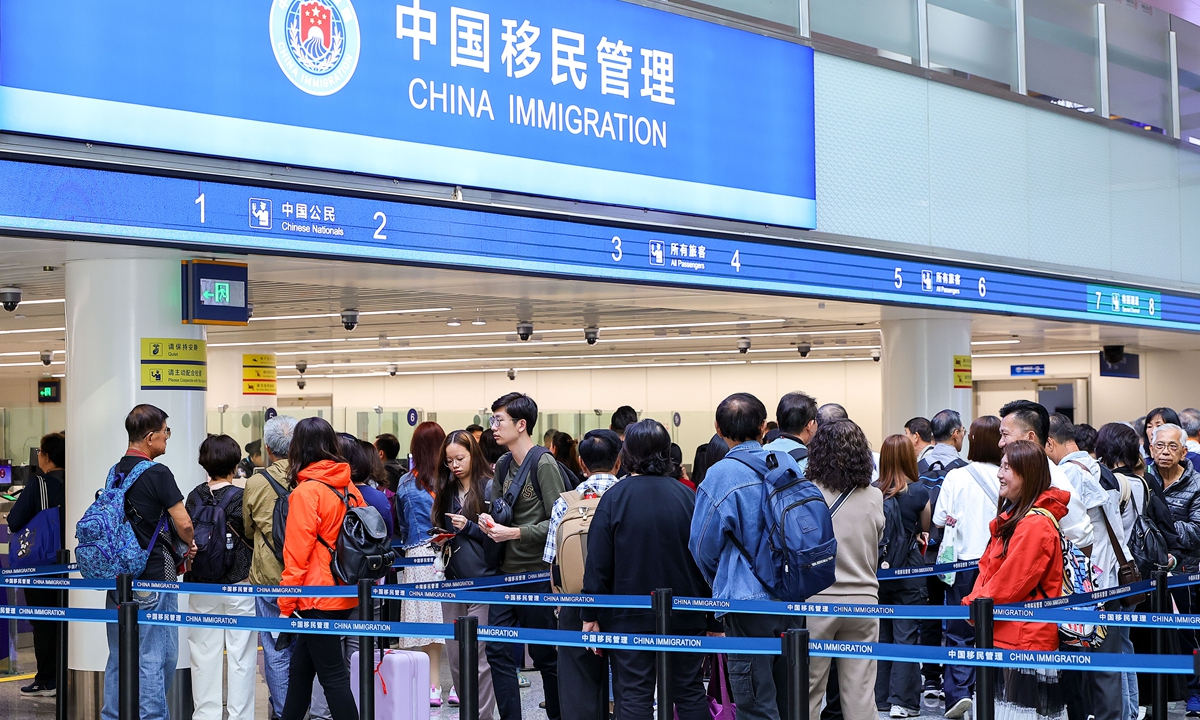
Inbound travelers line up for customs clearance at Haikou Meilan International Airport in South China's Hainan Province on March 17, 2026. (Photo: VCG)
Daily border crossings nationwide during the Qingming Festival holiday from April 4 to April 6 are expected to exceed 2.3 million, up 11.1 percent year-on-year, the National Immigration Administration said on its official website.
The Qingming Festival holiday, a traditional time for returning home to honor ancestors, has long been a peak period for spring outings and enjoying the season. This year, the overlap of school spring breaks in multiple regions and a five-day holiday in Hong Kong and Macao is expected to further boost cross-boundary travel during the holiday.
Observers said that China's visa-friendly policies are gaining reciprocal responses from travelers, helping boost holiday spending in popular inbound destinations. Many regions have made upbeat projections for inbound tourist arrivals during the holiday.
During the Qingming holiday, Hangzhou expects sustained high volumes of cross-border passenger traffic at its ports.
The port is expected to handle more than 250 passenger flights from April 4 to April 6, up 5.5 percent year-on-year. Daily passenger throughput is projected to peak at about 16,000, with total traffic nearing 45,000, up more than 16 percent year-on-year, local media outlet Daily Business reported on Wednesday.
Travelers from China's Hong Kong, Macao and Taiwan, as well as Singapore and Malaysia, are expected to rise significantly, reaching nearly 10,000, up more than 30 percent from previous years.
On Tuesday, Northeast China's Jilin Province outlined expected inbound travel during the Qingming holiday. At Changchun port, 18 cross-border passenger flights are scheduled to and from Hong Kong, Seoul, and Tokyo, with total arrivals and departures projected to exceed 3,000 from April 4 to 6, according to the official WeChat account of the province's border inspection headquarters on Wednesday.
At Yanji port, about 32 passenger flights to and from Seoul are planned, with cross-border passenger flows expected to surpass 6,000, and daily traffic exceeding 2,200, the account noted.
At the end of 2024, China extended the visa-free transit stay to 240 hours and expanded the number of eligible entry ports to 60.
In the first year since the policy was implemented, inbound foreign arrivals through ports nationwide reached 40.6 million as of December 16, 2025, with the number of travelers using the 240-hour visa-free transit policy rising 60.8 percent year-on-year, the People's Daily reported on Tuesday.
As China continues to expand its visa-free policies, many popular overseas destinations for Chinese tourists have introduced corresponding preferential measures to attract more Chinese visitors.
South Korea has eased requirements for multiple-entry visas for Chinese visitors, Seoul's diplomatic mission in Beijing said on Tuesday, in line with efforts to attract more tourists and enhance convenience for business travelers, the Korea Times reported on Wednesday.
The Korea Tourism Organization said that it had carried out promotional campaigns in China, its largest inbound tourism market, from March 23 to 28, aiming to boost travel demand through deeper platform cooperation, expanded flight networks and cruise development, the Yonhap News Agency reported on Monday.
Two-way opening-up has become a key trend in regional tourism development, with China expanding visa-free access while neighboring countries ease visa policies and roll out targeted measures to attract Chinese travelers, creating policy synergies that will help accelerate the recovery of cross-border tourism, Zhang Yi, CEO of the iiMedia Research Institute, told the Global Times on Wednesday.
He added that competition for Chinese tourists is intensifying, with destinations such as South Korea and Southeast Asia competing directly in visa facilitation, flight connectivity and tourism products.
"The short-haul cross-border travel market is likely to enter a more competitive phase," Zhang said, noting that cooperation is gaining momentum.
"In areas such as reciprocal tourist flows, route connectivity and multi-destination travel, regional coordination will accelerate, shifting the market from competing for a single source of tourists toward a more integrated, win-win development model."