


Chinese humanoid robotic company offers annual salary up to $18 million to recruit chief scientist, setting one of the highest payrolls in the industry
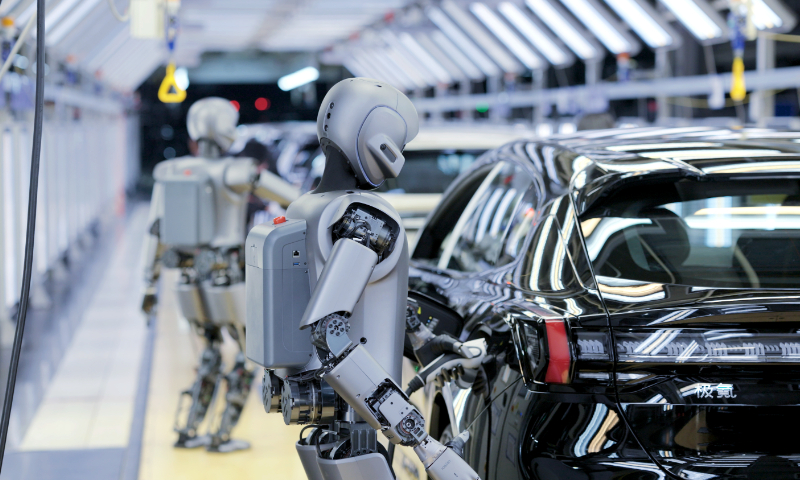
Dozens of UBTECH industrial humanoid robots carry out training tasks at a smart factory in the Qianwan New Area in Ningbo, East China's Zhejiang Province, on March 1, 2025. (Photo: VCG)
Chinese humanoid robotic company UBTECH has released an eye-catching global recruitment notice for its chief embodied intelligence scientist, offering an annual salary between 15 million yuan ($2.18 million) and 124 million yuan ($18 million), the Hong Kong-listed company confirmed with the Global Times on Friday. The highest offering could reportedly set one of highest payrolls for top talent in Chinese robotics sector.
The highest salary of 124 million yuan is equivalent to the annual fiscal revenue of a medium-sized Chinese township or a small county-level city. It also reportedly matches the salary levels of top scientists at global tech giants such as OpenAI and Meta. According to the IPO prospectus of another Chinese humanoid robot company Unitree Robotics, the company's founder, CEO, and CTO, Wang Xingxing, earned an annual salary of 2.5 million yuan.
"This is the ceiling for working-class professionals… The chief embodied intelligence scientist we're looking for is not only a trailblazer in the company's technology but also a true game-changer in the humanoid robotic industry," reads a post on UBTECH's Wechat account.
The Global Times learned that the salary offer will be structured as a combination of cash, benefits, and equity.
"This position - as a leader in technological exploration and a driving force in turning vision into reality - will define UBTECH's technology roadmap in the fields of humanoid intelligence and embodied intelligence," the company's spokesperson told the Global Times on Friday, while stressing that the rapid development of an enterprise cannot be achieved without the solid support of a strong pool of outstanding talent.
The role will lead groundbreaking research in core areas such as vision-language-action models, foundational robot models, manipulation and dexterous skill learning. It will drive the transition of cutting-edge embodied intelligence technologies from the laboratory to real-world applications, accelerate the large-scale deployment of humanoid robots across diverse scenarios including intelligent manufacturing, commercial services, and home companionship, and truly fulfill the mission of "bringing intelligent robots into millions of households," the spokesperson said.
The company also opened a series of high-end positions to build a comprehensive technical talent network, including reinforcement learning algorithm engineer, senior hardware engineer, EtherCAT Master Station Development Engineer, Mechanical Engineer, and Rust Development Engineer.
The recruitment comes as China's humanoid robot as well as embodied intelligence industry has been in a fast-lane development and reached a critical juncture of technological breakthrough. In domestic market, embodied intelligence industry has entered a golden window period for explosive growth and is included in the Government Work Report for consecutive two years. In global market, humanoid robots - as the best carrier for embodied intelligence - have been placed at the core arena of global tech rivalry, the UBTECH spokesperson said.
In addition to UBTECH, both Chinese and US humanoid robot firms have been ramping up efforts to recruit top talents. According to a report by the Securities Times, US company Tesla on March 25 has issued a specialized recruitment notice for its Optimus humanoid robot via its official channels, seeking over 80 talents in artificial intelligence, engineering, and manufacturing. The announcement stated that Optimus will reshape the economic landscape of the labor force and manufacturing industry, with the goal of achieving large-scale mass production of Optimus as soon as possible.
"The industry still faces a number of technological difficulties in key areas including core algorithms, foundational models, and dexterous manipulation. A top talent will be able to steer the technology direction, drastically shorten the development cycle, and reduce the trial-and-error cost," Wang Peng, an associate research fellow at the Beijing Academy of Social Sciences, told the Global Times.
He added that against the backdrop of increasingly white-hot competition, the top technological design will also accelerate the mass production and commercialization process.