


US car buyers warm up to Chinese EVs
US consumers — especially younger drivers — are increasingly open to buying Chinese-made electric vehicles, even as steep tariffs and other restrictions keep them out of the market.
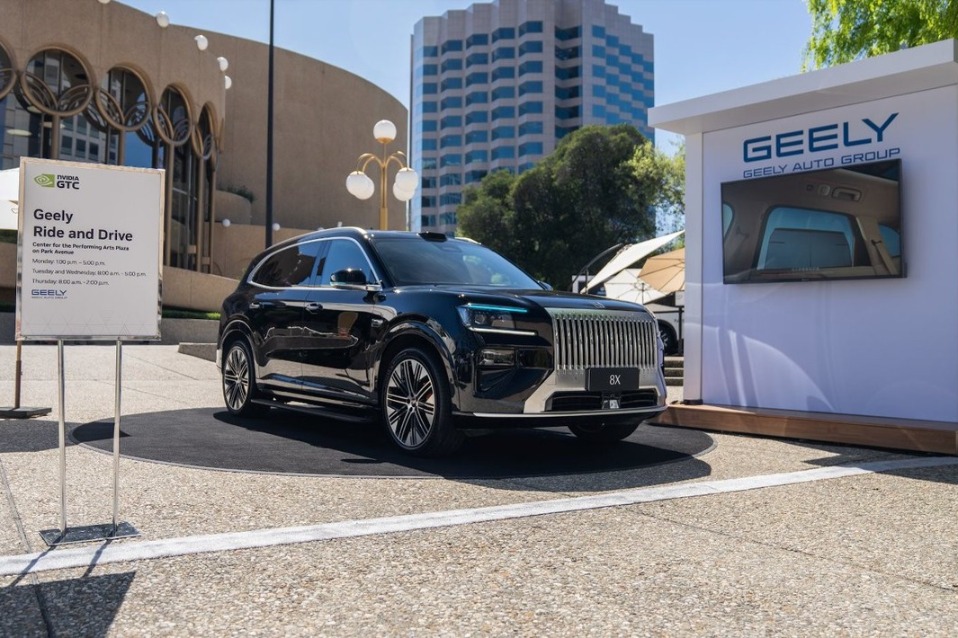
Photo via China Daily
The auto market in the US is currently closed off to EVs made in China after the US government under former president Joe Biden effectively banned them by placing a hefty tariff of over 100 percent on them to "protect American jobs." There are also federal restrictions on Chinese vehicle technology.
But a growing number of Americans say they are intrigued by Chinese EVs' design, features and relatively low prices, a perception fueled in part by positive reviews circulating on YouTube and TikTok.
Interest has been further reinforced by rising fuel costs linked to the US-Israel war with Iran, as well as the high price of electric vehicles at home. The average transaction price for a new EV in the United States reached $57,245 last year, according to the Kelley Blue Book.
Sarano LaGrande, 72, from New York, told China Daily: "I'd be interested in driving a Chinese electric car, because I'd hope that it would save me gas. I've seen these cars all over the internet on my computer and social media and I like the way they look.
"Of course, Americans should have access to the cars, why not? They're beautiful cars, not too expensive, too. I would enjoy driving one because it's something new in the city. Many people ain't got that. They make some nice cars, and the price is reasonable prices. Many of our cars (in the US) are for $30,000 and up, that's too much."
Bill Russo, founder and CEO of Shanghai-based investment advisory firm Automobility Limited, is clear what sets Chinese EVs apart from other cars.
"Chinese EVs are differentiated primarily by speed, cost competitiveness and integration of digital technologies. Brands like BYD, Geely (including Zeekr), Xiaomi and NIO stand out for different reasons: BYD for vertical integration and scale, Geely for global positioning, Xiaomi for its digital ecosystem, and NIO for premium user experience and services," Russo said.
"As for the US market, technically yes — these vehicles could be competitive. However, geopolitical and regulatory barriers, including tariffs and national security concerns, make large-scale entry into the US challenging in the near term," he added.
Among Americans, the potential adoption of Chinese cars appears to be stronger depending on a driver's age group, Cox Automotive — a firm that provides forecasts on the new and used vehicle markets — found in its Dec/Jan poll.
"Consumer sentiment toward Chinese auto brands is sharply divided," Cox said in its report. "Younger, EV-oriented shoppers show meaningful openness, while older and domestic-loyal buyers remain resistant."
Beau, 59, from Alabama, who declined to give his surname and currently drives a gasoline-powered Porsche (made in Europe), said he would be reluctant to drive a Chinese-made car over a European or US-made one.
However, at least 69 percent of Generation Z (aged 14 to 29) car shoppers polled by Cox Automotive between Dec. 29 and Jan. 2 said that they were "more likely" to consider Chinese auto brands than others.
In China, at least 100 domestic EV companies are jostling for poll position with customers. The industry has developed rapidly after receiving large investments and support for a few decades. It is now eying further expansion abroad.
China, the world's largest auto producer and exporter, has expanded EV sales into Europe and Latin America, and is beginning to enter markets such as Canada.
Canada became the latest country to allow EVs from China into their market, by cutting tariffs to 6.1 percent on the 49,000 quota Chinese EVs initially brought into the country annually.
In Mexico, which allows imports of the EVs, Chinese automakers are looking into acquiring factory space in the region, Reuters reported.
But in the US, where Tesla is a market leader in EVs, auto trade groups urged the Trump administration in a March 12 letter to prevent Chinese automakers from entering the domestic market.
China's automaker BYD sold more EVs than Tesla worldwide in 2025.
Trump, however, has hinted that he is open to allowing China's automakers into the US in the next two years if they use American factories and workers. "Let China come in," Trump said in a speech at the Detroit Economic Club in January.
Tony Jackson, 68, originally from Missouri but now living in New York, told China Daily: "I'd be interested in a car made in China, if it was a well-made car. For me, the most important thing when buying a car is that the metal does not bend up if I get into an accident. It must have good support beams.
"Here in New York City, if you're going to drive an electric vehicle, you have to have some place to charge it. That's really important. They have plenty in California, not so many here. The US should be open to allowing the cars from China here, because it's for the people in America. If it's good prices, and good vehicles, that's perfect."
Among dealerships, Cox Automotive's survey found that 15 percent of dealers supported Chinese auto brands coming into the US.
Russo added: "In the near term, it is unlikely that Chinese EVs will be widely available in US dealerships due to policy constraints. That said, if those barriers were reduced, Chinese EVs would likely be well received by consumers based on their value proposition — high feature content at competitive prices."