


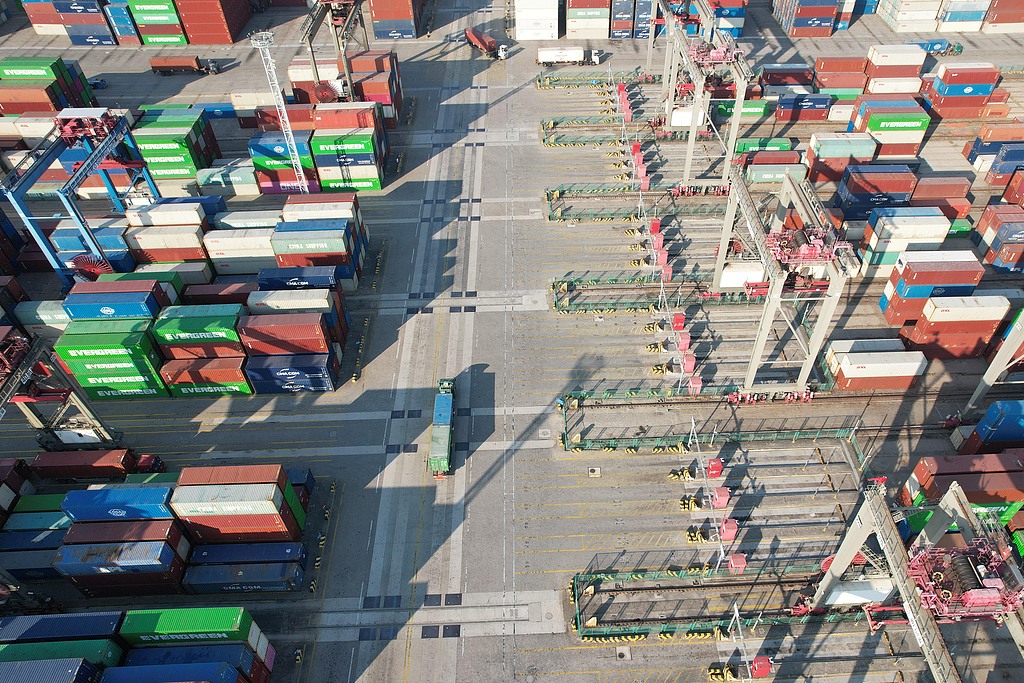
Transport vehicles shuttle at Xiamen Ocean Gate Container Terminal, Xiamen, Fujian Province, China, January 4, 2026. /VCG
Editor's note: Wang Xiaolei is an assistant researcher at the Institute of State System Research and School of Economics of Zhejiang University. The article reflects the author's opinions and not necessarily the views of CGTN.
Amid growing complexity in the Taiwan Strait, cross-Strait economic and trade relations are undergoing deep structural adjustments. Despite geopolitical uncertainties, economic interdependence continues to deepen, due to strong market complementarities.
From Taiwan region's perspective, its economic reliance on the mainland has reached unprecedented levels, with the mainland serving as a key external growth engine. Official data shows that the mainland's cumulative trade deficit with Taiwan region from 2014 to 2025 exceeded 10 trillion yuan (approximately $1.4 trillion), with the annual average exceeding 1 trillion yuan (approximately $140 billion). These figures highlight both the depth of trade integration and the mainland's pivotal role in Taiwan's export economy.

A wafer displayed at the Semicon Taiwan exhibition in Taipei, China's Taiwan region, September 10, 2025./ VCG
Yet close ties face several challenges. The island's industries have polarized, concentrating heavily in high-tech sectors like semiconductors. This has increased supply chain fragility and vulnerability to external shocks. Meanwhile, rising costs — labor, energy, and logistics — are eroding Taiwan firms' competitiveness, underscoring the need for more diversified, resilient cross-strait cooperation.
China's 15th Five-Year Plan reaffirms support for policies benefiting Taiwan compatriots and enterprises. It also calls for expanding cross-strait financial markets and capital channels, creating space for deeper industrial ties. This positions industrial synergy and market integration as key drivers for shared development during modernization.
A practical pathway: The cross-Strait production network
Building cross-regional production networks offers a concrete way forward. The mainland boasts the world's most complete industrial system, ample energy reserves, and stable commodity supplies. Taiwan excels in precision manufacturing, green tech, and digital economy, with a higher per capita GDP and top global innovation rankings.
A cross-Strait network leverages these complementarities: Taiwan firms gain from the mainland's full industrial chain and market scale, while the mainland boosts productivity via Taiwan's tech expertise. For example, WUS Printed Circuit (Jiangsu), a Taiwan-funded firm, combines Jiangsu's manufacturing base with Taiwan's precision R&D talent to enhance competitiveness.
Regionally differentiated approach
Mainland should promote integration based on local strengths. The Fujian Cross-Strait Integration Zone can eliminate institutional barriers. The Yangtze River Delta and Pearl River Delta provide industrial and talent advantages, while central and western regions offer vast markets and computing infrastructure. This regionally differentiated, market-driven approach embeds Taiwan deeply into the mainland's modern industrial system.
Taiwan's tech prowess plus the mainland's industrial scale and market depth form a strong foundation for synergy. The 15th Five-Year Plan provides a strategic window. By building cross-Strait production networks within modernization efforts, both sides can achieve deeper integration and new growth.