


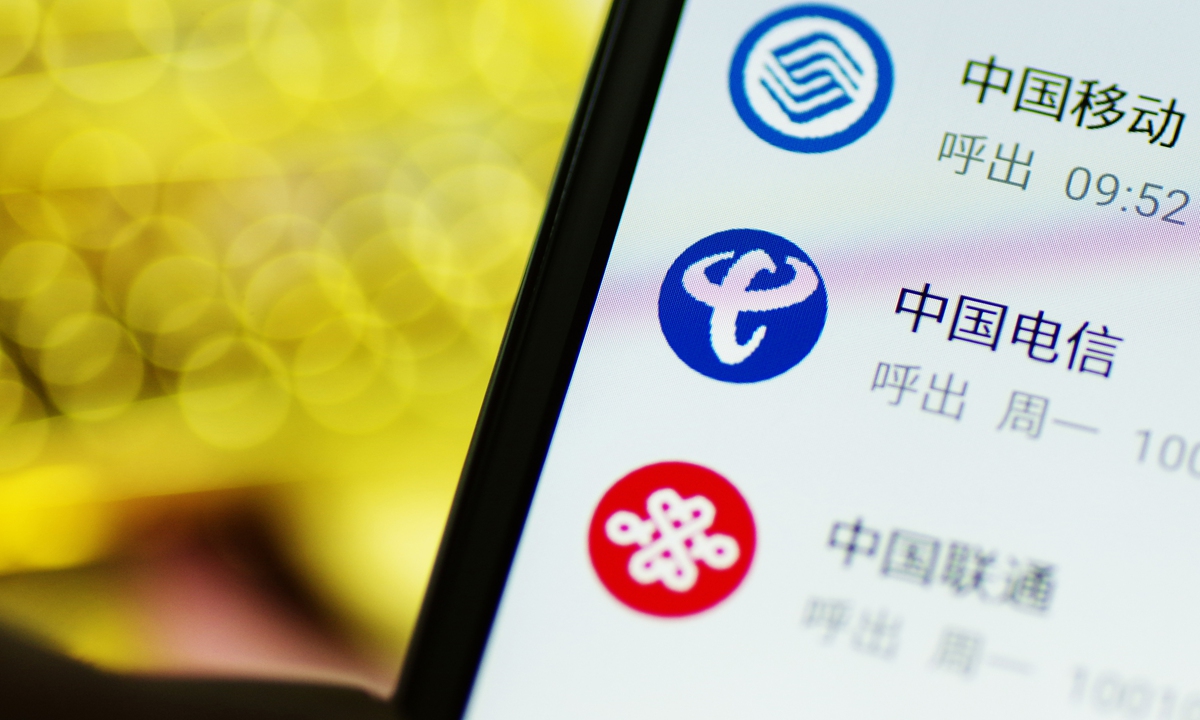
A smartphone screen displays call records featuring China's three major telecom operators - China Mobile, China Telecom and China Unicom. (Photo: VCG)
The US is considering further restrictions on Chinese telecom companies, in what analysts describe as a continued expansion of Washington's tech-related curbs on China under the pretext of "national security", warning that the move could further undermine the stability of bilateral economic and trade ties.
According to a Reuters report on Thursday, the Federal Communications Commission (FCC) of the US claimed it may bar major Chinese carriers including China Mobile, China Telecom and China Unicom from operating data centers in the US, and also could ban telecom carriers from connecting with these Chinese carriers.
The FCC claimed that it has tentatively concluded it should prohibit American and other telecommunications carriers operating in the US from interconnecting with companies on the so-called "Covered List" that it says pose "national security" concerns, according to a fact sheet published by the FCC on Thursday. This includes China Mobile, China Telecom, and China Unicom.
The agency claimed that it is also considering barring Chinese telecom firms that operate data centers or so-called Points of Presence at internet exchange points from interconnecting with other companies. It added that it may extend the existing ban on providing telecom services in the US to certain affiliates of companies on its national security list, according to Reuters.
The FCC could also bar telecommunications carriers from interconnecting with companies that use equipment from firms on the list, including Huawei and ZTE, the Reuters report said.
Li Yong, a senior research fellow at the China Association of International Trade, told the Global Times on Friday that the move, at its core, reflects an irrational expansion of the US' so-called national security concept, driven less by genuine security concerns than by political motives to push decoupling in the China-US technology and telecommunications sectors - a course that ultimately benefits no one.
The FCC plans to take an initial vote on the proposal at its April 30 meeting.
Responding to the agency's move, the Chinese Embassy in Washington said that China "consistently opposes the overstretching of the concept of national security and the abuse of state power to suppress Chinese enterprises," according to Reuters.
The latest proposal is not an isolated move but part of a broader escalation of US restrictions targeting Chinese technology firms across multiple segments of the communications supply chain.
A smartphone screen displays call records featuring China's three major telecom operators - China Mobile, China Telecom and China Unicom. (Photo: VCG)
The US is considering further restrictions on Chinese telecom companies, in what analysts describe as a continued expansion of Washington's tech-related curbs on China under the pretext of "national security", warning that the move could further undermine the stability of bilateral economic and trade ties.
According to a Reuters report on Thursday, the Federal Communications Commission (FCC) of the US claimed it may bar major Chinese carriers including China Mobile, China Telecom and China Unicom from operating data centers in the US, and also could ban telecom carriers from connecting with these Chinese carriers.
The FCC claimed that it has tentatively concluded it should prohibit American and other telecommunications carriers operating in the US from interconnecting with companies on the so-called "Covered List" that it says pose "national security" concerns, according to a fact sheet published by the FCC on Thursday. This includes China Mobile, China Telecom, and China Unicom.
The agency claimed that it is also considering barring Chinese telecom firms that operate data centers or so-called Points of Presence at internet exchange points from interconnecting with other companies. It added that it may extend the existing ban on providing telecom services in the US to certain affiliates of companies on its national security list, according to Reuters.
The FCC could also bar telecommunications carriers from interconnecting with companies that use equipment from firms on the list, including Huawei and ZTE, the Reuters report said.
Li Yong, a senior research fellow at the China Association of International Trade, told the Global Times on Friday that the move, at its core, reflects an irrational expansion of the US' so-called national security concept, driven less by genuine security concerns than by political motives to push decoupling in the China-US technology and telecommunications sectors - a course that ultimately benefits no one.
The FCC plans to take an initial vote on the proposal at its April 30 meeting.
Responding to the agency's move, the Chinese Embassy in Washington said that China "consistently opposes the overstretching of the concept of national security and the abuse of state power to suppress Chinese enterprises," according to Reuters.
The latest proposal is not an isolated move but part of a broader escalation of US restrictions targeting Chinese technology firms across multiple segments of the communications supply chain.
Last Friday, the FCC has proposed banning imports of telecom and surveillance equipment from Chinese firms already on its "Covered List," widening a previous action targeting China, according to Reuter.
On Wednesday, the agency said it will also vote April 30 on a proposal to bar all Chinese labs from testing electronic devices for use in the US.
These measures build on earlier actions. In December, the FCC claimed that it could bar China Mobile, China Telecom and China Unicom from connecting to US networks, following a series of earlier moves that effectively shut them out of the market, including rejecting market entry and revoking operating authorizations in recent years.
"In fact, Chinese telecom operators and related firms already have only a limited presence in the US following a series of politically driven restrictive measures, and such discriminatory curbs are unlikely to have a significant impact on their actual operations or business performance," Li noted.
Chinese telecom carriers have already seen their US footprint significantly reduced, with Reuters previously noting they now maintain only a "small presence," mainly through cloud services and wholesale internet traffic routing.
Li warned that the repeated and erratic restrictions have eroded the credibility of the US market. "By invoking vague and loosely defined concepts to justify broad curbs, the US is making its business environment increasingly unstable and unpredictable, undermining multinational companies' confidence in investing there," the expert said.
In response to a question about the FCC's plan to vote on a proposal that would ban all Chinese labs from testing electronic devices used in the US, Chinese Foreign Ministry spokesperson Mao Ning said on Thursday that, "China firmly opposes the US overstretching the concept of national security."
This type of action has severely impeded the normal economic and trade exchanges between Chinese and US companies and does not serve anyone's interests, including those of American companies and consumers, Mao said, adding that China will continue to firmly safeguard its legitimate and lawful rights and interests.