


China's factory-gate prices returned to growth in March after 41 months of decline, while consumer inflation remained mild, with rising oil prices linked to Middle East tensions beginning to feed through to domestic prices, official data showed on Friday.
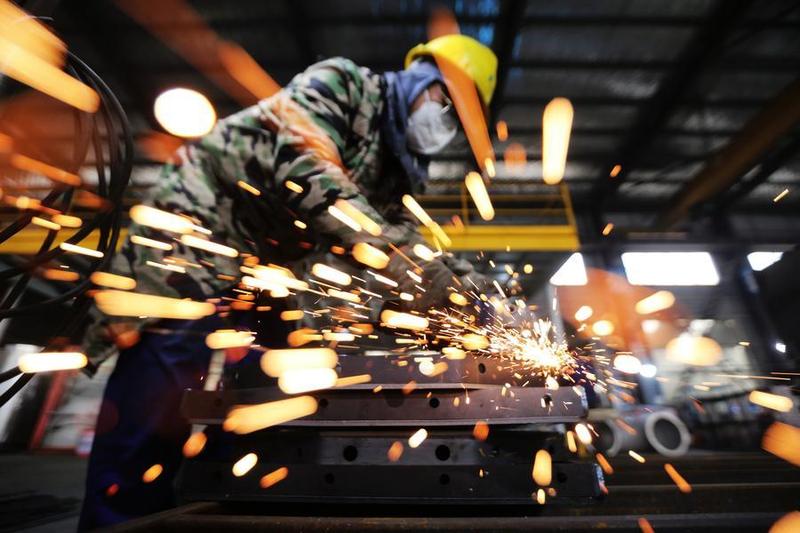
A staff member performs grinding work at a machinery factory in Yangmiao town, Yangzhou city of East China's Jiangsu province, Dec 29, 2025. (File photo: Xinhua)
Analysts said that policymakers should guard against the negative spillovers from potential imported inflation in the Chinese economy, including higher costs for households and businesses.
They stressed that sustained and healthy price growth hinges on stronger domestic demand, rather than cost-push pressures from global commodity markets.
Although elevated oil prices may temporarily support inflation, their effects are likely to be uneven and short-lived, highlighting the importance of boosting consumption and stabilizing expectations to achieve a more sustainable and widespread price recovery.
The National Bureau of Statistics said China's producer price index — which measures factory-gate prices — turned positive in March, rising 0.5 percent year-on-year, marking the first year-on-year increase since the PPI slipped into negative territory in October 2022.
Dong Lijuan, chief NBS statistician, attributed the year-on-year rise in the PPI mainly to a rapid increase in international commodity prices and improving supply and demand conditions in some domestic sectors.
"Imported factors pushed up prices in related domestic industries or helped to reduce their declines. Prices in some domestic sectors also edged up as supply and demand conditions improved," said Dong.
She added that new growth drivers had continued to strengthen, as the "AI Plus" initiative gained pace and demand for computing power rose rapidly, helping lift prices in related sectors.
On a month-on-month basis, the PPI rose 1 percent in March, marking its sixth straight monthly increase. The increase was 0.6 percentage points higher than in February, and the fastest increase in 48 months.
The country's consumer price index — the main gauge of inflation — rose 1 percent year-on-year in March, easing from a 1.3 percent rise in February, said the NBS.
Analysts said that effectively expanding domestic demand will be crucial to sustaining a healthy price recovery in the Chinese economy.
Mao Zhenhua, chief economist at China Chengxin International Credit Rating Co, said that although the CPI has shown a modest pickup, it has remained at a low level for 11 consecutive quarters and is still some distance from the reasonable target of around 2 percent.
Mao said that rising oil prices would increase corporate costs and — if end demand remained weak — squeeze profit margins in the middle and lower parts of the supply chain, thereby limiting their ability to support a broader recovery in prices.
"In the longer term, the key to breaking out of a low-price environment lies in expanding effective domestic demand," he added.
Policy support for consumption has also been stepped up. The National Development and Reform Commission, the country's top economic regulator, announced on Friday that it had, together with the Ministry of Finance, recently allocated a second batch of 62.5 billion yuan ($8.6 billion) in ultra-long-term special treasury bond funds to local governments to support the orderly implementation of the consumer goods trade-in program.
Luo Zhiheng, chief economist and head of the research institute at Yuekai Securities, said that looking ahead, policymakers still have ample tools at their disposal and room for adjustment to navigate the complex mix of domestic and external challenges.
Regarding monetary policy, Luo said the moderately accommodative stance remains unchanged, with room still available for further cuts in the reserve requirement ratio and interest rates this year.
He added that structural monetary policy tools are expected to continue channeling support toward technological innovation, consumption expansion, as well as small and micro-sized enterprises.
Despite geopolitical headwinds, confidence in the resilience of the Chinese economy remains intact. With the NBS due to release first-quarter economic data later this month, a report by the China Macro-economy Forum — a Beijing-based think tank — said the economy is set to make a solid start to the year, with growth showing broad-based improvement.
The report also said that even in the face of greater external shocks, the economy is expected to remain broadly stable throughout the year.