


Forty-eight teams from around the world will gather in the United States, Canada and Mexico in June 2026 for the FIFA World Cup. Thousands of miles away, in Yiwu, often called the "world's supermarket," in east China's Zhejiang Province, businesses have been gearing up for the global event since last year.
Wen Congjian, general manager of Yiwu Danas Import and Export Co., Ltd., has been in the football jersey export business for nearly 19 years.
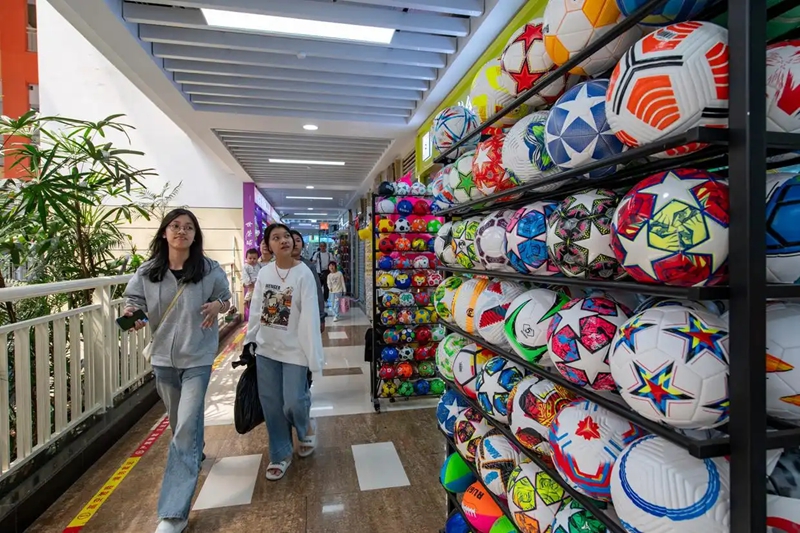
Merchants purchase sports goods at the Yiwu International Trade Market in Yiwu, east China's Zhejiang province, April 9, 2026. (Photo/Worker's Daily)
Spurred by the World Cup, the company has seen its orders surge to two to three times the usual volume, and demand has remained consistently high since last June, said Wen.
The boom goes beyond jerseys. Chen Shaomei, a veteran of the football business with over two decades of experience, has registered trademarks for his products and shifted toward building his own brand. His showroom features footballs in a wide range of colors, including a commemorative ball he designed for the upcoming World Cup, which has become a top seller.
"As soon as it was confirmed that the 2026 FIFA World Cup would be hosted across North America, we began developing new designs," Chen explained. From August last year to February this year, the company's orders rose by 20 to 30 percent.
Chen said the company's customers are spread across the globe, mainly in Africa and the Middle East. In the past, a typical client might place orders worth around 200,000 yuan ($28,000) a year. This year, boosted by the World Cup, that figure has climbed to between 300,000 and 400,000 yuan.
Among the hundreds of ball suppliers in Yiwu, Chen's company is one of the few that combines manufacturing, retail and branding under one roof. On average, companies like Chen's ship around 5,000 balls to customers around the world every day.
Having been through several World Cups, Wen has a firm grasp of the supply chain timeline and now handles large orders with far greater ease.
"This time, we planned everything in advance," Wen said. The company distributed orders among multiple partner factories, worked closely with logistics providers and shipped through different channels. Most orders were sent out before the Spring Festival, and nearly all have since been fulfilled.