


China’s leading EV makers, suppliers launch platform to tackle material ‘chokepoint’ issues
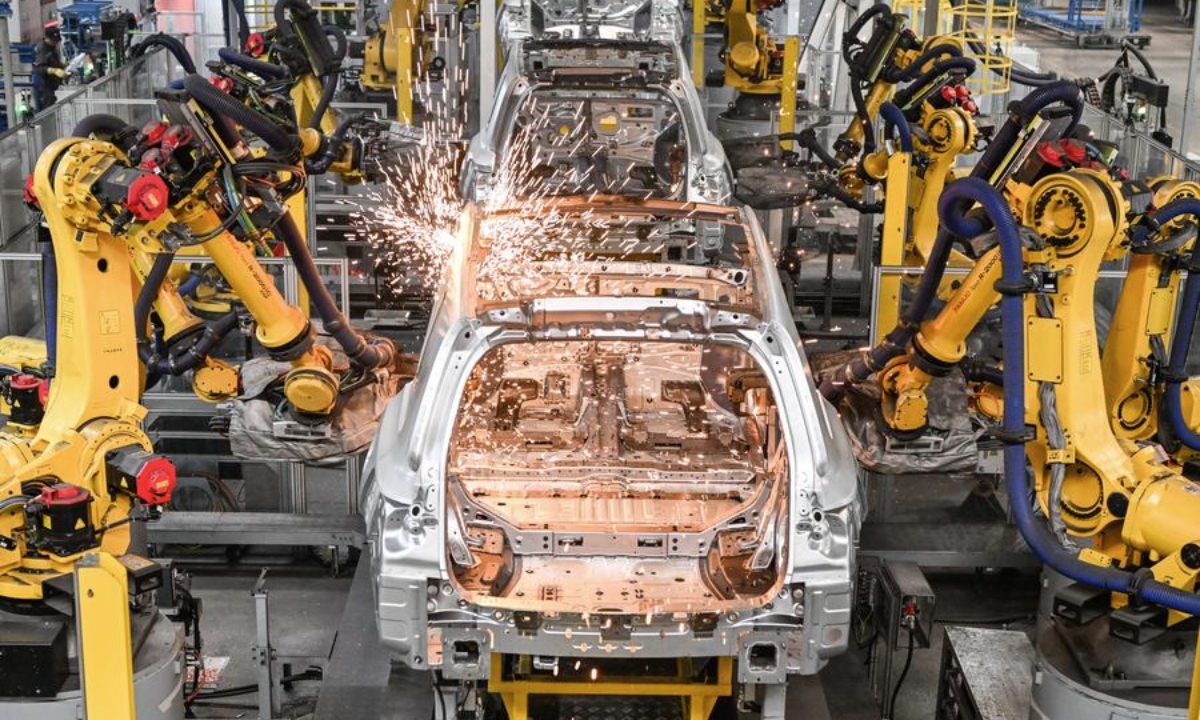
Robots weld bodyshells of cars at a workshop of Chinese electric vehicle (EV) maker Li Auto Inc. in Changzhou, east China's Jiangsu Province, Jan. 10, 2024. (Photo: Xinhua)
About 30 leading Chinese automakers, parts suppliers and auto material companies have jointly established a Strategic Materials Innovation and Application Platform in Beijing to address critical "chokepoint" material problems in the vehicle industry, China EV100, an initiator of the platform, said in a statement on Monday.
Industry analysts said that the number of components in a vehicle exceeds 10,000, making the safety of the domestic industrial supply chain particularly important.
The platform's goal is to build a comprehensive collaborative innovation system, covering vehicle manufacturers, parts suppliers, material companies, technology, standards, and supply chains, helping accelerate the application of advanced new materials in the automotive sector, read the statement.
The initiative also aims to provide strong support for the security and self-reliance of China's strategic new materials, CCTV News reported.
Companies participating in the platform's launch ceremony included BYD, Geely, SAIC, Dongfeng, Li Auto, PPG, Kingfa Science & Technology, KraussMaffei, China Salt Lake Group, Magna and Dow, according to a statement from China EV100, a non-profit organization and third-party think tank dedicated to advancing the EV industry.
"This platform brings together representatives from the entire automotive industrial chain, covering vehicle manufacturers, suppliers, and upstream materials companies. The participant structure is comprehensive and well-balanced," Zhang Xiang, a visiting professor in the engineering department of Huanghe Science and Technology University, told the Global Times on Monday.
The industrial application of new materials is a systemic project that requires close collaboration across the entire industrial chain. While upstream enterprises focus on technological innovation and materials research and development (R&D), the large-scale promotion and commercial application of new materials depend heavily on automakers to provide application scenarios and support, said Zhang Xiang.
An industry professional from a technology supplier for smart vehicles told the Global Times on Monday that given the high R&D investment required in the early stages of new materials, automakers - with their strong financial resources and powerful industrial driving capabilities - play a crucial role in supporting new material development.
"Only through close upstream-downstream cooperation and aligned efforts can new materials truly move from technological innovation to successful industrial application," the person said.
Among the participating companies, one Chinese tech company has achieved large-scale production of single-wall carbon nanotubes (a rolled structure of single-layer graphene), paving the way for key applications in new-energy vehicles (NEVs) and aerospace. Another firm has developed high-tech composite materials that make automotive parts both lower-carbon and significantly lighter, according to CCTV News.
"We can achieve carbon reduction of 30 percent or even over 40 percent," Liu Yanwei, general manager of Kingfa Science & Technology's Automotive Division, was quoted as saying.
Zhang Yongwei, vice chairman of China EV100, said at the launch ceremony of the platform that "the automotive industry has an extremely long industrial chain, and resources and materials are the most critical links."
"The establishment of this platform is mainly intended to solve the integration problem between the automotive industry and its supply chain. We need to strengthen strategic planning for raw materials, increase strategic reserves, and build early warning capabilities to ensure resource security," said Zhang Yongwei.
China still has relatively high dependence on foreign sources for certain key raw materials - more than 60 percent for lithium and more than 90 percent for nickel - posing challenges to supply chain stability. In addition, domestically produced automotive chips currently account for only about 20 percent of application in Chinese brand vehicles, CCTV News reported, citing industry experts.
Zhang Xiang also explained why developing new materials matters. "Taking NEV power batteries as an example, early ternary lithium batteries relied heavily on metals such as cobalt and nickel. These resources have limited reserves and are difficult to support long-term, large-scale application."
As the industry develops, power batteries have gradually shifted toward the lithium iron phosphate route. This technology offers better resource endowment and more stable supply for its core raw materials, serving as a prime example of new materials optimization and upgrading, said Zhang Xiang.
New materials are listed as one of the strategic emerging industries in China's 15th Five-Year Plan (2026-30).
"The new platform will help translate cutting-edge material innovations into real-world applications across industries," said Zhang Xiang.
The launch of the platform was announced during the Intelligent Electric Vehicle Development Forum held on Saturday and Sunday, hosted by China EV100. The event attracted representatives from multiple fields including government, automotive, energy, transportation, and technology, who gathered to discuss the development of the automotive industry.
Su Bo, former minister of industry and information technology, said at the forum that by 2030, NEVs will be the dominant force in China's automobile market, with the domestic penetration rate likely to exceed 70 percent.
Tsinghua University Professor Ouyang Minggao said at the forum that by 2030, new-energy passenger vehicles will account for 70 percent of annual new passenger car sales. The rate is expected to surpass 80 percent by 2035 and exceed 85 percent by 2040.