


AI redefines China's steel industry, injecting new vitality into nation's high-quality growth
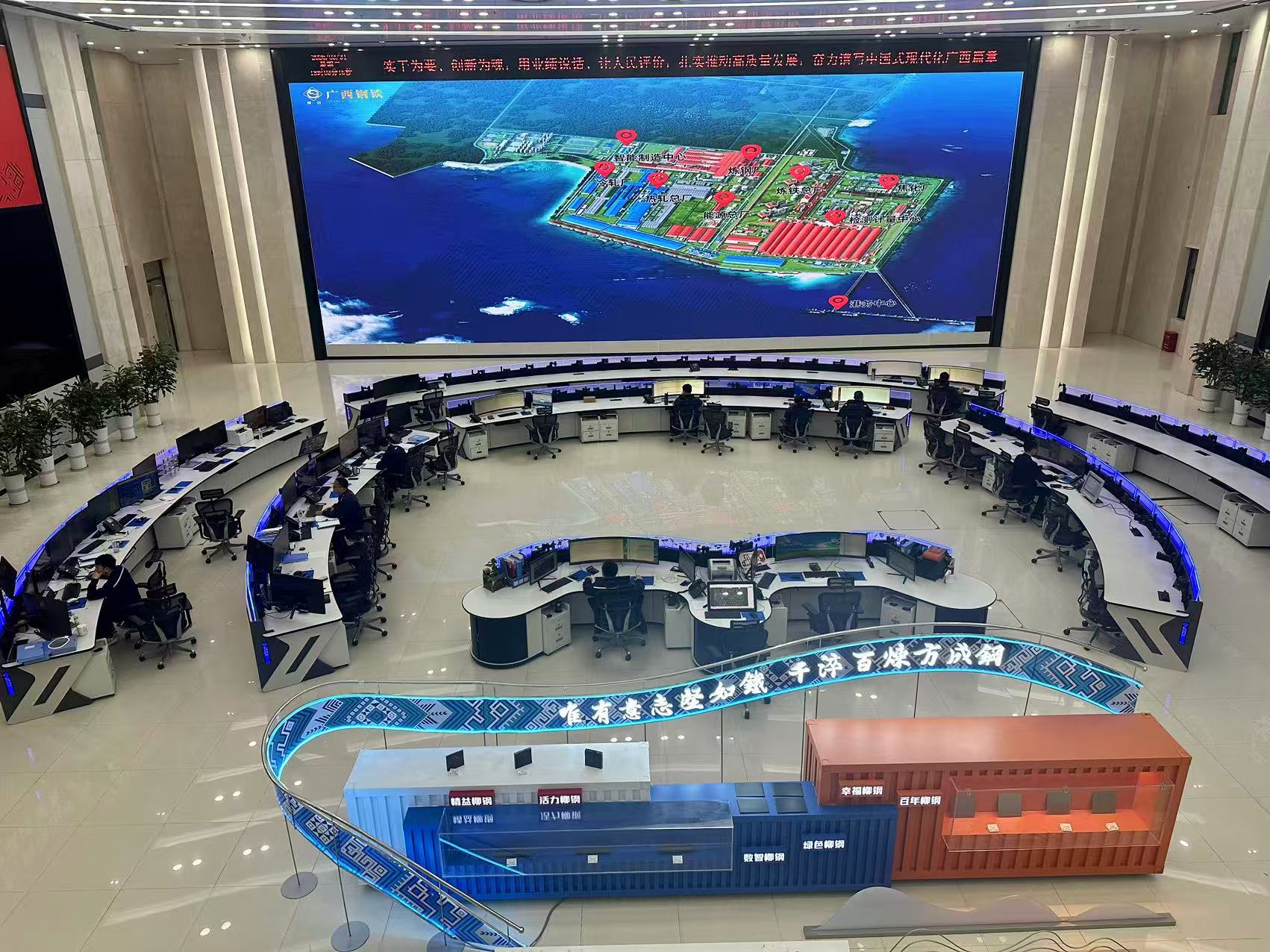
A view of the intelligent manufacturing center of the Fangchenggang base of Liuzhou Steel Group in South China’s Guangxi Zhuang Autonomous Region on March 31, 2026. (Photo: Ma Jingjing/GT)
Stepping into the Fangchenggang base of Liuzhou Steel Group on Qisha Peninsula, South China's Guangxi Zhuang Autonomous Region, one is easily attracted by multiple trains rattling from time to time along rail tracks stretching around 2 kilometers, carrying molten iron with a temperature of 1,500 degrees from furnaces to converters for steelmaking.
The scorching heat is unbearable even two or three meters away from the molten iron ladle. However, a team of over 70 workers such as shunting staff, drivers, and signalmen previously had to work 8-hour shifts in close proximity to molten metal. Under such extremely hazardous conditions, instructions were relayed via walkie-talkies, couplings were operated manually, and molten iron ladles were transported with open tops.
To overcome the challenges, Liuzhou Steel Group, in cooperation with Chinese tech giant Huawei and China Mobile, developed an intelligent molten iron transport system that deeply integrates the industrial internet, 5G, and artificial intelligence (AI), achieving a leap from "human control" to "intelligent control."
The system consists of three core components.
The first is the "brain" - the intelligent dispatching system. By integrating data from blast furnaces, transport lines, and steelmaking plants, the system autonomously plans tasks and routes for each vehicle carrying molten iron, making independent decisions on where resources are needed.
The second is the "torso" - the intelligent locomotive system. Equipped with sensor devices including cameras and radars, these driverless locomotives identify road conditions and obstacles in real-time, executing acceleration, deceleration, and braking maneuvers fully autonomously via onboard decision-making systems.
The third is the "arm" - the intelligent molten iron vehicle. Featuring functions such as automatic coupler disconnection and automatic parking, and utilizing BeiDou positioning, these vehicles achieve high-precision automated operations, completely freeing workers from manual labor.
"Now, across the entire operation area, basically no one is in sight except for a few inspection and maintenance personnel," Liao Liuqiang, a post-90s worker who previously worked as a shunter, told the Global Times.
This is the typical application of AI in the steel industry. Across China's steel industry, once noisy furnace floors are giving way to smart systems where "intelligent brains" analyze vast streams of production data, AI adjusts furnace temperatures dynamically, and robots spot defects with greater accuracy.
The Chinese steel industry is redefining the production paradigm with AI, injecting new vitality into China's high-quality growth.
AI empowermentOn March 31, Liuzhou Steel Group, in collaboration with Huawei and China Mobile Guangxi, formally launched Guangxi's first AI large-language model for the steel industry - the Xuantie Steel Model. Built on Huawei's Pangu AI Model as its pre-training foundation, it focuses on three core areas in steel production scenarios: "AI+Personnel," "AI+Data," and "AI+Manufacturing."
To date, it has established a "20+N"-scenario-based model system covering six key links, including ironmaking, steelmaking, rolling, logistics, environmental protection, and safety.
"The launch of the large model is part of Liuzhou Steel Group's efforts to break away from the traditional development model and shift from 'scale and speed' to 'quality and efficiency,'" Li Bin, chairman of Liuzhou Steel Group, said at the launch ceremony of the Xuantie Steel Model held in Nanning, capital of Guangxi.
Shen Min, deputy general manager of the group, told the Global Times that as Liuzhou Steel has deployed 33 AI models in full-process intelligent steelmaking, production efficiency has been increased by 8.5 percent through the application of the intelligent steelmaking scheduling model to enhance collaborative capability. Moreover, by using models such as the converter AI steelmaking model and the ladle AI argon‑blowing model, the production cost of crude steel has been lowered by 5 yuan ($0.73) per ton with the improvement of product quality and reduction in raw material consumption.
In addition to Liuzhou Steel Group, China Baowu Steel Group Corp in Shanghai has deployed Huawei's Pangu model to solve the centuries-old challenge of the "black box" in blast furnaces where the internal physical and chemical reactions are extremely complex, and are difficult to observe or measure directly.
HBIS Group's upgraded carbon-neutral digital platform, designed as a multifunctional and multi-scenario intelligent system, enables accurate energy consumption forecasting and can double the efficiency of carbon-allowance demand analysis.
"Currently, China's steel industry as a whole has entered a new stage of reduction and adjustment, optimization of existing capacity, and quality improvement and upgrading," said Li Yiren, vice president of the China Iron and Steel Association. "Intelligent manufacturing serves as the key technological pathway for developing new quality productive forces and achieving quality improvement and upgrading in the steel industry.".
Structural upgradingAs a key basic industry of the national economy, the steel industry is a sector that underpins stable industrial growth and economic operations. In recent years, Chinese government agencies have rolled out a series of policies to promote the high-quality development of the steel industry.
According to a document jointly released by the Ministry of Industry and Information Technology and four other government agencies in September 2025, China's steel industry should target value-added output growth at an average annual rate of around 4 percent for the 2025-26 period, calling for expanded effective investment in the steel industry to accelerate technological upgrades, digital transformation and green transition.
"The advent of AI has brought a key to industry transformation," said Jiang Wangcheng, a vice president at Huawei, at the launch ceremony of the Xuantie Steel Model.
As a leading global provider of ICT infrastructure, Huawei implements a dual strategy of independent innovation in foundational technologies and deep integration with industries, Jiang said.
On one hand, it strengthens its independent technology foundation, from computing power to algorithms. On the other hand, Huawei's Oil & Gas and Mining Business Unit goes deep into industry front lines, working side by side with over 300 metallurgical enterprises and more than 20,000 energy customers to promote AI from laboratories to production sites, he said.
Data from the China Iron and Steel Association show that 95.1 percent of Chinese steel enterprises have incorporated digital transformation strategies into their overall development plans, 82.9 percent have established centralized intelligent control centers, and 63.4 percent have applied 3D visualization and simulation systems to build digital factories, according to a CCTV report in August 2025.
Future steel industry competition will be a contest of comprehensive strength combining green and intelligent capabilities, Wang Guoqing, research director with the Beijing-based Lange Steel Information Research Center, told the Global Times.
"Chinese steel enterprises must leverage AI large models as their core engine and pursue a path of green and low-carbon development, high-end intelligence, and global service. Only then can they move from a 'major steel country' to a 'strong steel country' and secure global pricing power, standard-setting power, and industrial chain dominance," Wang said.