


EU's Industrial Acceleration Act creates investment barriers, discrimination; China to defend firms' rights: MOFCOM
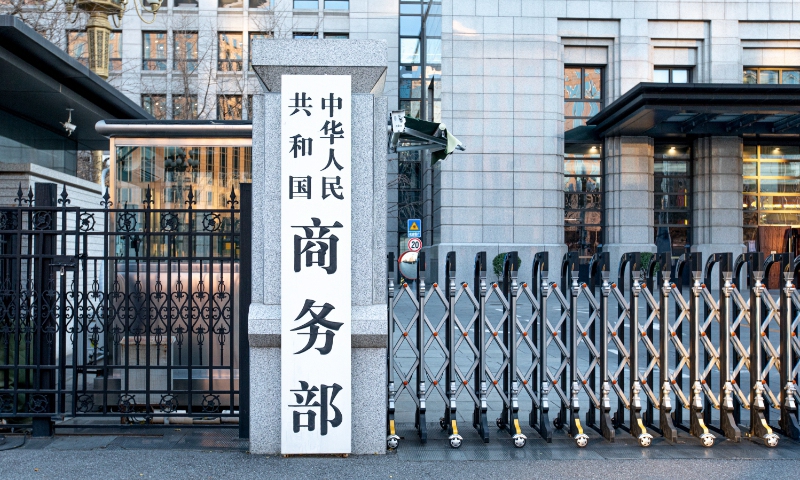
The Ministry of Commerce of China File photo: VCG
The EU's Industrial Acceleration Act imposes numerous restrictive requirements on foreign investment in four key emerging strategic sectors — batteries, electric vehicles, photovoltaics and critical raw materials — and introduces "EU origin" exclusivity clauses in public procurement and public support policies, constituting serious investment barriers and institutional discrimination, a spokesperson for China's Ministry of Commerce (MOFCOM) said on Monday.
The spokesperson made these remarks after MOFCOM on April 24 formally submitted comments to the European Commission on the EU's Industrial Acceleration Act to express China's official position and grave concerns.
In the comments submitted to the European side, China stated that the draft contains multiple issues, said the spokesperson.
First, it is suspected of violating core World Trade Organization (WTO) principles such as most-favored-nation treatment and national treatment. It is also inconsistent with several agreements, including the General Agreement on Tariffs and Trade 1994, Agreement on Trade-Related Investment Measures, Agreement on Trade-Related Aspects of Intellectual Property Rights, and the Agreement on Subsidies and Countervailing Measures.
Second, Chinese investors would face discrimination, which runs counter to the basic market economy principles of commercial voluntariness and fair competition, and further contravenes the important consensus reached by Chinese and EU leaders on properly managing frictions and differences, said the spokesperson. This would seriously affect Chinese companies' expectations for investment in Europe, the spokesperson said.
Third, it would slow the EU's green transition, undermine fair competition in the EU market and deal a fresh blow to multilateral trade rules.
In its comments, China suggested that the EU remove discriminatory requirements for foreign investors, local-content requirements, mandatory transfers of intellectual property and technology, and restrictions on public procurement, the spokesperson said, noting that China hopes the EU will attach great importance to and carefully consider China's comments, strictly abide by WTO rules and avoid discriminatory restrictive measures.
China will closely follow the legislative process and stands ready to engage in dialogue and communication with the EU, said the spokesperson, stressing that if the EU ignores China's suggestions and insists on pushing the legislation through, thereby harming the interests of Chinese companies, China will have to take countermeasures to firmly safeguard their legitimate rights and interests.