


China achieves first batch natural delivery of 10 cloned yaks: report
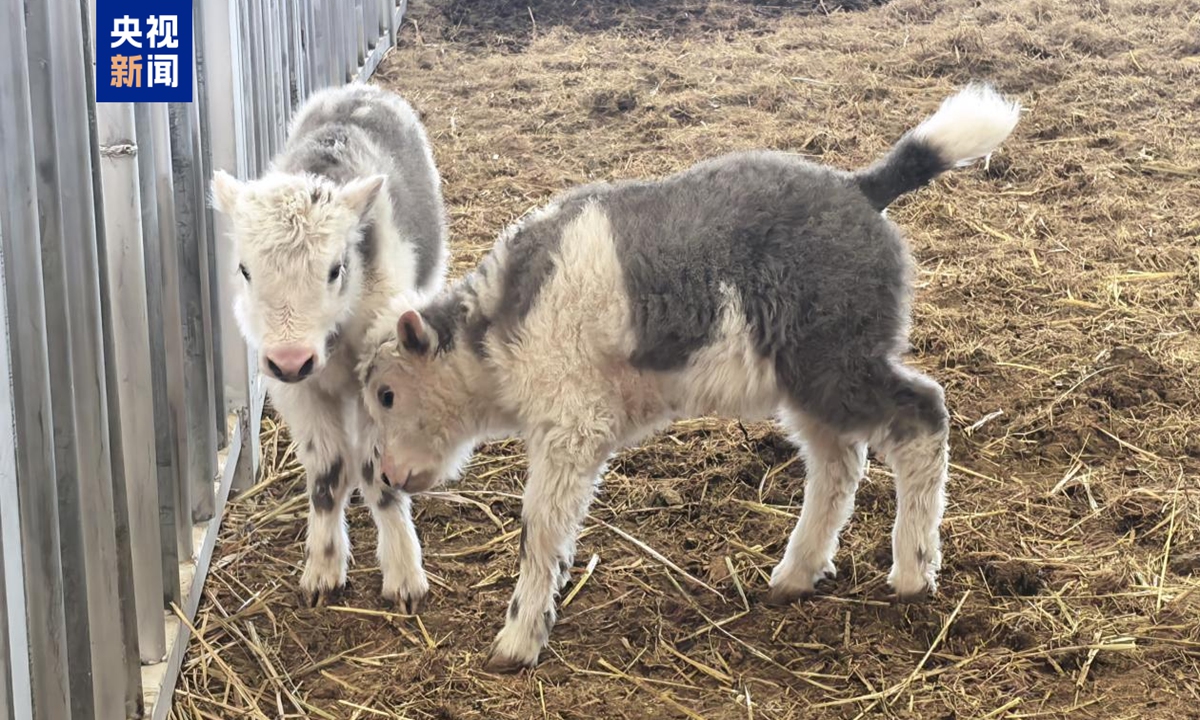
Clon yaks (Photo: CCTV News)
China's research team announced in Southwest China's Xizang Autonomous Region that cloned yaks have, for the first time, achieved batch pregnancies involving 10 yaks, all of which were delivered naturally, offering a solution for the next stage of industrialized production that can be scaled up and promoted, according to a China Media Group (CMG) report on Monday.
The report said that after three years of sustained efforts, a Chinese research team has successfully developed an integrated yak breeding technology combining whole-genome selection and somatic cell cloning, reaching a leading position domestically and an advanced level internationally.
On July 10, 2025, the team produced the world's first somatic cell-cloned yak using the self-developed technology, marking a "from zero to one" breakthrough in overcoming long-standing bottlenecks in traditional yak breeding in Xizang. The cloned calf weighed 16.75 kilograms at birth and reached 183.25 kilograms at 286 days.
From March 25 to April 5, 2026, the second batch of cloned yaks achieved, for the first time, batch pregnancies of 10 individuals, all of which were delivered naturally.
Expert noted that whole-genome selection enables the precise identification of superior genetic loci associated with large body size, rapid growth, high fertility, strong disease resistance, efficient feed conversion, and tolerance to cold, hypoxia and high-altitude conditions, allowing the screening of elite breeding stock, said CMG.
Building on this, somatic cell cloning achieves one-to-one genotype replication and rapid asexual propagation, shortening the breeding cycle to within five years and addressing key constraints such as low natural reproduction rates (just over 20 percent), scarce high-quality germplasm, and slow herd expansion.
The yak industry is one of nine key sectors prioritized during the 15th Five-Year Plan period (2026-30) in Xizang. Traditionally, yak breeding has relied on phenotypic selection, with cycles of up to 20 years, low efficiency and a risk of genetic degradation, according to CMG.
The integrated "whole-genome selection plus somatic cell cloning" technology represents a breakthrough solution to challenges including germplasm degradation, slow expansion of improved breeds and low industrial returns, while also delivering multiple benefits in scientific advancement, livelihoods, economic growth and ecological conservation.