



A panoramic view of Jingshan Village in Hangzhou, Zhejiang Province, China. The village has advanced low-carbon practices such as solar IoT street lamps, zero-carbon stations and eco-friendly green corridors, August 5, 2025. (Photos: VCG)
On April 22, 2026, the General Office of the Communist Party of China Central Committee and the State Council jointly issued the opinions on energy conservation and carbon reduction. The timing matters. It came at the start of China's 15th Five-Year Plan period (2025-30), signaling a forward-looking shift from sheer quantity-driven targets toward quality and efficiency. It offers a blueprint for how the world's largest energy consumer plans to balance growth, security, and green transition.
From quantity to higher quality
The document cuts wide the level of energy conservation from quantity to higher quality. For more than a decade, China's energy policy leaned heavily on intensity-based targets and total consumption caps. The new guidelines keep in line with such a regulatory framework, while stressing the need to "resolutely curb the unreasonable growth of energy consumption." It also seeks to boost energy and resource productivity and advance source emission reduction.
Relying solely on crude consumption controls has become unsustainable, making structural adjustment the core driver of the next round of decarbonization. By embedding the "conservation first" principle throughout production and consumption chains, the guidelines clarify that energy conservation is no longer an isolated sectoral task, but a fundamental underpinning of high-quality development.
Coordinating industrial upgrading and energy transition
Another highlight lies in balancing energy conservation, industrial upgrading and the energy mix. The opinions call for tighter regulation on high-emission projects, the orderly phase-out of outdated capacity, and faster growth of advanced manufacturing and modern services.
Concepts including zero-carbon industrial parks and "green-to-green" model — which uses renewable power to make eco-friendly products —are set to accelerate the low carbon transformation of both supply and demand sides.
The country aims to peak coal and oil consumption while scaling up non-fossil energy, new energy storage solutions and smart micro-grids, as well as expanding direct green power access. One notable policy signal stands out: Newly added clean electricity capacity will gradually cover all incremental power demand across society. This represents a major policy shift. Renewable energy is no longer a supplementary option for a coal-dominated power system, but is positioned as the core growth driver of China's future power sector.
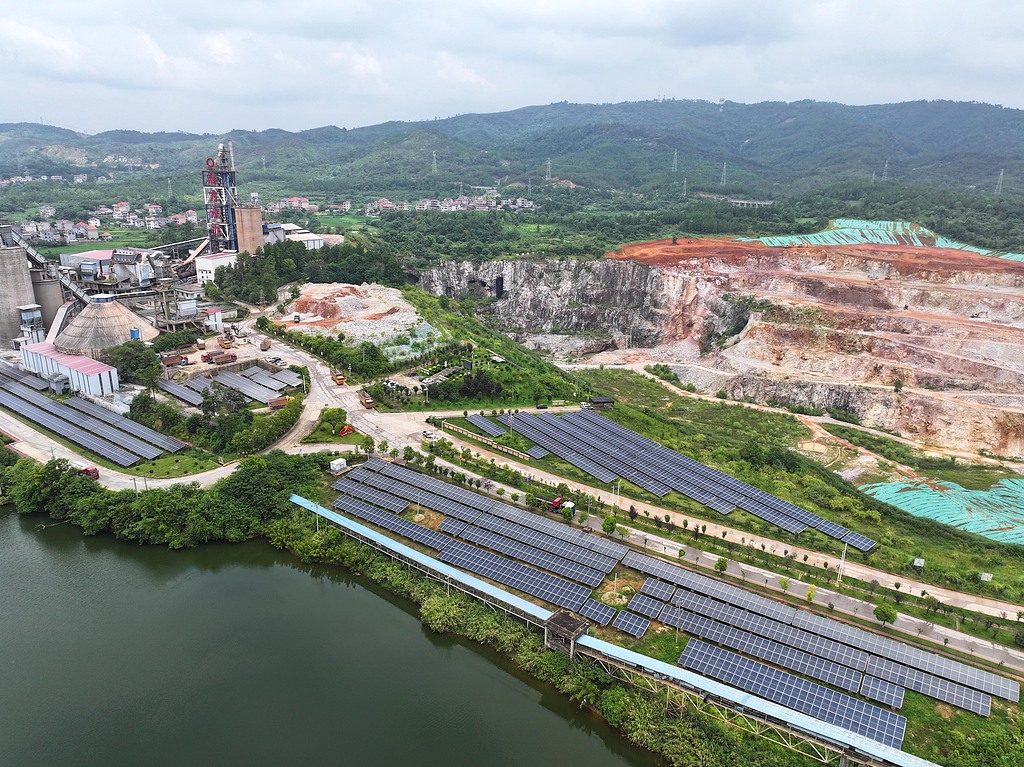
Photovoltaic panels are installed at a plant in Jiangxi Province, China, July 29, 2025.
A sector-by-sector roadmap with a digital edge
What makes the opinions feel particularly operational is their granularity. The document lays out tailored measures for industry, buildings, transport, digital infrastructure, and public institutions. In heavy industries such as steel and petrochemicals, the focus is on energy-saving diagnostics and cross-sector coupling, where waste streams from one process feed into another. In buildings, the policy promotes ultra-low-energy housing, building-integrated photovoltaics, and a long-discussed reform of district heating metering. For transport, there is renewed emphasis on multimodal logistics, electric and hydrogen-powered heavy trucks, and zero-carbon shipping corridors. The treatment of digital infrastructure is, in some ways, the most timely part. With computing power and data centers becoming significant new sources of electricity demand, the opinions impose stricter efficiency thresholds and call for waste-heat recovery, addressing one of the AI era's more uncomfortable tensions: How to keep scaling digital capacity without quietly eroding climate goals.
Institutional guarantees and global implications
The credibility of any policy ultimately depends on its enforcement architecture, and here the opinions break some new ground. They strengthen energy conservation reviews and carbon emission assessments for new high-energy projects, requiring "equal-quantity or reduced-quantity" carbon offsets, and mandate disclosure and tiered classification for key emitting entities. The document also pledges to revise the energy conservation law and the renewable energy law, develop a product carbon-labeling system, and explore a national low-carbon transition fund for traditional industries and resource-rich regions.
The international dimension matters too. The guidelines explicitly call for deeper global cooperation, mutual recognition of energy-efficiency and carbon-labeling standards, and support for Chinese energy-saving service firms going abroad, opening real opportunities for partners across Asia, Africa, and Latin America. Challenges remain, of course: Subnational implementation is uneven, transition costs in energy-intensive regions are high, and friction over carbon-related trade measures is unlikely to fade soon. Even so, the direction is fairly clear. By raising both the level and the quality of its energy conservation work, China is sharpening its own path to the dual-carbon goals while offering a more sophisticated template for how large emerging economies might grow, decarbonize, and modernize at the same time.