


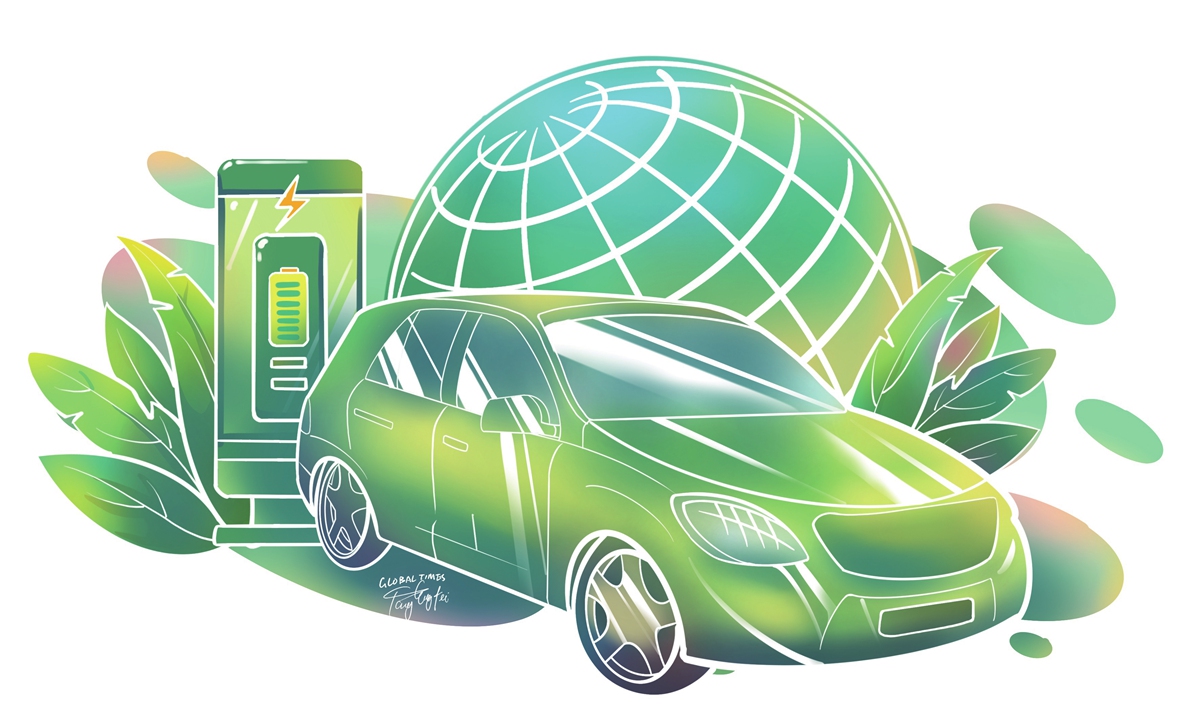
Illustration: Tang Tengfei/GT
During the just-concluded May Day holidays, new-energy vehicles (NEVs) were increasingly visible on China's highways, including for long-distance family trips, according to media reports.
This trend offers a concrete perspective on the evolving dynamics of China's NEV industry. Extended journeys test vehicle performance - particularly charging efficiency and running range - and the supporting infrastructure, providing insight into how the industry is responding to growing travel demand.
According to the Xinhua News Agency, the National Energy Administration (NEA) collected data from 57,600 highway charging points monitored through the national charging infrastructure service platform.
On May 1 alone, 23.03 million kilowatt-hours of electricity were provided to NEVs on highways, up 55.6 percent from the same day last year, and more than 946,300 charging sessions were recorded. Drawing on such a broad set of monitored facilities, these figures offer a clear picture of the NEV market penetration as well as the ability of the supporting infrastructure to meet rising consumer demand.
In the early stages of NEV development, a number of Chinese consumers were uncertain about the practicality of NEVs' long-distance running, particularly regarding access to charging poles along the way. Over time, these concerns appear to have eased, as longer trips with NEVs have become increasingly common. This change reflects a range of factors, including the ongoing expansion and gradual improvement of the country's power-charging networks.
According to the latest NEA statistics, China had 21.481 million NEV charging infrastructure units as of the end of March, marking a year-on-year increase of 46.9 percent. Beyond the rapid expansion in scale, China's NEV charging infrastructure is also undergoing quality upgrades and efficiency improvements. The average charging power per public charging gun in China has reached 46.5 kilowatts, up 33 percent year-on-year.
According to media reports, China has built the world's largest NEV charging network now. Starting from early May, efforts are in progress to strengthen power supply and improve electricity services. These include upgrading and modernizing distribution grids, particularly in older residential communities, rural areas, and highway service homes. At the same time, the share of green electricity in the charging mix is rising, while digital and intelligent management of the grid is being introduced to improve overall system efficiency and flexibility.
These developments reflect a pragmatic approach underlying China's NEV industry. By addressing practical issues in charging, removing barriers to adoption, and expanding the market base, the sector has grown in a sustainable way.
From urban centers to rural areas, and from individual charging points to broader upgrades of the power network, a coordinated effort to strengthen infrastructure has laid a solid foundation for consumer growth. This gradual, systematic buildup supports NEV adoption and demonstrates the approach the industry has taken to facilitate market expansion.
Supported by these developments and other contributing factors, China's NEV market has experienced years of rapid growth. According to the data released by the China Association of Automobile Manufacturers (CAAM) in January, China's NEV production and sales both exceeded 16 million units in 2025, bolstering the nation's position as the world's largest NEV market for the past 11 years.
NEVs have become an important focus of the automotive industry in the world, with many countries now trying to expand their local market penetration. China offers a practical approach: reducing barriers, improving infrastructure, and making NEV use more convenient.
By contrast, some Western economies have taken measures that, to some extent, can stifle market competition by restricting the movement of resources within the sector. Such actions will certainly raise NEV costs and constrain market adoption.
Market size is a key factor in shaping an industry's trajectory. Removing tariffs and other market barriers, rather than raising them, remains central to expanding NEV market in the world. China's increasingly improving highway charging network seen during the May Day holidays provides a clear illustration: building a strong NEV market cannot be achieved through playing zero-sum games, but through investment in technology and market expansion.