


KIGALI, May 6 (Xinhua) -- The International Monetary Fund (IMF) on Wednesday formally launched its latest Regional Economic Outlook for Sub-Saharan Africa in the Rwandan capital, Kigali, saying that the region has made significant economic progress but remains highly vulnerable to external shocks.
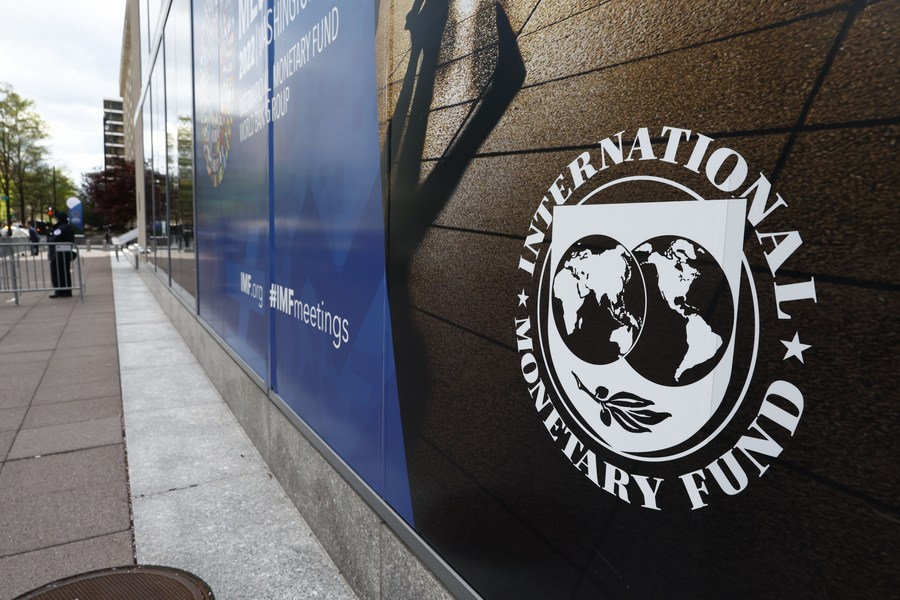
Photo taken on April 19, 2022 shows the IMF Headquarters in Washington, D.C., the United States. (Photo: Xinhua)
According to the report named "Hard-Won Gains Under Pressure," sub-Saharan Africa entered 2026 reaping the benefits of hard-won stabilization gains, following a strong 2025, during which economic activity accelerated broadly across country groups.
Regional growth reached about 4.5 percent, the fastest in a decade, supported by favorable external conditions and sound policies, particularly in several large economies, said the report.
Nikola Spatafora, senior economist in the IMF's African Department, underscored that the region's recent resilience is being tested by a combination of external shocks, tighter financial conditions, and geopolitical tensions.
He called for sustained macroeconomic discipline, careful calibration of monetary and fiscal policies, and continued efforts to rebuild buffers to safeguard stability.
Rwanda's Minister of Finance and Economic Planning Yusuf Murangwa said the report arrives at a consequential moment for the continent, emphasizing that while progress has been real, it remains fragile in the face of a difficult and uncertain global environment.
Murangwa said that although sub-Saharan Africa entered 2026 with its strongest economic momentum in a decade, the pace of growth remains insufficient to deliver meaningful improvements in living standards.
"In Rwanda, growth was 9.4 percent in 2025, among the highest recorded post-COVID-19. Inflation had dropped sharply, and fiscal positions had improved for most countries in the region," he said.
Murangwa stressed the need for a shift toward private sector-driven growth, noting that reliance on public spending, commodity windfalls, and external aid would not be sustainable given the region's rapidly growing population and labor force.
According to the report, inflation moderated through the end of 2025 due to lower global food and oil prices, easing exchange rate pressures, and appropriately tight monetary policies, while fiscal positions improved on the back of stronger growth and favorable exchange rate developments.
However, the report warns that the war in the Middle East has significantly clouded the outlook. Oil, gas, and fertilizer prices, alongside shipping costs, have risen sharply, while trade disruptions with Gulf partners, reduced tourist arrivals, and likely declines in remittances are expected to weigh on economic activity.
As a result, regional growth is projected to slow slightly to 4.3 percent in 2026, 0.3 percentage points lower than pre-war forecasts, with notable differences across countries.