


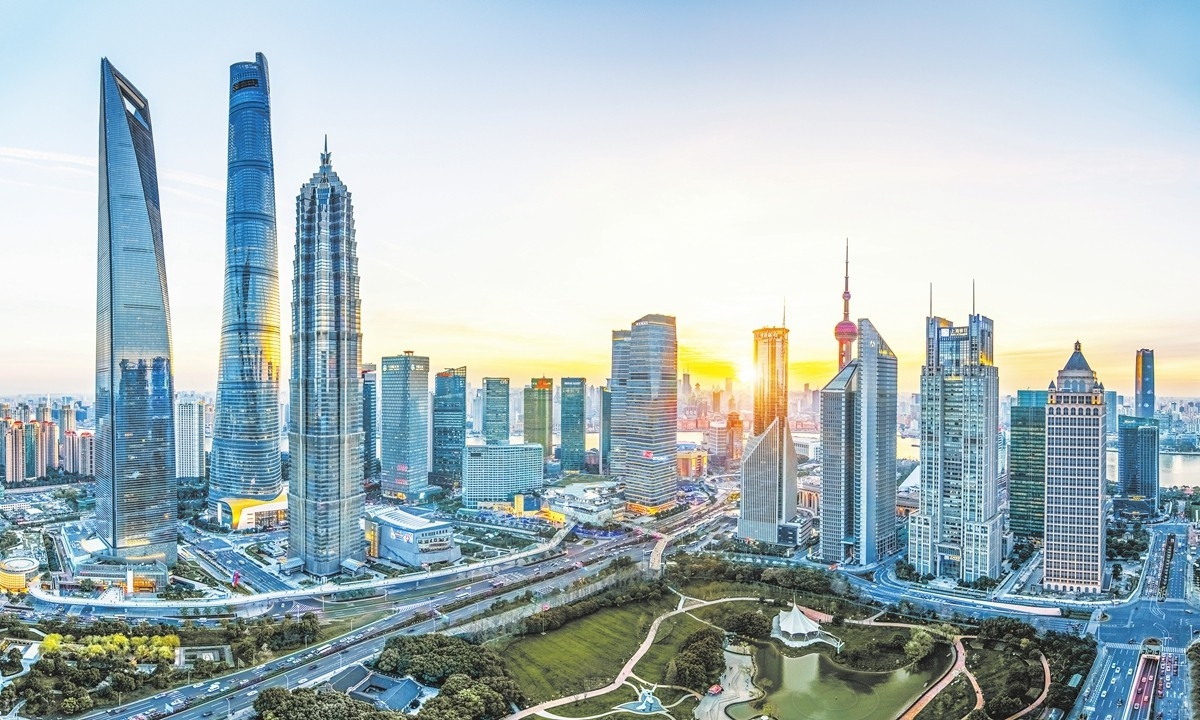
A view of Lujiazui, Shanghai (Photo: VCG)
Every minute counted on Pascal Daloz's itinerary during his visit to China. In just three days, the CEO of French industrial software giant Dassault Systèmes shuttled between six cities, including Shanghai, Guangzhou, and Shenzhen, engaging with leading industrial enterprises and conducting on-site inspections of innovative startups.
Through these intensive trips, he experienced firsthand the wave of innovation sweeping through China's business landscape.
"I'm seeing a new generation of entrepreneurs in China who are truly prepared for the global market," he told the Global Times. This, he emphasized, is what has impressed him the most over the past five years.
He recalled that five years ago, when he visited large Chinese companies, their primary agenda was catching up technologically. "Now, the agenda is to lead," he noted.
He highlighted the deepening cooperation between Chinese companies. Taking Chinese carmaker Xpeng as an example, he said they are moving so fast in car development — diversifying into humanoid robots and eVTOL aircraft.
"For them, we are a perfect fit," he explained, "because we are building the foundations not only to design their products, but also to produce them. But at some point, they will have to produce their products abroad — not just in China for the Chinese market. That is really where we become extremely relevant to them."
Ralf Brandstätter, the Volkswagen Group board member for China, echoed a similar sentiment in a recent interview with the Global Times. He highlighted the strong and deepening cooperation between Volkswagen and its Chinese partners.
"Together with them, we are now making strong progress," he said. He noted that partners such as XPENG, Horizon Robotics, and Gotion are fully committed to working with Volkswagen.
Brandstätter stressed the importance of collaboration, stating that Volkswagen is not doing this alone. "We are doing it together with the Chinese ecosystem," he explained. "We are only one part of it, and the main part is Chinese."
What multinational companies are experiencing through their local partnerships reflects a much broader trend — one being accelerated by China's push for new industrialization.
China's new industrialization is not only reshaping its domestic industrial landscape but also offering foreign companies a wealth of new opportunities — from smart manufacturing and green energy to industrial software and high-end equipment — where global expertise and local innovation are converging. This trend is already crystallizing in tangible outcomes, as Chinese companies rapidly advance their intelligent capabilities across critical sectors.
Midea's subsidiary Wan Dong Medical recently unveiled the MR Agent and DR Agent intelligent products, along with several new imaging devices. With a full-chain smart solution, Wan Dong is pushing China's domestic medical imaging equipment into the next era of intelligence, according to the information the company shared with the Global Times.
The MR Agent, the first intelligent diagnostic tool based on Chinese brain data, uses data from nearly 50,000 healthy individuals across 34 provinces to create a dedicated Chinese brain recognition model. The DR Agent, trained on over 4 million local DR images, automates the entire process from positioning and parameter setting to diagnosis and report generation.
Such innovations are not happening in a vacuum — they align closely with China's latest development blueprint, China's 15th Five Year Plan (2026-30), which underscores the strategic priority of building a modern industrial system and strengthening the real economy. It provides strong policy certainty and long-term direction for industrial development.
The outline of the plan places the integration of technological and industrial innovation in a prominent position, aiming to move lab-born technologies onto factory floors to unlock trillion-yuan opportunities across the real economy, reported the Xinhua News Agency on March 15.
These high-value opportunities stem from the plan's designation of new-generation information technology, new energy, new materials, intelligent connected new energy vehicles, robotics, biomedicine, high-end equipment and aerospace as strategic emerging industries for priority development.
This fast-paced, ambition-driven innovation environment has opened unprecedented opportunities for multinational companies to grow alongside Chinese enterprises — not just as software providers, but as strategic co-innovators in their journey to go global.
We see ourselves as a long-term partner in China's industrial transformation — supporting the upgrading of traditional industries through automation, digitalization, and software defined solutions, while enabling the development of emerging and future sectors such as new materials, high-end equipment, biomanufacturing, and embodied AI, Chief Technology Officer Industrial Automation at Schneider Electric Andreas Groeger told the Global Times in a recent interview.
At this year's Hannover Messe held in April, Schneider Electric showcased energy-tech convergence - the powerful integration of electrification, open software-defined automation, AI and digital intelligence - to help industrial organizations turn operational, energy and workforce challenges into competitive advantages.
In Groeger's view, China is an innovation driver in industrial automation, digital transformation, sustainable development, and high-quality growth. China's continued push for high quality development and openness strengthens our confidence to deepen localization, expand innovation, and contribute to China's industrial modernization while scaling these innovations globally, he said.
He Yadong, a spokesperson for the Ministry of Commerce, said on April 16 that in 2025, foreign investment in China's scientific research and technology services sector accounted for nearly one-fifth of the country's total actual utilized foreign capital — a share that has steadily risen for seven consecutive years, reaching 3.8 times the level in 2018.
China has a complete industrial system and a large market, and its innovation-driven industries are undergoing continuous upgrading. With numerous application scenarios, this combination provides foreign enterprises with more opportunities for development in China and greater market confidence, Hu Qimu, a deputy secretary-general of the Forum 50 for Digital-Real Economies Integration, told the Global Times.
Amid rising international uncertainty, China provides a stable operating environment for multinational corporations through institutional opening-up. The full liberalization of foreign investment access in the manufacturing sector and the deepening of services sector opening-up during the 15th Five-Year Plan period have continuously strengthened multinational corporations' confidence in long-term investment in China, Liu Minghua, CEO of Deloitte China, said on the company's official website on March 18.
An innovation ecosystem powered by high-end talent, a complete industrial chain, rich application scenarios, and efficient institutional synergy is rapidly taking shape, deeply integrating into the global R&D network. More and more multinational corporations are no longer limiting themselves to viewing China as a production base or sales market, but are elevating it into a global strategic R&D center and industrial chain collaboration hub, he added.
Julian Jenkins, director of sales and brand at Rolls-Royce Motor Cars, said in an earlier interview with the Global Times that China's 15th Five-Year Plan places strong emphasis on a higher level of opening-up, and "this opportunity is one where we very much support open trade and engagement, as we do around the world."
"For us, China is an important market, and we are very excited about the potential, and that is why we continue to invest," Jenkins said.
"You know, we are in China not only to serve the market," Daloz said. "We are in China also because innovation is now coming from China. The EV car is a good example. If you are not part of these ecosystems, in the end, you will not stay competitive in the long term."