


Rows of standardized crab ponds stretch neatly across an eco-friendly Chinese mitten crab aquaculture farm in Tonggui township, Xingqing district, Yinchuan city, northwest China's Ningxia Hui Autonomous Region.
At the water's edge, Zhang Ting, an entrepreneur born in the 1990s who returned home to start her business, walks local farmers through water quality management techniques. She reminds them to change the water frequently ahead of the coming heat and to feed the crabs in small, frequent portions.
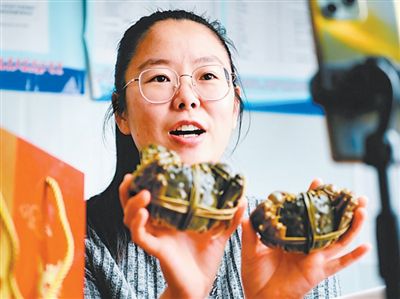
Zhang Ting, an entrepreneur born in the 1990s in Yinchuan city, northwest China's Ningxia Hui Autonomous Region, promotes Chinese mitten crabs during a livestream. (Photo courtesy of the interviewee)
Several years ago, this vast aquaculture farm was little more than a stretch of abandoned saline-alkali land along the Yellow River.
Zhang and her husband Liu Mingwei, both natives of Yinchuan, had been working in sales elsewhere before 2019. But every time they returned home, the sight of vast tracts of idle land nagged at them.
A chance visit sparked an idea: Yinchuan's appetite for Chinese mitten crabs was substantial, yet nearly all the crabs on the market were shipped in from elsewhere, fetching high prices and sometimes arriving less than fresh.
"We thought, with Yellow River water right here and natural wetland conditions already in place, why couldn't we raise crabs?" Zhang recalled.
The couple did their homework by visiting aquatic markets, consulting fishery experts, and analyzing Yinchuan's water quality, climate, and consumer demand. The findings were encouraging. The Yellow River's mineral-rich water and sharp day-to-night temperature swings were ideal for crab farming, and local supply was clearly lagging behind demand. In 2019, they returned home with their savings and set out to build their business.
However, progress didn't come easily. In their first year, only 15 percent of crab seedlings in their initial 13-mu (0.87-hectare) pond survived, and the couple kept near-constant watch over the water, monitoring temperature, aquatic plants, and molting patterns.
They brought in technical advisers from east China's Jiangsu Province — China's crab-farming heartland — and gradually refined their feed formulas and oxygenation systems to suit the Yellow River's higher mineral content.
Their persistence paid off. When lab results showed that the protein content in their crabs' roe was comparable to that of the celebrated Yangcheng Lake variety, Zhang knew the hard work had been worth it.
With the technical hurdles cleared, the couple turned to building a real industry. With support from the livestock and aquatic technology extension and service center of Xingqing district, they consolidated scattered ponds into a modern, standardized aquaculture farm complete with upgraded electrical infrastructure, paved roads, sorting workshops, and winter storage greenhouses. Their operation grew from 13 mu to nearly 2,300 mu.
Zhang steered clear of the low-margin wholesale model. She opened retail outlets in Yinchuan, targeted corporate bulk buyers and developed premium gift packaging for online sales. After registering a trademark, she built a loyal customer base and expanded sales to places including Beijing, Shanghai and Jiangsu, bringing the farm's annual revenue to more than 3 million yuan (about $441,566).
The brand's breakout moment came in October 2024, when Zhang brought 650 kilograms of crabs to the first Crab Industry (Shanghai) Expo. The entire stock sold out in three days, and several restaurants from east China's Zhejiang Province and Shanghai signed long-term supply agreements on the spot.
At the 2025 Shanghai International Crab Exhibition, her crabs took home four awards.
Zhang has not kept her success to herself. Through a model linking companies, farms and farmers, she now provides crab seedlings and technical guidance to farmers and helps with marketing.
By the end of 2025, Zhang had helped 43 households farm a combined pond area of over 10,000 mu, with each participating family earning an additional 50,000 yuan or more per year, while also creating more than 40 jobs.