


WASHINGTON, May 13 (Xinhua) -- Interactions between the heads of state provide irreplaceable strategic guidance for China-U.S. relations, Xie Feng, Chinese ambassador to the United States, has said.
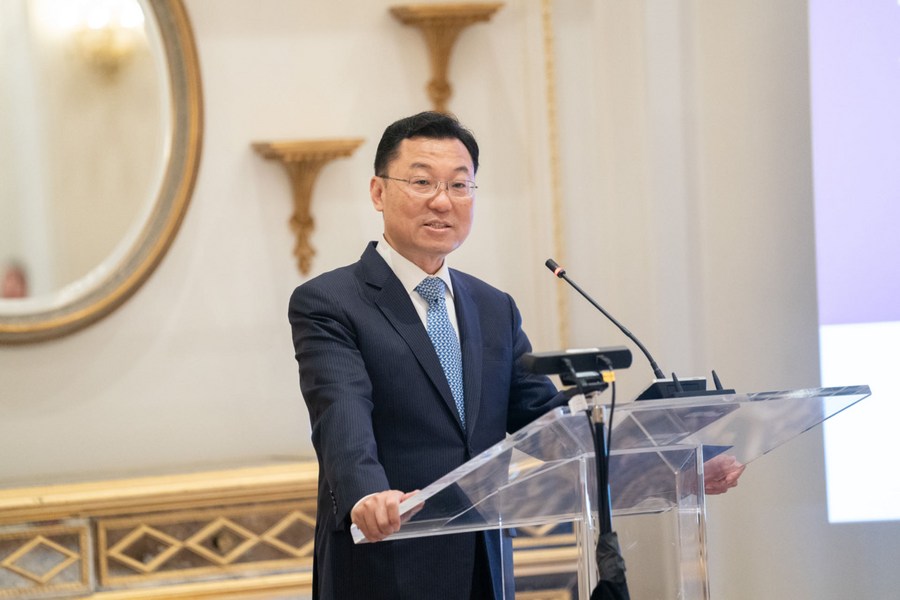
Chinese Ambassador to the United States Xie Feng delivers remarks at a breakfast briefing hosted by the Advanced Medical Technology Association in Washington, D.C., the United States, on June 28, 2023. (File photo: Xinhua)
Xie made the remarks in a recent interview with Newsweek on U.S. President Donald Trump's visit to China and China-U.S. relations, noting that in an increasingly turbulent world, the strategic value of China-U.S. relations becomes more prominent.
During the interview, Xie said President Xi Jinping and President Trump respect each other, and have maintained close communication, and that since last year, the two leaders have spoken on the phone five times and exchanged multiple letters, and held a successful meeting in Busan, the Republic of Korea, recalibrating the course of the China-U.S. relationship and steering it toward overall stability.
He expressed hope that with the joint efforts of both sides, the meeting between the two heads of state in Beijing would chart the right course for the future development of China-U.S. relations, and pave the way for making the list of dialogue and cooperation longer and advancing the positive agenda, while shortening the list of problems and properly managing differences.
That would not only promote the steady, sound and sustainable development of bilateral relations this year, but also explore a right way for China and the United States to get along in the new era based on mutual respect, peaceful coexistence and win-win cooperation, said Xie.
History has proven it once and again that a tariff war or trade war produces no winner, damages the interests of both sides, and hurts the whole world, Xie said, noting that under the guidance of the two leaders, China and the United States have reached a series of common understandings through economic and trade consultations, and have stabilized bilateral economic and trade relations.
This has not come easily and should be cherished, but it is still far from enough, Xie said, expressing hopes that the U.S. side will move further ahead, and completely remove the unilateral tariffs and other restrictive measures.
On the Taiwan question, Xie said that he believed the American people, who faced the danger of division and had a Civil War in history, can understand China's will and determination to safeguard national unity.
The Chinese side urges the U.S. side to commit to the one-China principle, the three China-U.S. joint communiques with concrete actions, make the right choice as early as possible, fundamentally remove the biggest obstacle to China-U.S. relations, which is the Taiwan question, a burden that risks dragging the two countries into confrontation and conflict, and open up broader room for developing bilateral ties, Xie said.
When asked about the fentanyl issue, Xie said the fentanyl crisis in the United States was not created by China, but China has been doing its utmost to provide assistance with the greatest goodwill out of humanitarian spirit and for the sake of China-U.S. friendship.
He urged the U.S. side to appreciate and cherish China's goodwill, view bilateral cooperation outcomes in a just manner, stop shifting the blame for the fentanyl issue, avoid imposing alternative tariffs as substitutes for fentanyl-related tariffs, and remove China from the list of so-called "major drug source countries" as soon as possible.
On artificial intelligence (AI), Xie said that the world does not want to see an "Iron Curtain" in AI, nor attempts at technological enclosure, let alone a Star Wars-style rivalry in AI.
Xie expressed hope that the U.S. side would work with China in the same direction to enhance dialogue, manage competition and conduct cooperation, so that AI could become a new frontier for China-U.S. cooperation and a new ladder for human progress.
Speaking of the growing tendency among people in Western countries to view Chinese culture as fashionable, Xie said that both the "Becoming Chinese" trend that emerged at the end of last year and "Chinamaxxing" this year reflect the growing eagerness of the two peoples to reach out to one another.
The Chinese side welcomes more American students to study in China, and more American people to take advantage of China's 240-hour visa-free transit policy and online visa application system to travel to China and have a wonderful journey, Xie said.
Xie also expressed hope that the U.S. side would remove bottlenecks in visa application and border entry for Chinese citizens as soon as possible, stop taking selective and discriminatory measures toward Chinese visitors, and further increase direct flights, so as to further unlock the potential of people-to-people exchanges.