


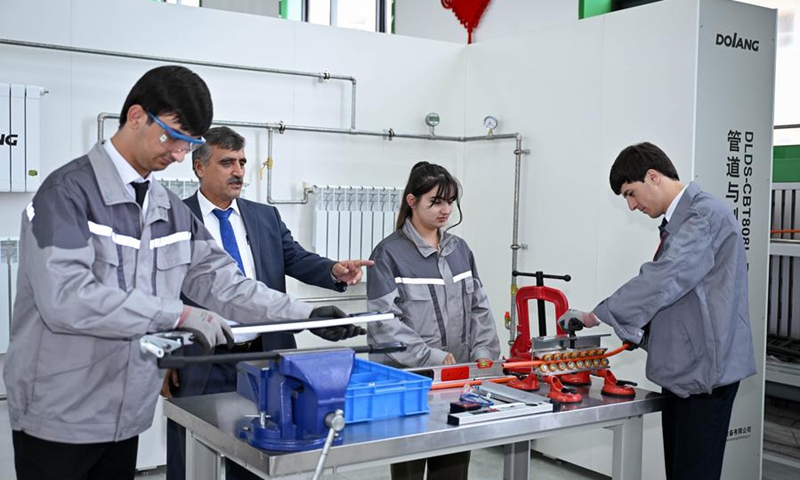
Students learn skills at the Luban Workshop in Dushanbe, Tajikistan, May 31, 2025. (Xinhua/Li Renzi)
Along with the signing of the China-Tajikistan Treaty on Permanent Good-Neighborliness, Friendship and Cooperation on Tuesday, the scale of bilateral trade is expected to further expand, radiating out to drive numerous industries and bringing more tangible benefits to the peoples of both countries, Han Dongqi, secretary-general of the Tajikistan Federation of Overseas Chinese, told the Global Times in an interview on Thursday.
Han said that the terms outlined in the treaty such as "strengthening the synergy between the Belt and Road Initiative and Tajikistan's national development strategies" and "deepening cooperation in trade, investment, energy, connectivity, minerals, agriculture, science and technology, digital economy, green development, and other areas of common interest" show that China-Tajikistan pragmatic cooperation will advance to a deeper level, with both the quality and scale of cooperation achieving a dual leap.
"The profound and enduring friendship between the two peoples has cemented the foundation for bilateral economic and trade ties," Han said.
During much of the past two decades, Han has been deeply engaged in commercial operations and China-Tajikistan exchanges. Not only did he participate in the construction of landmark projects such as Central Asia's first Luban Workshop, but he also spearheaded the establishment of Tajikistan's first Chinese library.
"When I first arrived in Dushanbe [the capital of Tajikistan] years ago, I had a storefront in the wholesale market. In my spare time, a local youth would always come by to learn Chinese. He later went to study in China, and upon returning to Tajikistan, we met again. I happened to learn his Chinese name was Han Fei - sharing the same surname as me," Han said. This transnational bond of shared surnames - mentor and friend bond - is a vivid microcosm of the mutual understanding and affinity between the peoples of China and Tajikistan.
Han said that most Chinese businesspeople currently based in Dushanbe focus on the infrastructure materials sector. In the past two years, the industry has shown strong momentum, driven by surging local demand for infrastructure investment and factory construction. As infrastructure promotes people-to-people exchanges, it also creates benefits for sectors such as catering and hospitality, foreign trade, and retail. Amid rising commercial vitality, local residents gain massive employment opportunities, creating a virtuous cycle of mutual benefit and coordinated development.
During his time in Tajikistan, Han also witnessed firsthand how the Luban Workshop broadened career paths for locals. Launched in 2022, the Luban Workshop in Tajikistan is the first of its kind in Central Asia, and it has provided training to more than 1,500 local students.
Han calculated the impact: "The monthly salary of an ordinary manual worker in Tajikistan is only about 2,000 somoni ($213.59) to 3,000 somoni. But after acquiring professional skills at the workshop, that can double to 5,000 or 6,000 somoni, allowing a family to achieve a qualitative leap in its standard of living.
"The locals are extremely enthusiastic, signing up for training proactively," Han said. He looks forward to the expansion of training into fields such as culinary arts, welding, and particularly information technology and computer applications, so that the Luban Workshop can benefit even more people.
"We look forward to seeing the implementation of more high-quality projects," Han said, noting that the federation will continue to play its bridging role, actively promoting more solid, projects that benefit people and writing a new chapter of China-Tajikistan friendship through people-to-people exchanges as a bond.