


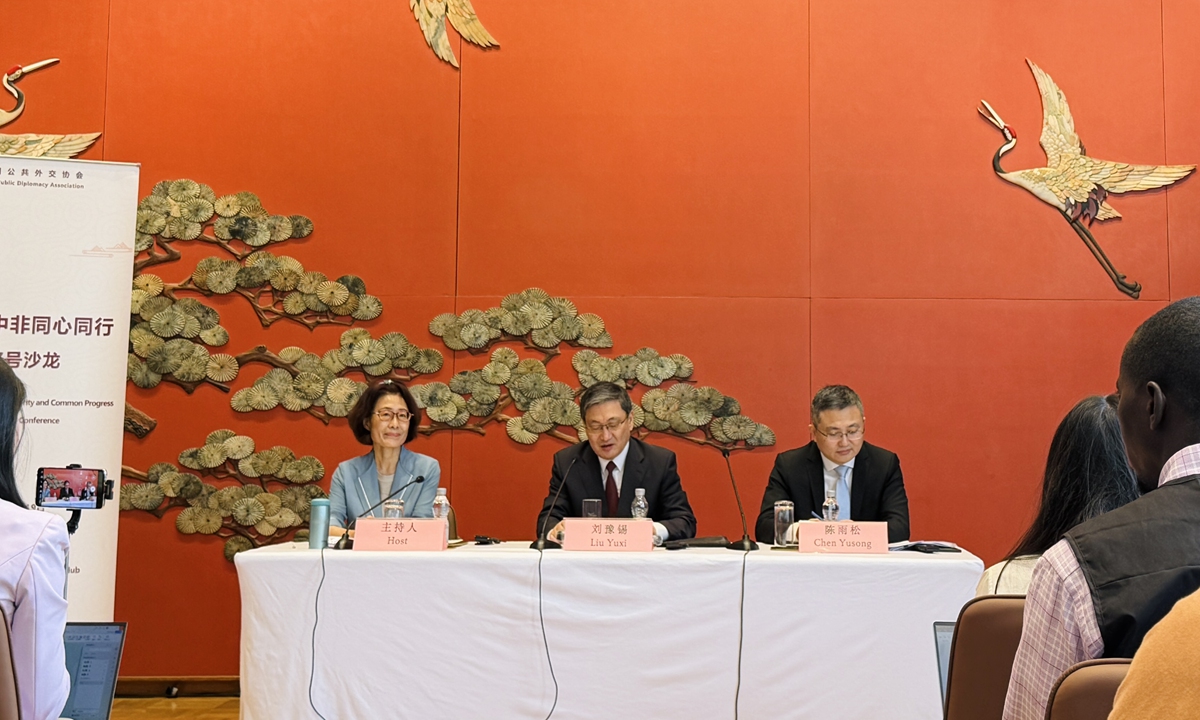
Liu Yuxi (center), ambassador for Forum on China-Africa Cooperation affairs at the Chinese Foreign Ministry, speaks at a salon on China's zero-tariff policy for African countries that have diplomatic ties with China, on May 19, 2026. (Photo: GT)
From ports along the South China Sea to those on the Bohai Rim, African products such as South African fresh apples, Kenyan avocados, Egyptian oranges, Moroccan gypsum and Nigerian cattle bone granules are moving faster into China after the zero-tariff policy for all African countries with diplomatic ties took effect on May 1.
The zero-tariff arrangement is not an isolated tariff cut, but part of a broader package of upgraded facilitation measures, Chinese officials said on Tuesday, pledging to keep advancing negotiations on the China-Africa Common Development Economic Partnership Agreement (CADEPA) to provide more durable institutional support for long-term bilateral cooperation.
The remarks came at a salon hosted by the China Public Diplomacy Association that brought together major African and Chinese media outlets for discussions on expanding China-Africa trade cooperation.
The zero-tariff policy is being advanced as part of a broader "combination package, Liu Yuxi, ambassador for the Forum on China-Africa Cooperation affairs of the Chinese Foreign Ministry, said during his speech at the salon.
As the tariff arrangement takes effect, China has also upgraded the "green channel" for African products entering the Chinese market, with the General Administration of Customs optimizing quarantine access procedures and adopting facilitation measures such as risk-based management, Liu said.
Taking African dried chili peppers as an example, the ambassador said that such products are now covered by an integrated access arrangement, allowing them to be exported to China once they meet the unified requirements set out in relevant announcements, without the need for separate access protocols to be signed one by one.
"The green channel does not mean lowering standards," he stressed, saying that it is designed to help competitive African products welcomed by Chinese consumers gain market access faster, so that the dividends of the zero-tariff policy can be translated earlier into concrete cooperation results.
In response to a Global Times question on how the policy will promote two-way industrial interaction, Liu said that zero tariffs are pushing China-Africa industrial chains toward value co-creation.
The policy is expected to lower the costs for Chinese companies investing and producing in Africa, while deepening trade, industrial and investment integration, strengthening Africa's endogenous development capacity, and providing more diversified and stable overseas supply and market support for China's development of new quality productive forces, according to Liu.
On the facilitation front, "China will continue to upgrade the green channel for African products entering the Chinese market, support enterprises in building overseas warehouses and logistics nodes in Africa, and expand e-commerce cooperation channels," the ambassador noted.
China on May 1 began implementing expanded zero-tariff treatment on imports from all 53 African countries with which it has diplomatic relations, marking a major step in the country's firm efforts to expand high-level opening-up and advance voluntary opening-up.
The measure made China the world's first major economy to unilaterally grant tariff exemptions to all African nations with diplomatic ties.
The comprehensive zero-tariff measure is an innovative, phased arrangement introduced during China's CADEPA negotiations with African countries that have diplomatic ties with China but are not classified as least-developed countries, Chen Yusong, deputy director-general of the Department of WTO Affairs at the Ministry of Commerce, said at the salon.
The arrangement is designed to address a practical difficulty, which is that some African countries may not be able to complete negotiations with China in a short period of time, allowing them to benefit from zero-tariff treatment as early as possible and better cope with current global economic turbulence, Chen said.
According to a previous announcement by the Customs Tariff Commission of the State Council, the preferential tariff treatment will run from May 1, 2026 to April 30, 2028.
During the two-year period, China and relevant African countries still need to continue negotiations and complete early-harvest talks under the CADEPA, so that African countries can enjoy comprehensive zero-tariff treatment in a long-term, stable and institutionalized manner consistent with World Trade Organization rules, Chen noted.
"China is ready to work with African countries to continue advancing CADEPA negotiations and help drive practical China-Africa cooperation onto a faster track," Chen said, adding that China is confident of achieving this goal together with African partners.
Asked about reciprocity in the arrangement, Chen said that China follows a principle of shared but non-equivalent commitments during CADEPA negotiations: both sides have shown a willingness to reduce tariffs, but China does not seek fully reciprocal tariff cuts from African countries.
African countries may make tariff-reduction commitments on some products based on their own conditions and capacity, the official said.
"China hopes that, through equal and friendly consultations, the two sides can set mutually recognized levels of preferential treatment, arrange transition periods and establish safeguard measures, so as to balance domestic industrial development with economic security while ensuring consistency with WTO rules," he noted.
China has remained Africa's largest trading partner for 17 consecutive years. The latest data showed that bilateral trade exceeded 800 billion yuan ($117 billion) for the first time in the first four months of the year.
Ethiopian coffee, Kenyan avocados, Gambian cashew nuts and Tanzanian sesame have already formed stable demand in the Chinese market. "China believes the zero-tariff measure will further facilitate the expansion of African exports to China, while also effectively enriching supply in the Chinese market and providing consumers with more diversified new choices," Chen noted.
Over the longer term, the policy also speaks to Africa's aspiration to export more manufactured goods, beyond agricultural and mineral products.
The zero-tariff measure provides strong policy momentum for supporting China's expanded direct investment in Africa, helping break the traditional international division of labor in which Africa exported raw materials and imported manufactured goods, Chen said.
"This will open a new path for African countries' economic development beyond the Western model," he added.
Arkebe Oqubay, a former senior minister and special adviser to the prime minister of Ethiopia, told the Global Times that the zero-tariff treatment will contribute to increased investment in manufacturing and value addition based on inputs from agriculture and mineral resources, helping develop productive capacity across the continent.