


Guangdong Customs announced 20 new initiatives to streamline cross-border trade and customs cooperation across the Guangdong-Hong Kong-Macao Greater Bay Area at a news conference in Guangzhou on Thursday, targeting faster clearance times and deeper regulatory alignment with the two special administrative regions.
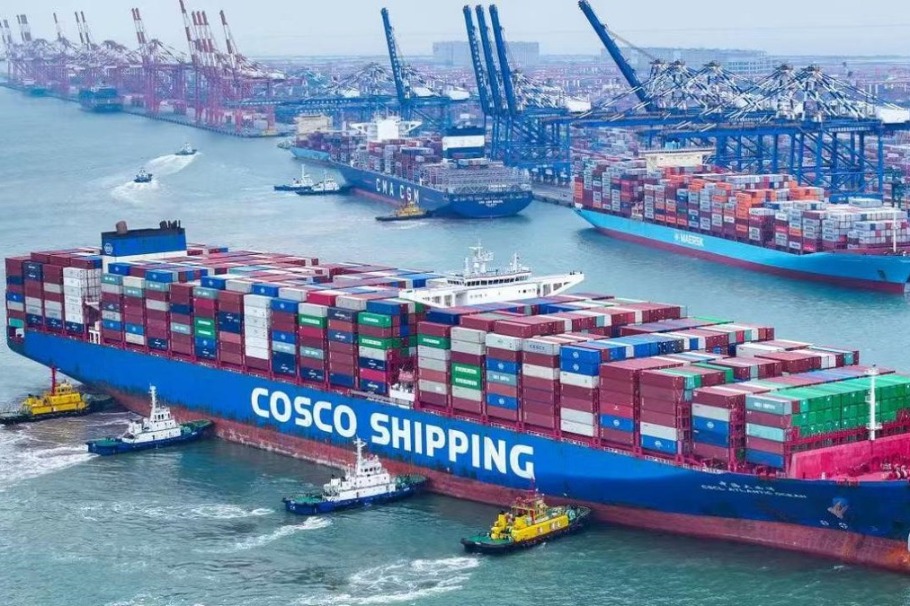
Photo via China Daily
The initiatives cover five areas: integrated development, science and innovation, new business forms and models, the dual-circulation development framework, and major cooperation platforms.
Speaking at the news conference, Zhang Geping, director of the Guangdong Sub-Administration of Customs, laid out the goals of the initiatives and the context in which they operate.
Trade volume across the nine mainland cities of the GBA surpassed 9 trillion yuan ($1.32 trillion) in 2025, and reached a record 3.4 trillion yuan in the first four months of this year, up 18.4 percent year-on-year, said Zhang, adding that the region contributed a quarter of China's total foreign trade growth over the period.
The new measures include expanding the "one document, dual declaration" mechanism, which allows enterprises to submit a single declaration valid across both regions, cutting declaration time by half. The cross-border single-lock supervision system will also be broadened, reducing customs clearance time for freight by 30 percent, Zhang said.
Targeted policies tailored to each zone would be rolled out for the Hengqin, Qianhai, and Nansha pilot free zones and the Hetao Shenzhen-Hong Kong Science and Technology Innovation Cooperation Zone, Zhang said.
Lin Shaobin, director-general of General Administration of Customs' General Operations Department, said the new measures precisely cater to the needs of innovative foreign trade development in the GBA.
Lin also outlined an inspection model for high-tech goods sealed in vacuum packaging that cannot be opened at ports, allowing them to be transported to qualified venues for examination, reducing clearance times and the risk of damage to sensitive cargo.