


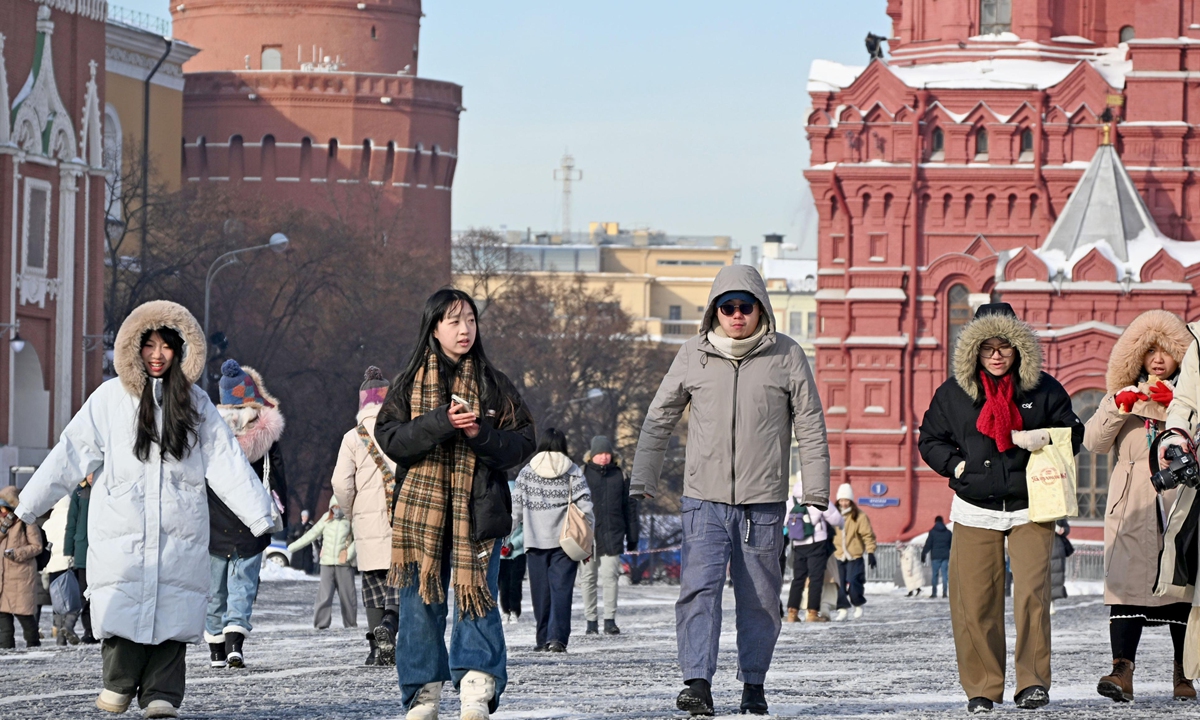
Chinese tourists walk through Moscow's Red Square on February 18, 2026, during the Lunar New Year holidays. (Photo: VCG)
Moscow welcomed more than 470,000 visitors from China in 2025 and China broke into the top five in terms of tourist flow growth to the Russian capital, the Moscow City Tourism Committee said in a statement sent to the Global Times on Sunday. The visa-free program is expected to become one of the key drivers of further growth in tourist arrivals from China, the committee said.
The tourism authority of the Russian capital made the comment in response to a Global Times inquiry about China-Russia cooperation in tourism following Russian President Vladimir Putin's state visit to China last week.
The Chinese Foreign Ministry announced last week that China has decided to extend the visa-free policy for Russian citizens to December 31, 2027. Russia, like China, will extend the visa-free regime through 2027, Kremlin spokesperson Dmitry Peskov told Russian news agency TASS on the same day, noting that the visa-free program has yielded very positive results. Russia implemented a visa-free policy of up to 30 days for Chinese nationals in December last year.
"We expect simplified travel procedures to support stronger people-to-people exchanges and encourage more group, individual, cultural and business travel between the two countries in 2026 and beyond," said Evgeny Kozlov, chairperson of the Moscow Tourism Committee.
Data for the first quarter of 2026 is set to be published in June, the committee said. According to surveys conducted among Chinese tour operators, Russia ranked No.6 worldwide for Chinese New Year travel in 2026 - with Moscow frequently singled out as the destination of choice.
The visa-free program significantly simplifies travel planning, lowers barriers for first-time visitors and makes short-term and spontaneous trips more accessible. It also reflects the growing openness and connectivity between Moscow and the Chinese market. Together with expanding air connectivity, active cultural exchanges and Moscow's promotion in the Chinese market, it creates favorable conditions for continued tourism growth, the committee said.
During the period of the visa-free program, Russia was visited by 2 million Chinese citizens, while about 1 million Russians traveled to China, according to TASS, which quoted Russian presidential aide Yury Ushakov.
As of the end of 2025, 84 percent of Chinese tourists had opted for independent travel rather than organized tours. The recently introduced visa-free program is expected to further boost solo trips, the committee said, noting the latest travel pattern of Chinese tourists to Moscow.
The age profile is also shifting, as 53 percent of visitors are now between 18 and 35 years old. This new generation is seeking authentic experiences, local culture, traditions, and nature-based recreation - expanding the traditional tourist map far beyond classic sightseeing itineraries, the committee said, predicting this positive trend to continue in 2026.
There is also noticeable and strong interest, as well as a reorientation toward the Chinese tourist on the part of Moscow businesses, according to the committee.
For example, during the Chinese New Year festival in Moscow, a record number of companies took part in the celebrations - more than 40 hotels offered gifts and special deals to Chinese tourists, while more than 140 restaurants offered special holiday menus.
Since the implementation of the visa-free policy for Chinese citizens, Russia has consistently been one of the fastest-growing outbound travel destinations, the Beijing Daily reported on May 21, citing travel information platform qunar.com. So far this year, the most popular destinations for Chinese tourists flying to Russia have been Moscow, Vladivostok, St. Petersburg, Irkutsk, and Khabarovsk.
During the upcoming summer vacation, which covers July and August, hotel bookings in Russia have more than doubled year-on-year, and air ticket bookings by Chinese tourists to St. Petersburg have also more than doubled, the report said.