


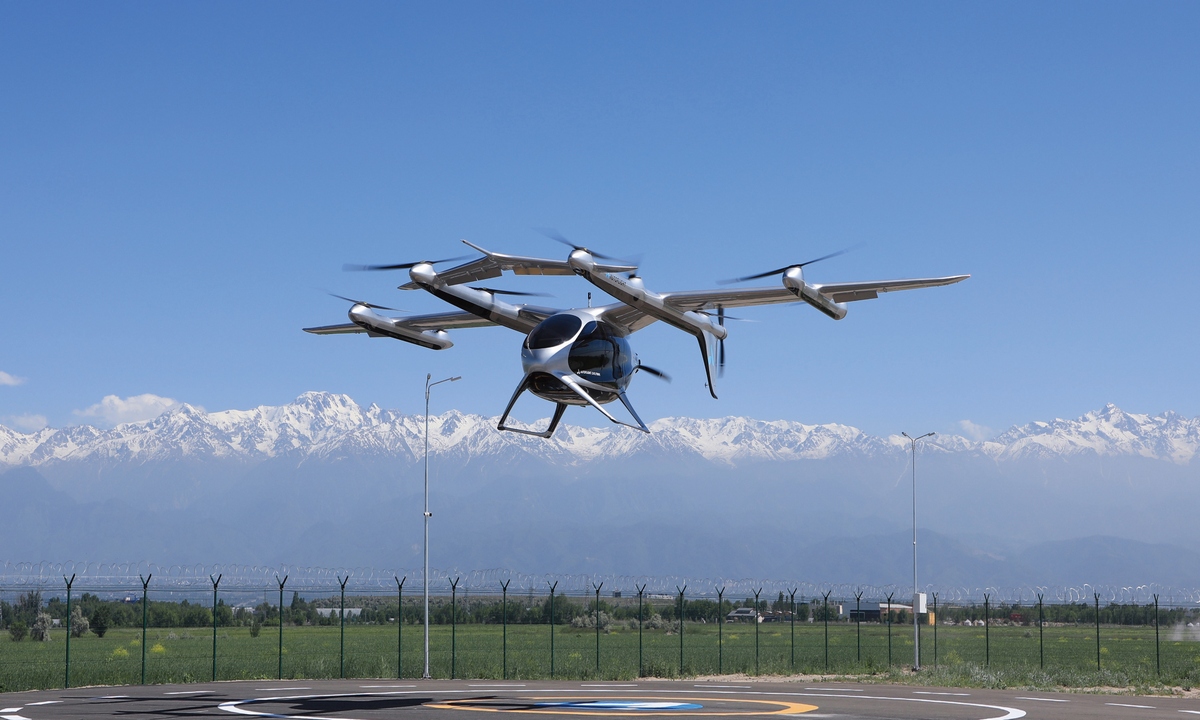
Chinese eVTOL developer AutoFlight completes a demonstration flight of its self-developed 2-ton eVTOL craft in Almaty, Kazakhstan, on May 19, 2026. (Photo: Courtesy of AutoFlight)
As a major drone and aerial industry exhibition opened in Shenzhen, South China's Guangdong Province on Thursday, visitors crowded the exhibition stands to check out the state-of-the-art aviation products, gathering around a streamlined 2-ton electric vertical take-off and landing vehicle (eVTOL) prototype to experience the vision of future air travel.
Meanwhile, thousands of kilometers away in Almaty, Kazakhstan, Chinese eVTOL maker AutoFlight had recently completed a landmark demonstration flight of its self-developed eVTOL craft.
As Chinese eVTOL developers advance at home and abroad, the Civil Aviation Administration of China (CAAC) has set up a low‑altitude safety department. This is the second national‑level body dedicated to the sector, following the low‑altitude economy department launched by the National Development and Reform Commission (NDRC) in December 2024.
The upgraded national-level industrial planning and aviation governance have laid a solid foundation for the long-term, standardized and high-quality growth of China's low-altitude economy, insiders said.
Breakthroughs in progressThe 2026 International Low Altitude Economy and Unmanned Systems Expo has drawn more than 1,200 Chinese and foreign companies across 110,000 square meters, displaying over 10,000 products including drones, eVTOLs and flying cars.
FCourier, a brand under Chinese eVTOL manufacturer Vertaxi, stole the spotlight by unveiling its 2‑ton eVTOL prototype M1, the first full-size large eVTOL ever displayed at the expo. The company also debuted two new products: the E80A cargo drone designed to fill logistics blind spots within the last 100 kilometers, support emergency rescue operations and remote medical deliveries, as well as the AP5 automatic airport system. The latter enables the round-the-clock autonomous drone operations, widely applicable to energy inspection, forestry management, border patrol and maritime supervision.
Overseas expansion is also gaining momentum. On May 19, AutoFlight completed a landmark demonstration flight of its 2-ton-class eVTOL aircraft in Almaty, Kazakhstan, which represents the first urban air mobility flight conducted by large-scale eVTOL models across Central Asia.
The achievement not only facilitates in-depth technological connectivity between China's advanced eVTOL solutions and Central Asia's local low-altitude industry, but also builds a new model for green and smart transportation cooperation under regional frameworks, according to the information the company shared with the Global Times.
New safety regulator formedThe booming domestic and overseas expansion of low-altitude businesses coincides with the launch of the dedicated low-altitude safety department under CAAC.
CAAC said the new department is responsible for formulating development plans for low‑altitude civil aviation, coordinating low‑altitude safety and development, and building low‑altitude flight service dispatch platforms and flight service station systems, according to the Xinhua News Agency.
This institutional arrangement comes amid China's nationwide drive to unlock the huge potential of the low-altitude economy, which covers diverse economic activities relying on manned and unmanned aircraft operating mainly within 1,000 meters above ground.
Back in December 2024, the NDRC already established a special department focusing on low-altitude economy development, responsible for drafting medium and long-term strategic blueprints, releasing targeted policy suggestions and coordinating major cross-industry issues, according to Xinhua.
The dual-department governance model has clarified respective responsibilities for industrial planning and professional aviation supervision, winning wide recognition and positive responses from leading market players.
AutoFlight told the Global Times that the firm highly welcomes the establishment of the new institution, as it believes clear rules will be set for the safe operation of the industry.

A visitor explores cutting-edge eVTOL displays at the 2026 International Low Altitude Economy and Unmanned Systems Expo in Shenzhen, South China's Guangdong Province, on May 21, 2026. (Photo: Courtesy of Vertaxi)
Michael Sheng, vice president of Vertaxi, told the Global Times that for the day-to-day operations of eVTOL enterprises, the policy benefits are highly tangible. Clearer categorized approval workflows will greatly raise efficiency in aircraft type certification, flight service application and air route planning. In addition to that, clarified industrial compliance norms will help enterprises win more capital investment and deepen cooperation with local governments, thus greatly enhancing overall business stability.
According to Sheng, Vertaxi's small and medium eVTOL revenue has grown rapidly for three consecutive years while its large cargo eVTOL M1B is advancing the process to obtain official cargo operation certification.
Aerofugia, another leading domestic eVTOL developer, also voiced full affirmation of the new regulatory setup, noting that targeted policy support brings unprecedented development certainty and strong growth momentum for the whole sector.
"Previously, the industry was held back by inconsistent rules covering research and development [R&D] progress, airworthiness verification, airspace management and commercial flight operations. The establishment of the low-altitude safety department has set unified industrial standards, bridged regional regulatory gaps and greatly shortened the commercialization cycle of our products," a company spokesperson told the Global Times.
Currently Aerofugia has secured more than 1,000 eVTOL orders and it is exploring diverse operational scenarios, including integrated air travel services, business jet linkage and cross-region low-altitude tourism projects.
Li Hanming, a civil aviation insider, told the Global Times that the CAAC department's debut indicates the low‑altitude economy has "passed the concept stage and entered regularized, institutionalized supervision."
"This means future low-altitude flight policies will be more enforceable and practically implementable," Li noted.
The continuous improvement of regulatory systems is rooted in the vigorous market expansion of the low-altitude economy. CAAC forecasts that China's low-altitude economic scale will surpass 3.5 trillion yuan ($511 billion) by 2035, according to Xinhua.
Industry insiders remain highly optimistic about the long-term prospects of this emerging sector.
Sheng believes the sector is poised to enter a new phase marked by stronger policy implementation, improved industrial standards and accelerated commercial rollout.
China's low-altitude economy is entering a new era with solid policy execution, unified industry standards and faster commercial rollout. In the near term, complete regulations and supporting infrastructure will be put in place; in the medium term, more low-altitude applications will become commercially viable alongside improved industrial chains; and in the long run, low-altitude mobility will be integrated into urban transport systems, unlocking vast market potential, Michael Sheng said.
Aerofugia also voiced an upbeat outlook on the booming sector. The firm expects mainstream eVTOL manufacturers to complete R&D as well as airworthiness certification between 2026 and 2027, followed by trial operations of intercity fixed flight routes from 2027 to 2030. Regular commercial services are likely to become widely available after 2030.