


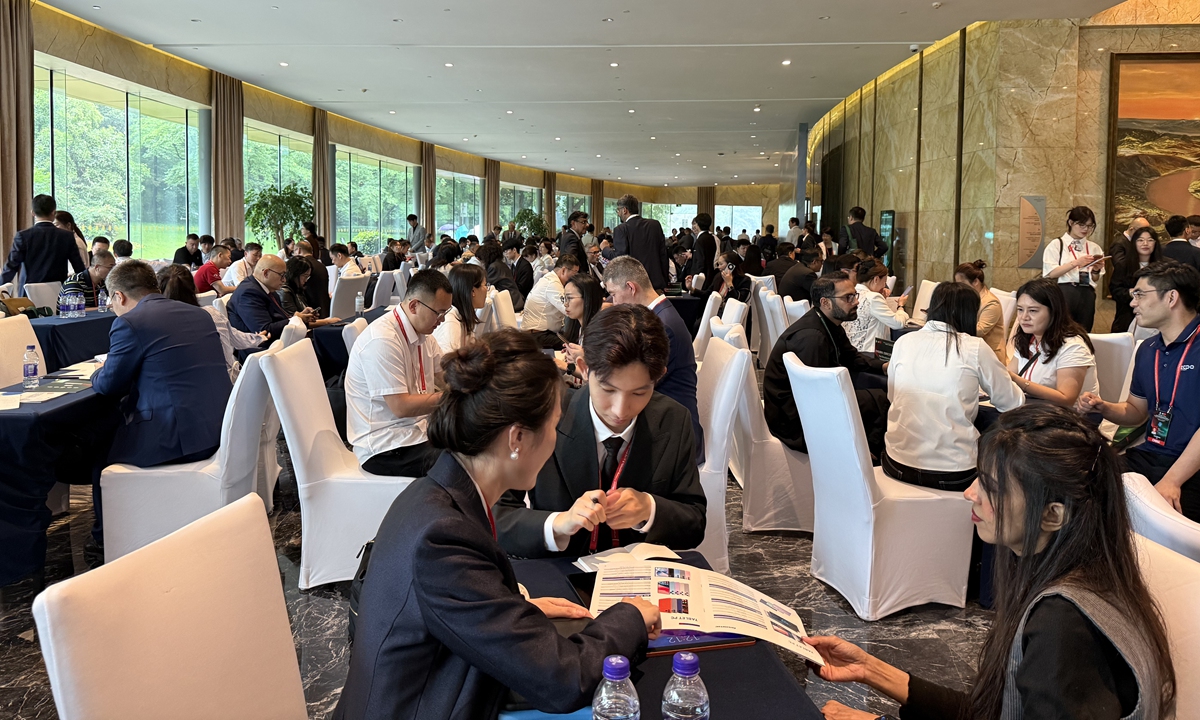
Chinese and Pakistani business representatives communicate during matchmaking sessions at the Pakistan-China B2B Investment Conference in Hangzhou, East China's Zhejiang Province, on May 24, 2026. (Photo: Global Times)
The third Pakistan-China B2B investment conference was held in Hangzhou, East China's Zhejiang Province, on Sunday, attracting more than 500 leading enterprises from both countries. As one of the key events during Pakistani Prime Minister Shehbaz Sharif's visit to China, the conference highlighted new trends of cooperation between China and Pakistan in information technology and other emerging industries.
Sharif attended the conference and delivered a keynote speech, expressing expectations for deeper bilateral cooperation in key areas including information technology (IT) and the digital economy.
Heavy rain poured outside the Hangzhou venue on Sunday, but inside the Hangzhou International Conference Center, the atmosphere was lively and energetic. Participants engaged in in-depth discussions on IT and telecoms, BESS and agriculture - all sectors in which China has developed strong advantages in recent years and that are also key industries Pakistan urgently hopes to upgrade.
As Sharif put it, "Pakistan is looking for expertise, experience and investment." China, meanwhile, offers technology, industrial capacity and innovation ecosystems that Pakistan is eager to learn from. This also explains why the conference was held in Zhejiang's Hangzhou, a major tech hub and home to a thriving digital innovation ecosystem.
The conference focused on three major sectors - IT and telecoms, battery energy storage systems (BESS), and agriculture. The IT and telecoms sector covered several priority subsectors, including e-commerce, fintech, cybersecurity, artificial intelligence (AI), gaming and animation, telecom hardware, mobile phones and handheld devices.
As a business-oriented and results-driven investment matchmaking event, the conference targeted multiple emerging sectors with strong growth potential, providing a platform for direct communication and practical cooperation between enterprises from both countries. Inside the matchmaking venue, hundreds of Chinese and Pakistani companies explained their businesses, exchanged contacts with potential investors and partners, discussed possible areas of cooperation, and signed MOUs one after another.
Adnan Aftab from Select Technologies told the Global Times that this was his third time attending a China-Pakistan B2B investment conference. "Every conference brings new opportunities. New companies and entrepreneurs join every time, and we get the chance to explore cooperation across different sectors," he said.
Aftab noted that the battery sector was among his main areas of interest at this year's conference, as he works in the mobile phone and laptop manufacturing industry and sees significant opportunities in Hangzhou. "China is among the world's leading countries in digitalization and technology. For Pakistan, it is an honor to work with Chinese companies to advance digitalization," he said.
"We have been cooperating with Chinese companies for more than 20 years. It is always a pleasure to work with them. They are highly professional and extremely capable," Aftab added.
A Chinese representative from Ruanjiang Turing AI Tech Co Ltd told the Global Times that during the conference, multiple Pakistani companies approached the firm to exchange contact information and express interest in potential cooperation.
The representative said that Chinese AI companies hold advantages in areas such as algorithms, chips and practical applications, while direct engagement with Pakistani firms helps identify concrete AI application scenarios in Pakistan, including healthcare and security. "By targeting specific local needs, products are more likely to achieve practical implementation," the representative said.
Mian Khalil Ahmad from The Grains Industries Private Ltd said that his company is committed to introducing the latest global manufacturing technologies and applying them in Pakistan's food-processing industry, including flour mills, rice mills and edible oil plants.
"China has advanced technology and many strong enterprises and corporate groups seeking sustainable growth opportunities. If Chinese companies invest capital and transfer technology to Pakistan, both sides can achieve common development," Ahmad told the Global Times.
Zhejiang has long been at the forefront of China-Pakistan local cooperation. According to Zhejiang Governor Liu Jie, two-way trade between Zhejiang and Pakistan reached $6.74 billion in 2025, up 19.3 percent year-on-year. Zhejiang's exports to Pakistan totaled $5.82 billion, up 23.5 percent.
In terms of investment, Zhejiang enterprises have invested in 43 companies in Pakistan, with registered investment totaling $116 million, while Pakistani investors have established 917 enterprises in Zhejiang with contracted investment worth $360 million.
"Zhejiang is one of China's most dynamic regions for private-sector development and innovation," Liu Zongyi, director of the Center for South Asia Studies at the Shanghai Institutes for International Studies, told the Global Times. "Pakistan's strong interest in Zhejiang reflects the Pakistani government's strong desire to boost economic development and enhance its economic capacity. China's innovation-driven economy, e-commerce sector and private enterprises can play an important role in Pakistan's economic transformation."