


The 2026 Asia-Pacific Economic Cooperation Ministers Responsible for Trade Meeting concluded on Saturday in Suzhou, Jiangsu province, after helping forge broad consensus among participating economies on economic and trade cooperation, government officials and business executives said.
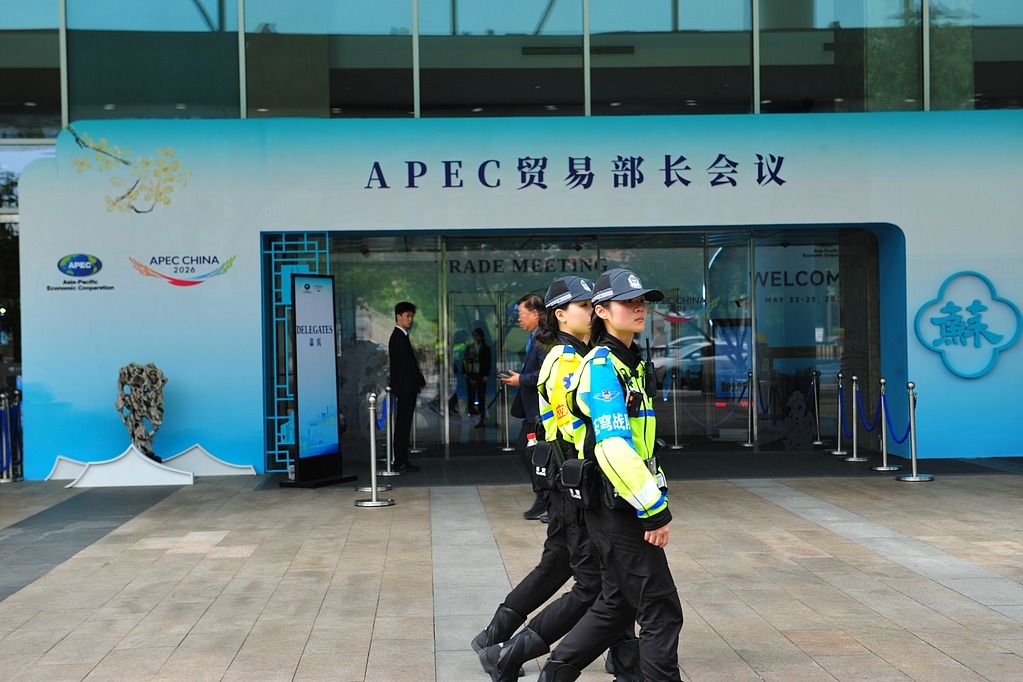
Photo via China Daily
Speaking at a news conference after the meeting, Commerce Minister Wang Wentao said that representatives from APEC economies, APEC observers, the World Trade Organization and other international organizations held candid, in-depth and constructive discussions and achieved fruitful results.
The two-day meeting concluded with the release of the 2026 APEC Ministers Responsible for Trade Joint Statement and the approval of the APEC Roadmap for Innovative, Competitive and Resilient Services.
Wang said the meeting reaffirmed support for the long-term vision of the Free Trade Area of the Asia-Pacific, helped advance discussions on WTO reform, and set out a roadmap for the development of the services sector over the next decade to deepen regional economic integration.
Carlos Kuriyama, director of the Policy Support Unit at the APEC Secretariat in Singapore, said that amid rising protectionism, advancing trade agreements remains of great significance.
Citing the continued efforts by many APEC economies to advance free trade arrangements, including the expansion of the Comprehensive and Progressive Agreement for Trans-Pacific Partnership and the upgrading of the China-ASEAN Free Trade Area, he said these efforts will help lower trade barriers and create better conditions for China's imports.
China has signed 24 free trade agreements or economic and trade deals with 31 countries and regions, including 15 APEC economies. In recent years, it has also completed upgrades to free trade agreements with APEC economies such as Singapore and Peru, according to the Ministry of Commerce.
Reflecting the deepening economic ties between China and other APEC economies, East China's Jiangsu province saw its trade with APEC economies reach 1.44 trillion yuan ($212 billion) in the first four months of this year, up 21.7 percent year-on-year, statistics from Nanjing Customs showed.
The meeting also brought about a fresh consensus on strengthening digital trade cooperation, substantive progress on a regional digital trade cooperation framework, and the exploration of new measures to advance green trade.
As trade patterns evolve, Tu Xinquan, dean of the China Institute for WTO Studies at the University of International Business and Economics in Beijing, said the traditional multilateral trading rules system, mainly designed for goods and services trade, has limited adaptability to emerging issues.
"APEC economies should therefore be encouraged to pioneer new approaches within the WTO framework through plurilateral arrangements," Tu said.
Business leaders said these efforts will strengthen supply chains and accelerate cross-border industrial collaboration in the Asia-Pacific region.
German testing, inspection and certification company Dekra Group plans to open two new testing centers in Suzhou and Chongqing in the second half of the year, expanding its services for automotive components, consumer electronics and other industries in China and other Asia-Pacific markets.
Kilian Aviles, executive vice-president of Dekra and head of its Asia-Pacific arm, said continued efforts by APEC economies to advance trade facilitation, digital cooperation and regulatory connectivity will help companies reduce compliance costs and improve the efficiency of regional business operations.