


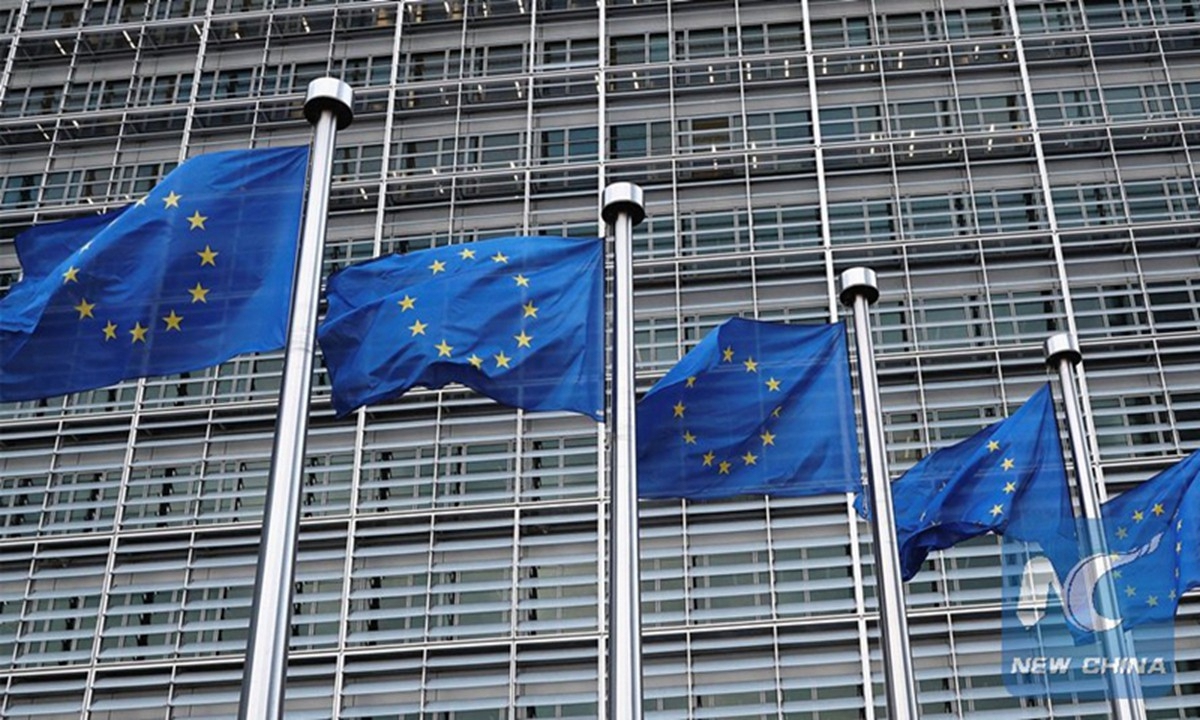
The European Union flags in front of EU headquarters in Brussels, Belgium. (Photo: Xinhua)
Germany and Spain are leading opposition to European Commission (EC) plans to ban Chinese technology suppliers from telecom networks as part of new cybersecurity rules, Bloomberg reported on Wednesday (European time), citing people familiar with the negotiations.
Officials from the countries want to keep state-level control and have expressed concerns that banning products from China's Huawei Technologies Co and other Chinese suppliers at the EU level risks retaliation, according to the report, citing anonymous sources. The states also warned that a ban risks making the bloc's plans to build out artificial intelligence (AI) infrastructure more expensive.
The reported stance by Germany and Spain, two important members of the EU, with concerns about decision-making power on supplier risks being raised, has underlined opposition and divisions from EU members on the EC's proposed revision of the Cybersecurity Act (CSA2), Chinese analysts said on Thursday. The proposed EU rule goes against market principles and is set to harm the interests of EU consumers, analysts said.
They noted that the EU's proposed revision of the CSA2 essentially reflects a Cold War mentality in handling China-EU relations. The rational opposition has laid bare the EC approach, which is not based on mutual benefit but rather turns hypothetical risks into actual policy restrictions without a rational foundation, they said.
The voice from Germany and Spain came as the EC proposed a new cybersecurity package including a "Proposal for a Regulation for the EU Cybersecurity Act" in January, which aims to gradually phase out components and equipment from "high-risk suppliers" in critical infrastructure. This move is widely seen as targeting Chinese companies and forms part of a broader set of EU protectionist tools targeting China.
The EC has labeled Huawei and ZTE Corp "high-risk suppliers" for telecom networks, and Brussels has urged member states to exclude the two companies from connectivity infrastructure by pushing for stronger oversight through revisions to its Cybersecurity Act, which would expand cybersecurity assessments to include the risks of foreign state influence and dependency on particular suppliers, while making the commission's recommendations legally binding across the EU, according to the Bloomberg report.
According to the Bloomberg report, a representative for Spain said the country supports the act's revision but "believes that member states must continue to have adequate participation in the decision-making process regarding whether a country, supplier or products present certain structural risks."
German Economy and Energy Minister Katherina Reiche, who is visiting China this week, said in Beijing on Wednesday that the EU should ensure that any measures it applies on Chinese trade do not harm the bloc's exports to China, according to a separate report by Bloomberg.
Li Yong, an executive council member of the China Society for WTO Studies, told the Global Times on Thursday that the reported opposition from Germany and Spain reflects facts-based rationality from some EU countries.
"Chinese enterprises have provided tangible technological progress in past cooperation, offering more mature technology, lower costs, and significant accessibility advantages. At the same time, Chinese technology offers ecosystem compatibility that meets the needs of the European internet environment, and it has shown friendly integration into local ecosystems," Li said, adding that Chinese companies have so far maintained a good security record, despite all the noise that says otherwise.
Experts have criticized some EU politicians for acting out of a Cold War mentality and using security as a pretext to suppress Chinese companies. Such practices not only increase costs for users and reduce efficiency, but also undermine high-tech cooperation between China and Europe.
"As seen from the report, Germany and Spain are trying to bring rationality back to technical and economic cooperation and keep it away from political distortion, allowing each country to independently choose its partners based on its specific national conditions and security needs," Li said. "Rational voices from these major EU countries should be heard and valued in today's international political and economic environment."
The EU move has drawn criticism from multiple Chinese chambers. The China Chamber of Commerce to the EU said earlier this month that the EU's proposed revision of the Cybersecurity Act could carry a price tag of nearly 367.8 billion euros ($427.04 billion) if it forces the replacement of Chinese suppliers across 18 critical sectors.
Some European countries are beginning to adopt a more rational approach at the bilateral level, placing greater emphasis on market principles and real economic interests, and expressing a willingness to maintain cooperation with China, Zhang Jian, a vice president of the China Institutes of Contemporary International Relations, told the Global Times on Thursday.
Reiche said on Wednesday that the German business community remains optimistic about China's economic outlook and innovation capabilities and will continue to deepen cooperation with China, according to the Xinhua News Agency.
On May 8, Chinese Foreign Ministry spokesperson Lin Jian said that China's competent authorities submitted comments to the European Union regarding the draft revision of its Cybersecurity Act, expressing China's serious concern and formal position.
Lin expressed China's willingness to engage in dialogue with the EU on the issue, saying Beijing hopes that the bloc could view the China-EU economic and trade relations in a comprehensive, objective and positive manner, abide by the WTO rules and market principles, and stop actions that hurt others while bringing no benefits to its own. Lin warned that, if the EU side insists on revising the Act and treating Chinese firms in a discriminatory way, China will take resolute measures to safeguard the firms' legitimate rights and interests.