


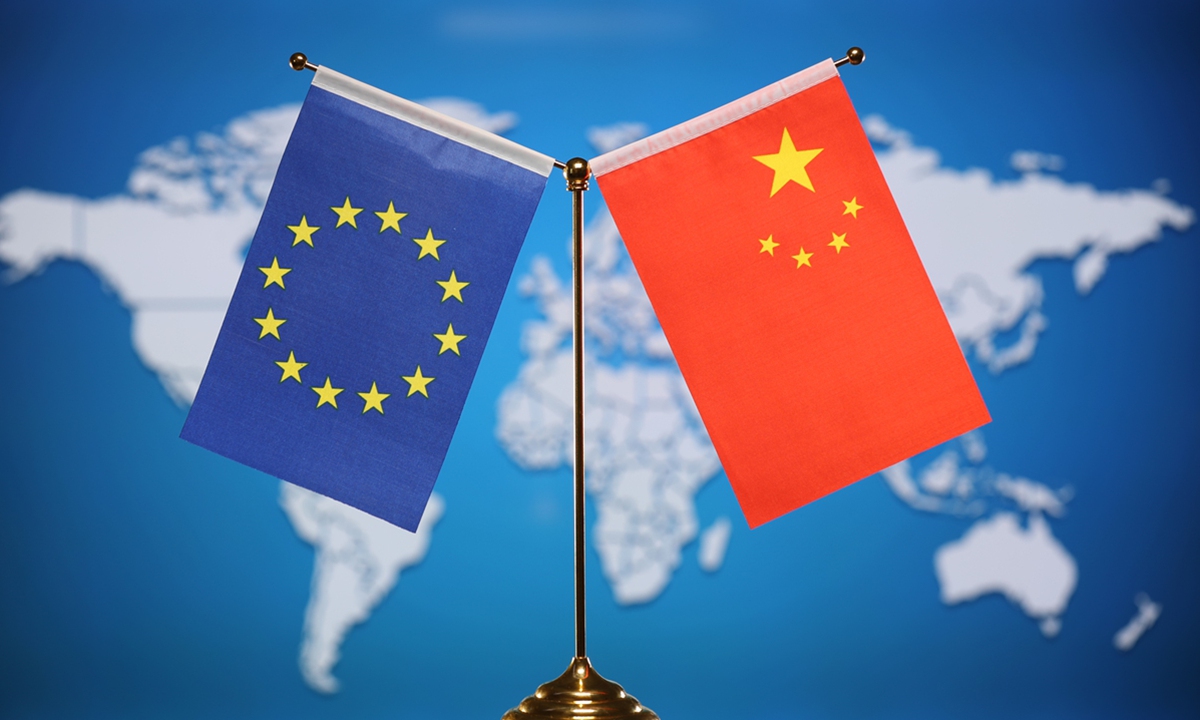
China EU Photo:VCG
China's foreign ministry on Thursday urged the European Union to view its trade ties with China comprehensively and objectively and honor its commitment to free trade, after reports claimed the EU plans to expand tools to address "imbalanced trade" with China including using import quotas and tariffs on Chinese goods.
Whatever the terms - "de-risking," "reducing reliance" or "trade imbalance," they are protectionism in nature, and will only hurt the interest of European consumers, raise companies' costs and weaken Europe's industry competitiveness in the long run, Chinese Foreign Ministry spokesperson Mao Ning said on Thursday.
Mao made the remarks in response to a question from AFP seeking comments after European Union's industry chief told the Financial Times newspaper ahead of a meeting of EU commissioners on Friday that the EU plans to expand tools to address imbalanced trade with China which includes stepping up the use of import quotas and tariffs to protect certain sectors like chemicals and clean technology against unfair competition.
"International trade is a two-way street. There's no forced trade. The China-EU trade relations are win-win in nature. China does not aim for trade surplus. Focusing only on trade in goods while ignoring trade in services and investment returns, on pure quantities while overlooking trade structure and profit flows, and on imports from China while neglecting one's own export restrictions - anyone who sees trade this way sees nothing but imbalance," Mao said.
The EU needs to put trade ties with China in perspective and honor its commitment to free trade. China will closely follow the EU's moves and take all measures necessary to safeguard legitimate rights and interests, Mao stressed.
EU Industry Commissioner Stéphane Séjourné has claimed that "the EU would deploy import quotas and tariffs more systematically because European industries such as chemicals, metals and clean technology were at risk of being destroyed by unfair Chinese competition," the Financial Times reported on Thursday.
"Our objective is not to break with China but to have a real rebalancing and real measures that allow us to do it," Séjourné claimed.
The EU official's rhetoric adds weight to recent China-EU economic and trade tensions. The European Commission (EC) proposed a new cybersecurity package including a "Proposal for a Regulation for the EU Cybersecurity Act" in January, which aims to gradually phase out components and equipment from so-called "high-risk suppliers" in critical infrastructure.
Moreover, the European Parliament approved on May 19 limits to duty-free steel imports into the EU. The measures are to take effect from July 1, according to the European Parliament's website.
In 2025, the main sources of steel imports into the EU were Turkey, South Korea, Indonesia, the Chinese mainland, India, Ukraine, and the island of Taiwan, Reuters reported.
China is currently engaged in negotiations with the EU within the framework of the World Trade Organization (WTO) on the EU's plan, China's Ministry of Commerce said on Thursday.
The EU's move is essentially trade protectionism, which not only fails to uphold the competitiveness of its steel industry but will also severely disrupt China-EU steel trade and affect the stability of global production and supply chains, said ministry spokesperson He Yadong at a press briefing.
"China hopes to achieve a win-win outcome through negotiations, while promoting the stable and healthy development of China-EU economic and trade relations. Should the EU discriminate against Chinese companies and products, China will take corresponding measures to firmly safeguard its legitimate rights and interests," He Yadong said.
Despite the hardening stance toward China from some European politicians, divisions persist within the EU. Bloomberg reported on Wednesday that Germany and Spain are leading opposition to EC plans to ban Chinese technology suppliers from telecom networks as part of new cybersecurity rules, according to people familiar with the negotiations.
"Officials from the countries want to keep state-level control, and have expressed concerns that banning products from Huawei Technologies and other Chinese suppliers at the EU level risks retaliation from Beijing, the people said, asking not to be identified as the discussions are not public," according to the report.
The reported opposition from Germany and Spain reflects facts-based rationality from some EU countries, Li Yong, an executive council member of the China Society for WTO Studies, told the Global Times on Thursday.
"Chinese enterprises have provided tangible technological progress in past cooperation, offering more mature technology, lower costs, and significant accessibility advantages. At the same time, Chinese technology offers ecosystem compatibility that meets the needs of the European internet environment, and it has shown friendly integration into local ecosystems," Li said.
"Globalization has forged deeply symbiotic and complementary ties between China and the EU. Turning to protectionism is not the cure for Europe's weakening industrial edge or its anemic growth but will only miss opportunities," Zhang Jian, a vice president of the China Institutes of Contemporary International Relations, told the Global Times.
China has always regarded Europe as a sincere partner and has shown ample goodwill toward the EU. However, such goodwill is not without boundaries. Any unilateral measure that undermines the legitimate interests of Chinese companies will be met with resolute countermeasures from China, Zhang said.