


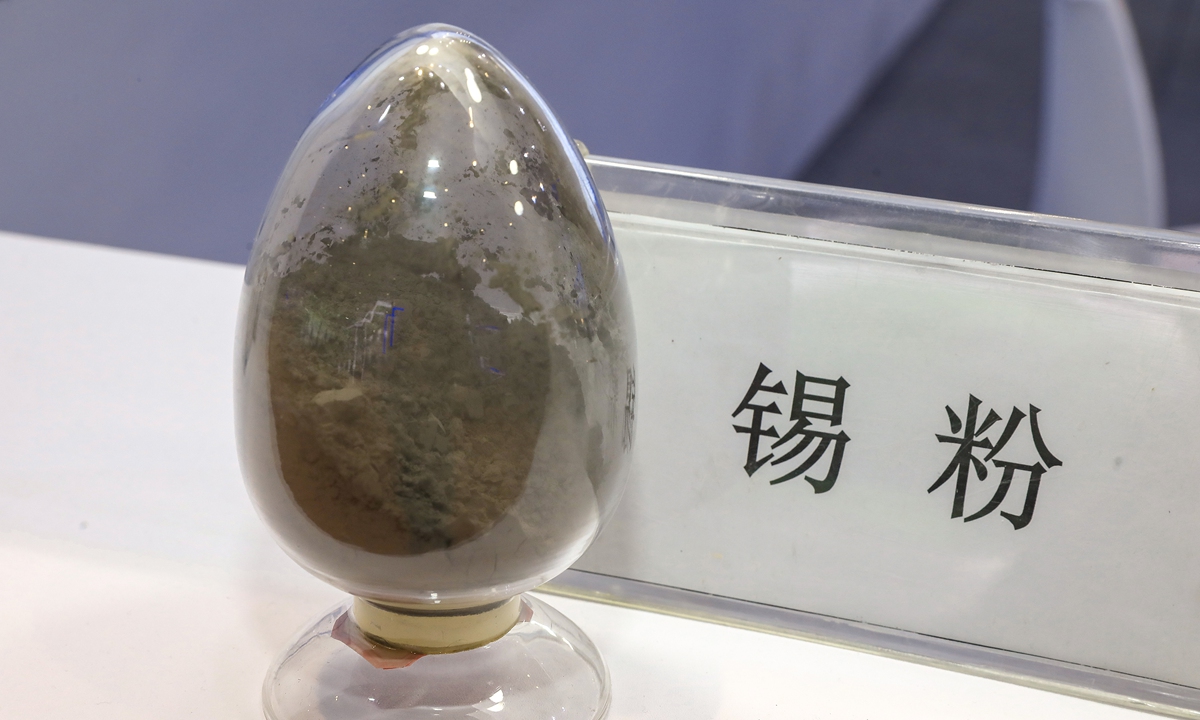
Tin powder on display at the 18th China International Powder Metallurgy and Cemented Carbide Exhibition (PM China 2026) in Shanghai on March 24, 2026. (Photo: VCG)
The price of tin, hailed as the "metal of computing power," has surged about 40 percent within six months in China, reaching a historic high. Industry insiders said that behind this price hike lies a combination of factors including a reshaped global supply-demand structure and explosive growth in artificial intelligence (AI) technology.
Tin, known for its excellent conductivity, low melting point, and strong soldering stability, is a major material in advanced semiconductor packaging. As computing power increased and chip stacking density rises, tin consumption grows accordingly - earning it the nickname "computing power metal," according to a report by CCTV News on Monday.
Data showed that tin prices rose from 300,000 yuan ($44,342) per ton in November 2025 to approximately 420,000 yuan per ton at the end of May 2026, marking a 40-percent increase over six months and maintaining a historically high level, the report said.
Computing power, algorithms, and supporting infrastructure represent key upstream components of AI development. At its core, global AI competition is essentially a contest between computing power and energy supply, Yang Delong, chief economist at Shenzhen-based First Seafront Fund, told the Global Times on Monday.
Yang explained that the growth in AI demand is also reflected in the current tech market rally, which is centered on six core sectors, all deeply connected to AI, including semiconductor chips, computing power and algorithms, humanoid robots, solid-state batteries, commercial aerospace, and biopharmaceuticals.
Some analysts in the industry expect that tin prices will continue to rise during the coming two years. The analysts pointed out that new demand drivers such as AI and optical modules are among the key factors supporting the long-term upward trend in tin prices. The overall price level of metallic tin will remain elevated.
The boom of the AI industry is reshaping the demand structure for tin, becoming a key driver behind price increases. Traditionally, tin has been primarily used in consumer electronics and tin-plated steel sheets. Today, AI servers, optical modules, and advanced semiconductor packaging have become the main users, according to a report by the Xinhua News Agency on Monday.
Industry research shows that a single AI server uses more than three times as much tin as a conventional server, Xinhua reported.
Guo Ning, Secretary-General of the Tin Branch of the China Nonferrous Metals Industry Association, stated that the world is currently marching into an era powered by intelligent technology.
"With accelerated domestic equipment substitution, demand for high-end tin products in China will continue to rise," said Guo, according to Xinhua.
An imbalance between supply and demand is also a key reason for high tin prices. Downstream demand remains strong. Meng Bin, deputy general manager of Laibin Huaxi Smelting Co, said that currently, smelters are operating their production lines at full capacity, yet still struggle to meet robust demand, as quoted by CCTV News.
Although China is the world's largest producer and consumer of refined tin, the country relies on imports for about two-thirds of its tin ore used in smelting. Combined with export restrictions and geological disruptions affecting major producing countries such as Myanmar, Indonesia and the Democratic Republic of the Congo, global tin supply remains tight, said the CCTV News report.