


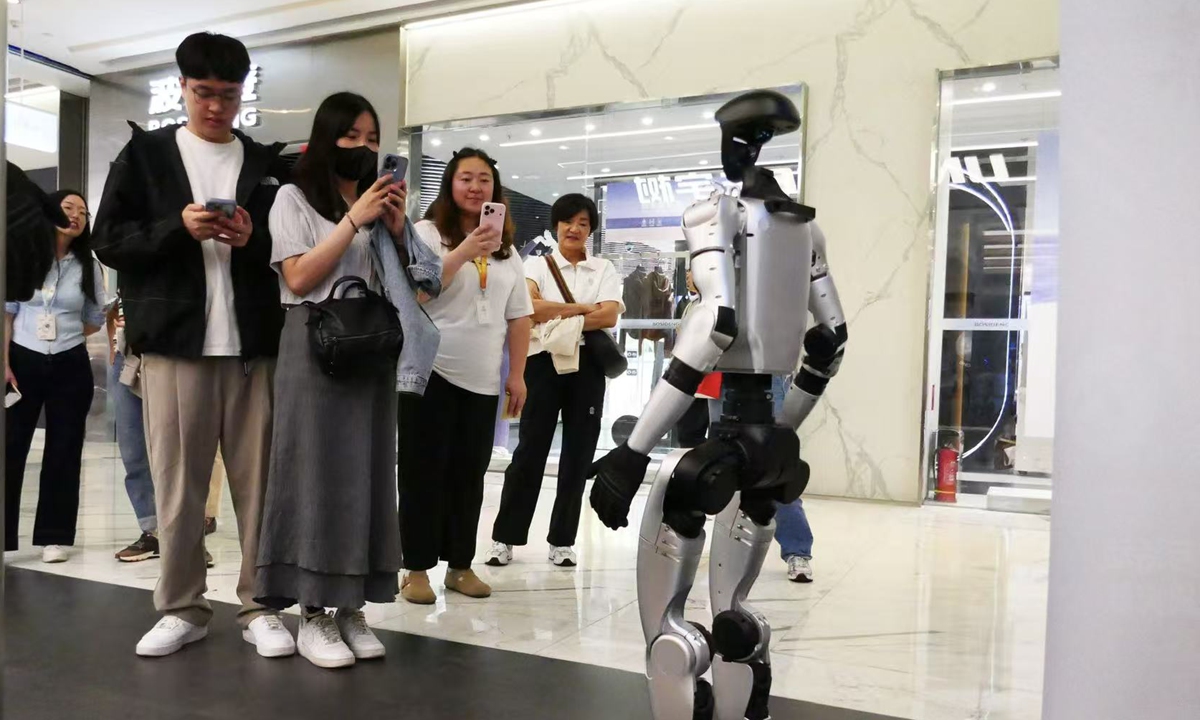
People take photos of the G1 humanoid robot at the Unitree offline store in Beijing on April 30, 2026. (Photo: Tao Mingyang/GT)
Unitree Robotics has partnered with Nvidia and Sharpa to co-develop an advanced humanoid robot system specifically designed for academic research.
A Chinese expert said the partnership marks a significant collaboration that combines Unitree's hardware expertise with Nvidia's AI computing power and Sharpa's specialized robotics solutions to accelerate innovation in humanoid robotics for the global research community.
Chinese humanoid robot company Unitree Robotics said on Monday that it will launch a new humanoid robot reference design, the H2 Plus, built on Nvidia's Isaac GR00T development platform, in a move to accelerate frontier humanoid robotics research.
In a press release it sent to the Global Times, Unitree Robotics said that it has formed a partnership with US chip giant Nvidia and Singapore-based robotic hand producer Sharpa to release the new robotic system.
Wang Xingxing, founder and CEO of Unitree Robotics, said that "H2 Plus combines Unitree's humanoid with Nvidia Jetson Thor and the Nvidia Isaac GR00T development platform, giving teams a validated starting point for creating robot skills and bringing them into real-world applications."
Unitree said that the system is designed to help research teams move more quickly from robot bring-up to skills development and real-world validation. It described the H2 Plus as a way to "democratize frontier humanoid robotics research" by offering advanced hardware and an open software stack without requiring proprietary platforms.
Nvidia said that researchers at Stanford University and the University of California San Diego, among others, plan to use the robotics system, Reuters reported on Monday.
Nvidia founder and CEO Jensen Huang said that humanoid robots will help bring physical AI into major industries and create a multitrillion-dollar economic opportunity. He said that the Nvidia Isaac GR00T Reference Humanoid Robot, built on H2 Plus, offers researchers a single open platform for making breakthroughs in general-purpose physical intelligence, according to the Unitree's press release.
Unitree said that the H2 Plus, an upgraded version of Unitree's H2 humanoid robot, will be available in late 2026.
The company also said that Nvidia's Isaac GR00T platform and reference workflow for Unitree's G1 humanoid robot are expected to be released soon on GitHub and Hugging Face.
The news comes as Unitree Robotics' initial public offering (IPO) met the requirements for issuance, listing, and information disclosure on Monday.
The news comes as Unitree Robotics' initial public offering (IPO) met the requirements for issuance, listing, and information disclosure on Monday.Unitree Robotics seeks to raise 4.2 billion yuan ($620 million) through a listing on Shanghai's STAR board. The exchange was scheduled to review the IPO application on Monday. Unitree disclosed that more than 40 percent of its revenue already comes from markets outside China, according to a CNBC report.
Nvidia's decision to work closely with a leading Chinese humanoid robot company underscores the commercial appeal of the Chinese robotics market supported by business investment and rapid industrial scaling. Chinese hardware is perceived globally not just as a manufacturing advantage, but as a foundational layer for the next generation of robotics research, according to a Chinese expert.
The collaboration also highlights the increasingly modular nature of humanoid robotics, with Unitree supplying the robot body, Sharpa providing the hands, and Nvidia delivering the onboard computing and software stack, Liu Gang, chief economist at the Chinese Institute of New Generation Artificial Intelligence Development Strategies, told the Global Times on Monday.
Liu said that the partnership could help advance global humanoid robotics research by combining Chinese hardware manufacturing strengths with Nvidia's AI and developer ecosystem.
This "US chips + Chinese hardware" model may prove durable and win-win, because it matches the comparative advantages of each side: The US remains strong in frontier AI software, developer ecosystems, and high-end computing, while China has scale, manufacturing depth, and fast-moving robotics hardware companies, Liu noted.
The partnership among the three companies illustrates how humanoid robotics is becoming increasingly modular, with different countries and companies specializing in distinct layers of the stack, such as mechanical systems and software workflows, Wang Peng, an associate research fellow at the Beijing Academy of Social Sciences, told the Global Times on Monday.
In the robotics industry, reference designs are essentially a set of "technical blueprints" that other companies, developers, and research institutions can adopt and customize. Nvidia has continued to roll out such reference designs, aiming to make itself an indispensable software and hardware supplier in the rapidly growing robotics industry, Wang said.
For China's robotics industry, the partnership may help fill several long-standing gaps, particularly in high-end AI computing integration, advanced tactile manipulation, and standardized development workflows, he said.
"By pairing Chinese-made humanoid hardware with Nvidia's software ecosystem, the H2 Plus could help Chinese manufacturers move closer to the center of global robotics research and potentially strengthen their influence in the future technical standards."
China's humanoid robot sales will more than double to 28,000 units in 2026, according to a new report by Morgan Stanley. "Looking ahead, humanoids and robots will be the next key drivers of China's export machinery over the coming five to 10 years," analysts from Morgan Stanley said in a note.