


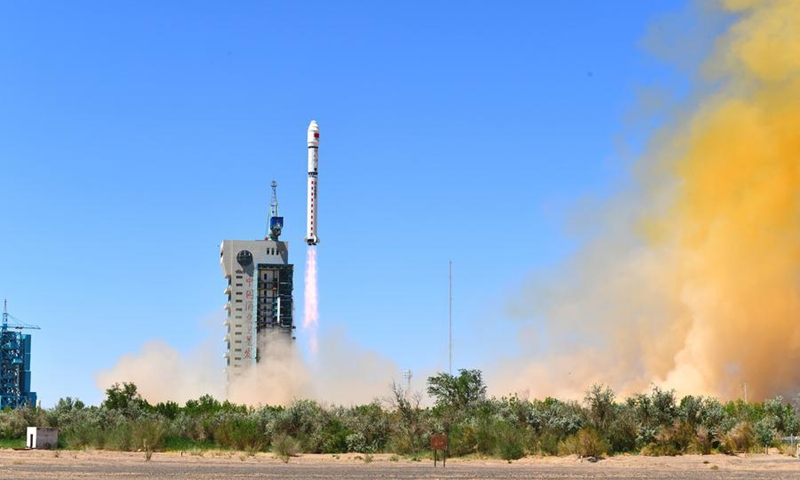
A Long March-2D carrier rocket carrying a space computing satellite constellation blasts off from the Jiuquan Satellite Launch Center in northwest China on May 14, 2025. (Photo by Wang Jiangbo/Xinhua)
Chinese cities are accelerating their push into space computing, with Beijing, Tianjin and Chengdu successively rolling out dedicated research institutes and joint innovation centers in an effort to set up a strategic foothold in the next frontier of artificial intelligence (AI) infrastructure.
Beijing established its first space computing innovation center on Monday, according to a Securities Times report. The center will adopt a company-plus-alliance model and focus on six key areas across the space computing industrial chain, aiming to connect the full stack of chips, hardware, platforms, AI, networks, and applications, thereby creating a coordinated industrial system for space computing, said the newspaper report.
On Sunday, the Global Times learned from GalaxySpace, a privately-owned space company, that a space computing research institute was recently set up in Beijing E-Town aimed at ramping up tech innovation including space-borne computing chips and inter-satellite laser communications, space-based energy and thermal management, integrated space-ground networking, and setting space security standards.
On May 29, at the World Intelligence Expo 2026 in North China's Tianjin Municipality, the National Supercomputing Center in Tianjin joined with relevant companies and institutes to establish a joint consortium for space digital intelligence infrastructure.
The consortium will concentrate on building an integrated space-ground computing infrastructure, targeting breakthroughs across modular and scalable computing payloads, high-performance on-board chips, in-orbit intelligent operation and management, space computing software stacks, integrated energy-thermal control systems, flexible space solar arrays, and satellite-ground mission coordination, financial news site Yicai.com reported.
On March 26, Chengdu-based aerospace company ADAspace, in collaboration with the small and medium-sized enterprises development promotion center of the Ministry of Industry and Information Technology (MIIT), launched the world's first space computing power cloud service platform for enterprises, named Prometheus, the Xinhua News Agency reported.
The plan aims to build a thousand-satellite network and begin commercial operations by 2030, with more than 95 percent of the satellites dedicated to inference computing, and to complete the full 2,800-satellite network by 2035, according to Xinhua.
Space computing, or orbital computing, refers to deploying chips, servers and data-processing hardware aboard satellites, enabling raw data to be processed in orbit rather than transmitted back to Earth. The model is gaining urgency as terrestrial data centers confront mounting bottlenecks in power consumption, heat dissipation and land availability, according to media reports.
According to industry experts, integrating aerospace, energy, computing and AI, space computing has become a new front for technological exploration and a fresh engine for commercial space development, which will underpin the high-quality growth of the digital economy.
"The construction of space computing infrastructure is significant, as it will fundamentally alter the global supply pattern of computing power. Currently, global AI development faces a computing power bottleneck, especially in edge computing and real-time inference scenarios, where ground-based computing power falls short," Xiang Ligang, director-general of the Zhongguancun Modern Information Consumer Application Industry Technology Alliance, told the Global Times on Tuesday.
Xiang noted that AI is driving a surge in demand for computing power. Ground-based computing power faces bottlenecks in energy consumption and heat dissipation, while space computing, with its solar power and wide-area coverage, is gaining pace. Industry analysts predict that, by 2030, the global space market size will exceed $1 trillion.
The coordinated regional moves come as the MIIT pledged support for forward-looking research on space computing, calling for the gradual establishment of a standards system covering hardware, software, networking and security, and promote the research and development of technologies and products like space-borne radiation-resistant chips and inter-satellite laser communications, Xinhua reported.
In addition to China, other countries have been working on the space computing industry.
US' SpaceX is reportedly planning to deploy millions of satellites to build an orbital "cloud." Russia is upgrading its Sfera constellation with enhanced computing capabilities. Japan is focusing on in-orbit processing of Earth observation data, according to Yicai.com.
China is "already at the forefront globally in terms of engineering implementation and commercial space deployment," and ranks among the world's top players in the space computing exploration, said Xie Lina, deputy director of the Cloud Computing and Big Data Research Institute under the China Academy of Information and Communication Technology.