


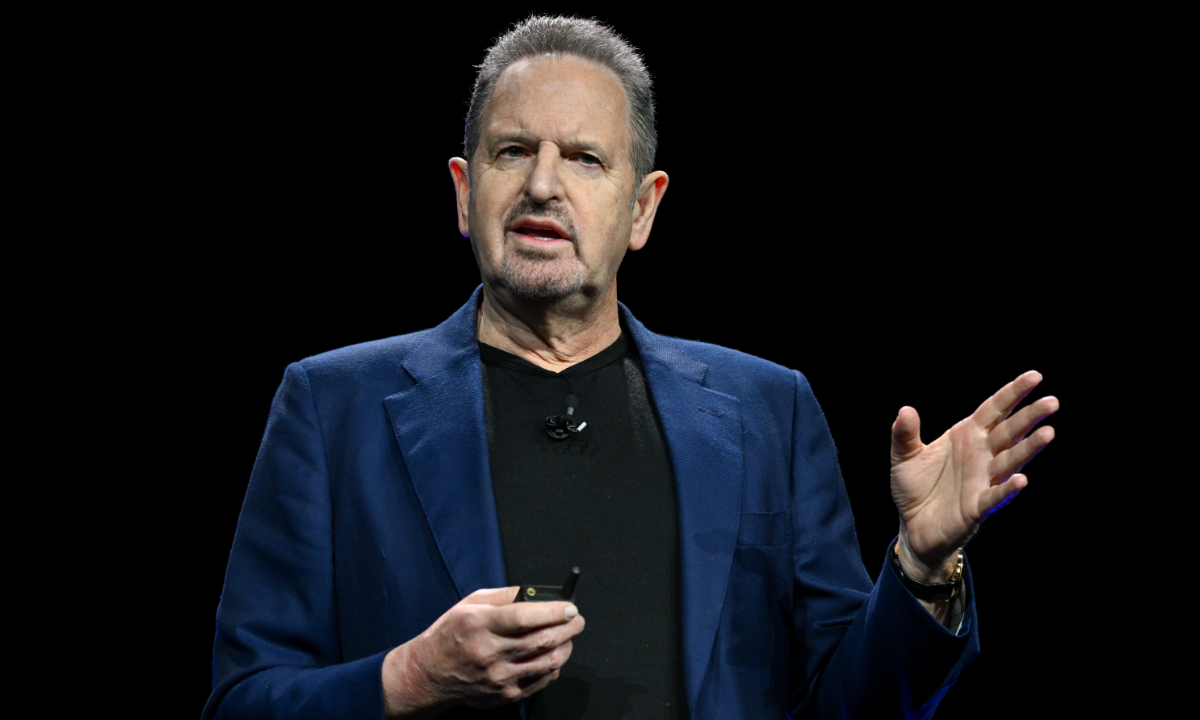
Rene Haas, chief executive officer of Arm Holding, speaks during the Arm Everywhere event in San Francisco, California, US, on March 24, 2026. (Photo: VCG)
Chip architecture firm Arm Holdings CEO Rene Haas said Tuesday that AI-capable CPU exports to China would be difficult to restrict because CPUs are “widespread use” and hard to distinguish by purpose. The executive previously criticized US export controls on China in June last year, warning that they could slow overall technological progress and ultimately hurt consumers and businesses.
Chinese experts said restrictions driven by political considerations create unnecessary burdens and added costs across the industry. Meanwhile, US restrictions are increasingly hurting the semiconductor ecosystem itself, squeezing smaller innovators, slowing capacity expansion and weakening the industry’s long-term innovation cycle, while pushing companies to forgo opportunities tied to the Chinese market, they said.
Haas said on Tuesday that it would be challenging to block the export to China of central processing units (CPUs) that are useful for artificial intelligence because of their widespread use and the difficulty in singling out those intended for the purpose, the Reuters reported on Tuesday.
Banning artificial intelligence CPUs would be nearly impossible, Haas told Reuters in an interview on the sidelines of the annual Computex trade show in Taipei, Taiwan, per Reuters. "They would have to limit everything," he said, adding that the US could attempt to do so but it was a harder area to control than AI chips.
Chen Jing, vice president of the Technology and Strategy Research Institute, said politically driven restrictions by the US would only create unnecessary regulatory burdens for the industry. He warned that vague and difficult-to-enforce curbs could backfire by weakening US firms’ own innovation capacity and raising compliance costs across the sector.
“Smaller companies would be particularly vulnerable, as shrinking cash flow and reduced economies of scale could undermine long-term R&D investment and competitiveness,” Chen said.
Haas’ comments came amid intensifying US efforts to tighten curbs on China’s access to advanced semiconductors and AI computing technologies. This is not the first time Haas has expressed concerns over US export controls targeting China.
In June last year, he noted that US export controls on China threaten to slow overall technological advances and are ultimately bad for consumers and companies, Bloomberg reported on June 12 last year.
Just on May 31 local time, the US Department of Commerce moved again to close what it described as “a potential loophole” that may have allowed companies to export advanced chips to subsidiaries of Chinese firms located outside China, according to another Reuters report.
According to the report, the so-called “loophole” may have been making their way to the subsidiaries of Chinese AI firms based in places such as Malaysia despite broader US efforts to starve Chinese firms of semiconductors needed to develop critical AI capabilities.
Recently, Nvidia CEO Jensen Huang acknowledged in an interview with US media CNBC on May 20 that the company had “evacuated” the Chinese market, adding that “we really largely conceded that market to them [Chinese companies].”
Reuters also reported in May that the US has cleared around 10 Chinese firms to buy Nvidia's second-most powerful AI chip, the H200, but not a single delivery has been made so far.
Due to US export control policies, Nvidia had previously been unable to directly sell its most advanced artificial intelligence chips to Chinese customers.
Notably, the situation also highlighted stronger global demand for semiconductors, driven by evolving industry needs and growing demand for AI-related applications. Against this backdrop, continued US restrictions could further weigh on companies’ customer access and market opportunities, an expert said.
Arm on Tuesday announced two new customers - Chinese tech company ByteDance and US data centre firm Oracle - for its AGI CPU, unveiled in March, with Haas saying demand was stronger than it was eight weeks ago, according to Reuters.
Intel and Advanced Micro Devices have also seen a surge in demand because of AI applications that involve agents, or autonomous pieces of software that can interact with the internet and other software without user input, the Reuters said.
“China remains one of the world’s largest semiconductor markets, from a competitiveness perspective, years of restrictions have instead accelerated the development of China’s domestic CPU and AI chip ecosystem, giving companies such as Huawei’s Ascend, Hygon and Cambricon more room to grow,” according to Chen.
“What US companies risk losing is not only short-term orders, but also influence over technology standards and ecosystem leadership,” he added.
China’s Foreign Ministry has repeatedly stated its position on US chip restrictions targeting China, noting "Small yard and high fence" will not stop China's innovation-driven development, nor will it do any good to US companies or the entire semiconductor industry, open cooperation is the core driving force for the growth of the semiconductor industry and China is one of the major semiconductor markets in the world. Also, to fragment the market, destabilize global industrial and supply chains, and stymie efficiency and innovation serves no one's interests.