


China air cargo network shows strong growth momentum, with North America in focus
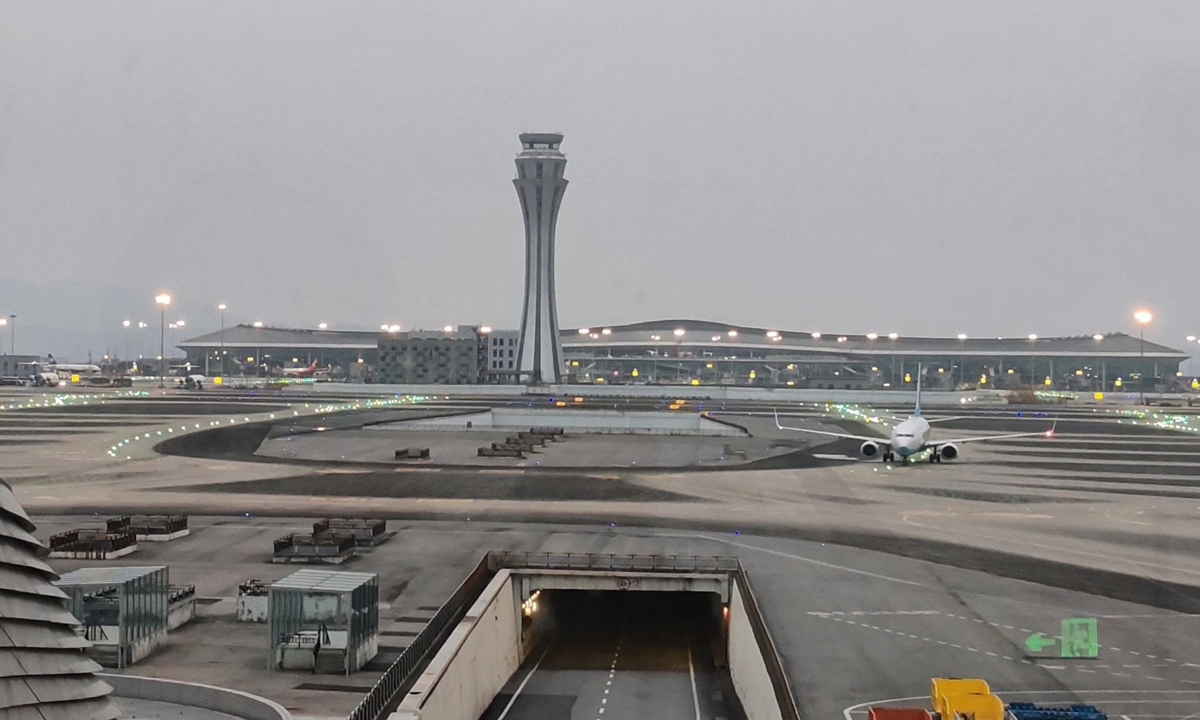
A view of Chongqing Jiangbei International Airport in Southwest China's Chongqing Municipality on March 19, 2026 (Photo: VCG)
China's international air cargo network is accelerating its expansion, with a particular focus on North American routes, recording notable growth momentum.
Federal Express Corporation confirmed with the Global Times on Wednesday that it has signed a Strategic Memorandum of Understanding with China Southern Air Logistics Co to formally establish a strategic relationship.
Both parties will leverage their respective resources and capabilities to deepen strategic collaboration and enhance operational efficiency and global service capabilities, working together to build a more efficient and resilient global air logistics network.
China Southern said in a release that against the backdrop of evolving patterns of globalization and a regional restructuring of manufacturing industries, the two parties will enhance the capacity of Guangzhou as an international air cargo hub and collaborate to accelerate the development of diversified international air cargo routes.
On May 22, China Cargo Airlines, a subsidiary of China Eastern Air Logistics, operated a Boeing 777F freighter from Chongqing Jiangbei International Airport on a direct international cargo route to Toronto, Canada.
The inaugural flight carried 88 tons of cross-border e-commerce merchandise and other cargo from Chongqing, making a technical stop at Anchorage Airport in the US, before continuing onto Toronto.
The substantial expansion of the air cargo network is by no means an isolated phenomenon; rather, it is a direct reflection of the deeply embedded nature of bilateral economic and trade patterns. It is rooted in the solid foundation of long-standing complementarity and mutually beneficial cooperation between the two sides, Guo Jia, a veteran market analyst, told the Global Times on Wednesday.
He added that cargo from China to the US is rapidly recovering and has now exceeded that of the same period last year.
Guo noted that North America is not always the final destination for cargo from China; it also acts as an important transfer hub to Latin America, which also drives cargo demand from China. This, Guo added, also shows that "global demand for Chinese cargo products remains strong."
Data from the aviation logistics branch of the China Federation of Logistics & Purchasing showed that as of March 31, a total of 47 new international cargo routes had been launched, representing over 118 weekly flights.
Among them were eight North American routes, carrying high-value-added goods such as cross-border e-commerce products, high-end manufactured items, electronic goods, auto parts, and biopharmaceuticals.
Air China Cargo Co expanded its A350F freight order on May 26, signing a purchase agreement with Airbus for four additional units. This brings its order for the aircraft to 10, following an initial ordered of six in November 2025.
Air China Cargo began integrating Airbus freighters into its fleet at the end of 2023, and currently operates eight Airbus A330-200P2F aircraft. In the near term, the A350F freighter will join the fleet, complementing the A330-200P2F freighters and maximizing their advantages on long-haul and medium-to-long-haul routes.
The International Air Transport Association (IATA) released its April 2026 global air cargo market data, saying that air cargo demand grew 4 percent year-on-year in April, driven by strong Asian trade.
By trade route, IATA data showed that cargo routes between Asian and North America saw a significant increase of 8.3 percent in April, marking six consecutive months of growth.
Guo also noted that local governments such as in South China's Guangzhou were encouraging the addition of more global cargo service routes.
Baiyun airport in Guangzhou on October 30 of 2025 officially opened a newly constructed Terminal 3 and fifth runway, making it China's first civil airport to operate five commercial runways.
In the near future, the airport will be able to handle 120 million passengers and 3.8 million tons of cargo and mail. With a terminal capacity of 140 million passengers and 6 million tons of cargo, it will be among the world's busiest airports in both categories, according to Xinhua News Agency.
Hong Kong's Cathay Cargo has launched a third multimodal route for importing perishables into the Greater Bay Area (GBA). The new Hong Kong Airport-GBA link complements existing air-to-air direct service to Guangzhou and existing air-to-road express lanes, which use trucks to transport perishables via the city of Zhuhai with a single air waybill and transit permit.
Top-tier perishables arriving by air can now be shipped directly by sea from Hong Kong International Airport to a logistics park in Dongguan, Guangdong Province. Originally designed for exports, the Dongguan Cathay Cargo Terminal has since late 2024 expanded into an import channel. It now supports chilled perishable transshipment across the Greater Bay Area under a single air waybill and single carrier, serving 80 million consumers.